Homework Help Overview
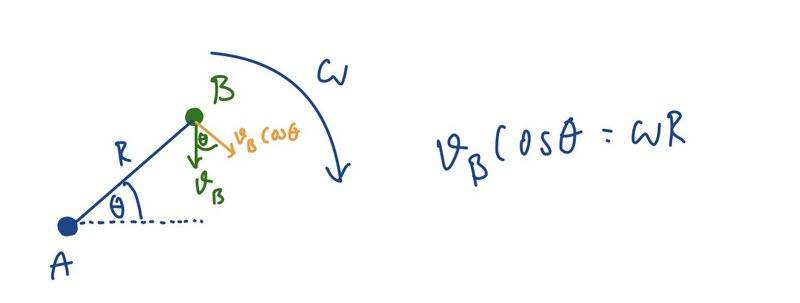
The discussion revolves around the relationship between linear velocity and angular velocity, specifically addressing the equation v = wr and its variations. Participants are examining the conditions under which these equations hold true and the implications of angular displacement on linear velocity.
Discussion Character
- Conceptual clarification, Assumption checking, Mixed
Approaches and Questions Raised
- Participants explore the validity of the equation v = wr versus v = wr*cos(theta), questioning the role of the angle theta in determining the correct relationship. Some participants analyze the components of velocity and their relevance to the angular motion.
Discussion Status
The discussion is active, with participants providing insights and questioning each other's reasoning. There is a focus on clarifying misunderstandings regarding the equations and the conditions under which they apply. Some participants express differing views on the correctness of the provided answers, indicating a lack of consensus.
Contextual Notes
Some participants suggest that the original problem statement may not have been fully conveyed, which could affect the interpretation of the equations discussed. The limits of theta are also being examined to understand the behavior of the equations in specific cases.