How can pie help you remember pi?
- Thread starter gary350
- Start date
-
- Tags
- Pi
Click For Summary
Discussion Overview
The discussion revolves around various methods and techniques for remembering the digits of pi, exploring both mnemonic devices and mathematical approximations. Participants share personal experiences, challenges, and humorous anecdotes related to recalling pi's digits, as well as the relevance of pi in engineering and physics contexts.
Discussion Character
- Exploratory
- Debate/contested
- Conceptual clarification
- Mathematical reasoning
Main Points Raised
- Some participants suggest using visual associations, like pie, to remember the digits of pi.
- Others express difficulty in recalling pi beyond a few digits, sharing their personal bests and methods.
- A few participants propose mathematical approximations, such as 22/7 and 355/113, as useful for practical applications.
- There are discussions about the significance of precision in engineering, with some questioning the necessity of remembering many digits of pi.
- One participant recounts a story about a coding error related to pi's value in a database, highlighting the importance of accuracy.
- Several participants engage in light-hearted banter about the relevance of significant digits and the use of slide rules in historical contexts.
- Some mention the use of formulas, such as those by Ramanujan, to calculate pi, discussing their effectiveness and accuracy.
- There are differing views on the practicality of memorizing many digits of pi, with some advocating for the art of approximation in engineering.
Areas of Agreement / Disagreement
Participants express a range of opinions on the necessity and practicality of memorizing digits of pi, with no clear consensus reached. Some advocate for memorization techniques, while others emphasize the importance of understanding significant figures and approximation in real-world applications.
Contextual Notes
Limitations include varying definitions of what constitutes a "useful" number of digits in engineering and the subjective nature of memory techniques discussed. The conversation also reflects differing levels of comfort with precision in calculations.
Who May Find This Useful
This discussion may be of interest to students, educators, engineers, and anyone curious about memory techniques, mathematical constants, and their applications in STEM fields.

- 16,219
- 4,934
3 1 4 1 5 9 2 6 5
But somehow I also remember the 3 5 9 that follow ( from my first TI-50 )
- 38,105
- 10,660
"Close enough for government work..."etotheipi said:No need! Just remember the fundamental theorem of Physics,$$\pi \approx e \approx \sqrt{g}$$
- 6,960
- 6,038
- 16,219
- 4,934
- 1,084
- 658
The units on this one bother me... And no, before you ask, I never got used to Gaussian units either!etotheipi said:$$\sqrt{g}$$
- 2,074
- 1,015
As a young mind I was able to do around 50 decimals if I trained often enough (that was without any particual memo-technique). Now, all those years later, the first 18 has somehow gotten stuck in memory and since I rarely need more than that as an engineer I'm quite happy I put in the effort back then

- 16,219
- 4,934
Tell us about those rare occasionsFilip Larsen said:rarely need more than that as an engineer
 !
!- 2,074
- 1,015
BvU said:Tell us about those rare occasions
They are pretty rare indeed. So rare, actually, that such occasion is still pending for me personally. But given how computer chips already are produced in nano-scale and humanity any time soon ought to start construction of some kind of Dyson sphere, that is, if we ever want to become a respectable member of the local community of astro-engineering civilizations, I guess is just a matter of time before those last few decimals becomes significant and THEN its going quite handy not having to look them up all the time.
- 451
- 339
It turned the discrepancies were traced to the value of pi being read into the program. The error was traced to the coder who entered the value of pi in the database as 3.14. He was asked where he obtained the value. The coder took out his HP calculator and pressed the pi key. For us old time HP calculator operators, we remember the default display of constants was "fix-2", so that only the first two digits were displayed. Apparently, the coder thought this value was exact, or at least close enough.
- 16,219
- 4,934

Anyway, @Filip Larsen was at 18 digits !
If I ever need 16 digits I use 2*arccos(0) but I do admit that's cheating

- 24,443
- 8,678
(An error of less than 1 millimeter error per kilometer).
And if you need accuracy to more than one part in a million - what the heck are you doing using shortcuts??
- 4,516
- 4,210
Sounds like your like me and you know the button you want is somewhere on the calculator, but you can't find it, so you just use another function. I never, ever, ask for "e", I find "e1" a much easier way to do it.BvU said:I use 2*arccos(0)
- 4,516
- 4,210
I seriously question any circumstance in engineering where you need 18 digits. How accurately do you know the yield strength of the steel your using, the value of the capacitor in your circuit, the fuel flow rate in your engine? Can you really measure your distances in meters to 1/100 the size of a proton?Filip Larsen said:Perhaps https://en.wikipedia.org/wiki/Piphilology has a useful sequence?.
As a young mind I was able to do around 50 decimals if I trained often enough (that was without any particual memo-technique). Now, all those years later, the first 18 has somehow gotten stuck in memory and since I rarely need more than that as an engineer I'm quite happy I put in the effort back then
I'm ok with people that want to play memory games for entertainment, but engineers need to know about significant digits, and the relative magnitude and accuracy of real world stuff. There's often nothing wrong with using 18 digits, but others might think you don't really understand "the art of approximation".
- 16,219
- 4,934

- 4,516
- 4,210
They got Buzz and Neil to the moon and back. Lots of impressive stuff was built with 3 significant digits, back in the day. Granted not as impressive as what consumers can buy today. No LHC or LIGO in 1970.BvU said:Engineers use slide rules
Anyway, for your amusement:
More here: https://www.sliderulemuseum.com/
- 4,516
- 4,210
- 38,105
- 10,660
Just slide on out before you break a rule...DaveE said:Uh oh. I've hijacked anther thread, haven't I? Sorry, I'll shut up now.
- 11,983
- 2,269
- 2,074
- 1,015
DaveE said:I seriously question any circumstance in engineering where you need 18 digits.
As you should. Luckily I never claimed to be using 18 digits for anything in particular, engineering or otherwise, only that those are the number of digits that comes to mind without effort. And I have faith in people, including any budding engineers, who are reading this thread to not come away thinking they now need to include 18 digits in any of their engineering calculations.
However, what I did try to suggest with my with post considering the topic of the thread being how to remember decimals of pi (or any other useful constant for that matter) is that if you train to recite a useful number of them without any special memorization technique when you are young then I would think there is a good chance you can recite them fairly effortless later in life as well.
- 16,219
- 4,934
Ah ! Figure of speech, not to be taken literallyFilip Larsen said:since I rarely need more than that
- 4,973
- 3,226
No they didn't. There is a good account of the pre-flight computations as well as the real time actions and post-flight analysis at https://history.nasa.gov/afj/index.html.DaveE said:[Slide rules] got Buzz and Neil to the moon and back. Lots of impressive stuff was built with 3 significant digits, back in the day.
The Apollo Guidance Computer had 14 hardware data bits, equivalent to 4.2 decimal digits, but I believe calculations were performed in a software VM in 24 bit (7.2 decimal digit) fixed precision.
- 11,983
- 2,269
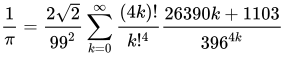
I just checked it for k=0, i.e. only using one term of that series, and I got 6 decimal places of accuracy, roughly 3.14159273, and two more with a second term. (Google says that I should get 8 more places of accuracy with each term, so my calculator is off somewhere.)
To top that with the elegant series pi/4 = 1 -1/3 + 1/5 -1/7 ..., seems naively to take about a million terms!
- 292
- 83
etotheipi said:No need! Just remember the fundamental theorem of Physics,$$\pi = e = \sqrt{g}$$
e = energy?
g = gravity?
I might take this opportunity to mention that, in case anyone didn't notice, the fundamental theorem of Physics isn't particularly fundamental. Or a theorem, for that matter.
- 38,105
- 10,660
e is the Euler number, the base of the natural logarithmgary350 said:e = energy?
g = gravity?
g is the acceleration due to gravity (about ##9.81 \frac{\text m}{\text{sec}^2}## or about ##32.2 \frac{\text {ft}}{\text{sec}^2}##)
- 21
- 9
Sir, I bear a rhyme excelling
In mystic verse and magic spelling
Celestial sprites elucidate
All my own striving can't relate
Just count the letters in each word.
- 2,180
- 10,014
Similar threads
- · Replies 19 ·
- Replies
- 19
- Views
- 1K
- · Replies 10 ·
- Replies
- 10
- Views
- 2K
- · Replies 9 ·
- Replies
- 9
- Views
- 3K
- · Replies 4 ·
- Replies
- 4
- Views
- 3K
- · Replies 2 ·
- Replies
- 2
- Views
- 3K
- · Replies 9 ·
- Replies
- 9
- Views
- 2K
- · Replies 4 ·
- Replies
- 4
- Views
- 2K
- · Replies 2 ·
- Replies
- 2
- Views
- 3K
- · Replies 8 ·
- Replies
- 8
- Views
- 3K
- Replies
- 13
- Views
- 2K