(resolved) Seebeck effect: why can't electron+hole combine at cold end?

  • Thread starter Thread starter jaus tail
  • Start date Start date
  • Tags Tags
    Cold
Click For Summary
SUMMARY

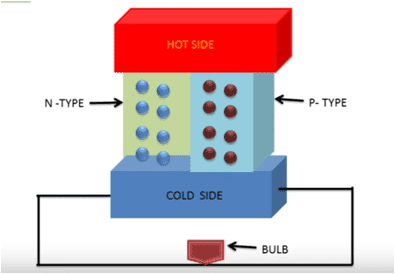
The discussion centers on the Seebeck effect, specifically addressing why electrons and holes do not recombine at the cold end of a thermoelectric material. When the hot region is heated, charge carriers migrate towards the cooler area, creating a potential difference. The inquiry focuses on the recombination of these carriers at the cold end rather than traveling through the entire circuit, which is essential for generating usable electrical power. The explanation emphasizes the role of energy barriers and the necessity of maintaining a potential difference to drive current through a load.

PREREQUISITES
  • Understanding of the Seebeck effect and thermoelectric phenomena
  • Familiarity with charge carriers: electrons and holes
  • Basic knowledge of electrical circuits and potential difference
  • Concept of energy barriers in semiconductor physics
NEXT STEPS
  • Research the principles of thermoelectric materials and their applications
  • Study the role of energy barriers in semiconductor physics
  • Explore the relationship between temperature gradients and electrical potential
  • Learn about practical applications of the Seebeck effect in thermoelectric generators
USEFUL FOR

Physicists, electrical engineers, and students studying thermoelectric materials and their applications in energy conversion technologies.

jaus tail
Messages
613
Reaction score
48
Hi,
In seebeck effect:
Ref:
1572843145788.png

Once the red region is hot, the electrons and holes move toward cooler region i.e. bottom. So there is a positive potential toward right side of cold side and negative region toward left side of cold side. So why can't the electrons and holes combine here only instead of going all the way across the wire and meet with a resistance (load of bulb). Why can't they just recombine in the cold side?
 
Last edited:
Engineering news on Phys.org
Sorry for question. I found a more appropriate diagram:
1572844375255.png

Ref:
 

Attachments

  • 1572844336273.png
    1572844336273.png
    29.4 KB · Views: 228
  • Like
Likes   Reactions: berkeman and Tom.G

Similar threads

  • · Replies 6 ·
Replies
6
Views
2K
  • · Replies 5 ·
Replies
5
Views
2K
  • · Replies 12 ·
Replies
12
Views
3K
  • · Replies 0 ·
Replies
0
Views
3K
  • · Replies 48 ·
2
Replies
48
Views
6K
  • · Replies 20 ·
Replies
20
Views
11K
Replies
35
Views
39K
  • · Replies 6 ·
Replies
6
Views
2K
  • · Replies 14 ·
Replies
14
Views
36K
  • · Replies 3 ·
Replies
3
Views
2K