Revisiting Einstein's Train Experiment: Unraveling the Mysteries of Relativity

Click For Summary
SUMMARY

The forum discussion centers on Einstein's Train Experiment and the implications of special relativity regarding simultaneity and the speed of light. Participants clarify that observers on a moving train perceive lightning strikes at different times due to their relative motion, despite the events being simultaneous in another frame of reference. The conversation emphasizes the importance of understanding Lorentz transformations and the relativity of simultaneity to grasp these concepts fully. A key takeaway is that the perception of time and simultaneity is frame-dependent, challenging the notion of absolute time.

PREREQUISITES
  • Understanding of special relativity principles
  • Familiarity with Lorentz transformations
  • Knowledge of the concept of simultaneity in different reference frames
  • Basic comprehension of light speed as a constant
NEXT STEPS
  • Study Lorentz transformations in detail
  • Explore the concept of simultaneity in various reference frames
  • Read a textbook on special relativity, such as "Spacetime Physics" by Edwin F. Taylor and John Archibald Wheeler
  • Investigate the implications of time dilation and length contraction in moving frames
USEFUL FOR

Students of physics, educators teaching special relativity, and anyone interested in understanding the nuances of time and simultaneity in different frames of reference.

GhostLoveScore
Messages
149
Reaction score
9
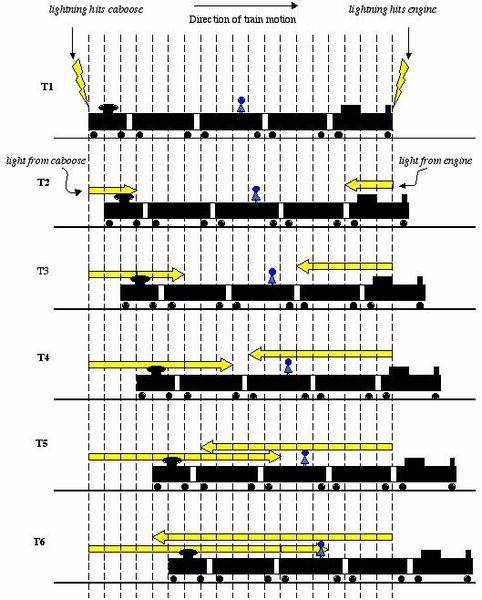
We all know the experiment - here

TrainImage.jpg


It says that for the observer on a train the lightning strike that we are traveling to happened first, but I have some questions.

1) We are moving towards right, so we must see the right lightning first. And we are moving away from left lightning so that light reaches us later than right lightning light. So that means that if the train speed is 0.5c, than we are moving towards right lightning at 1.5c and moving away from left lightning at 0.5c?

2) So for c to remain constant we say that for the reference frame on the moving train, the right lightning happened first?

That leads me to other question

3) If we were moving with 0.99c towards some galaxy. When we would look at it we would see it accelerated because we were moving towards its light and its time would seem to flow faster?
 
Physics news on Phys.org
First, There is nothing accelerated in the train thought experiment.

Second, you have to distinguish seing something at a certain time and the two things happening at the same time. In the train, these are equivalent because the lightnings are equidistant from the observer.
 
That is what I am asking - how do we know that the two lightnings didn't really strike at the same time but we are seeing it in different times because we are at different distances from it? Watching from the moving train reference point.
 
Since you know the speed of light and how far away the lightnings are, you can compute when they struck.
 
But to me the problem is in understanding this - it seems that for the observer on the train, that we are moving towards right lightning with 1.5c and moving away from left lightning with 0.5c.
 
No it does not. You cannot just add velocities in relativity. Light always moves with the speed of light. This is one of the relativity postulates.
 
I know. So than the observer on the train would see both lightning flashes at the same time? But it doesn't see both flashes at the same time. See what confuses me?
 
GhostLoveScore said:
I know. So than the observer on the train would see both lightning flashes at the same time? But it doesn't see both flashes at the same time. See what confuses me?

No, I don't know how you could interpret my responses like that. The observer in the train will observe the flashes at different times because in his frame they occur at different times.
 
They occur at different times because the light needs time to reach the observer? Is that similar to this - the sun explodes and we see it on Earth. It has happened, but on Mars it is not happened yet since the light didn't react Mars yet?
 
  • #10
GhostLoveScore said:
They occur at different times because the light needs time to reach the observer?
No. They occur at different times because they occur at different times. It has nothing to do with the actual observation.
 
  • #11
Can you than explain why they occur at different times? And please don't say "because the train is moving".
 
  • #12
GhostLoveScore said:
Can you than explain why they occur at different times?

Because this follows directly from the postulates of special relativity. In relativity, there is no such thing as an absolute time defining events to be simultaneous, it all depends on the reference frame.
 
  • #13
I think I understand now. An event has happened only when its light reaches us. As I said, any event on the Sun does not happen at the same time for Earth and for Mars, or any other planet?
 
  • #14
GhostLoveScore said:
An event has happened only when its light reaches us.
No, this makes it obvious that you do not understand.

Whether two events are simultaneous or not in a given frame depends only on how the frame is moving, it has nothing to do with when light is observed.
 
  • #15
OK, more general question - why does the right lightning strike happens first?
 
  • #16
GhostLoveScore said:
OK, more general question - why does the right lightning strike happens first?

This might help:

 
  • #17
But that video also shows that from the ground frame of reference, the photons were fired at the same time, the photon on the right took more time to arrive at the detector because it had to travel longer distance. That doesn't mean that the right photon fired first.
 
  • #18
It seems to me that you are trying to understand relativity simply from reading about the effects and not by looking into how the theory actually predicts these effects. In order to really understand relativity, you need to sit down and read the derivations of the Lorentz transformations, understand how the speed of light being the same in all directions in all frames lead to length contraction and time dilation, and to the relativity of simultaneity.
 
  • #19
Do you have any recommendation on what book to read about that?
 
  • #20
Any textbook on basic special relativity should do. Which one really depends on your level.
 
  • #21
GhostLoveScore said:
But that video also shows that from the ground frame of reference, the photons were fired at the same time, the photon on the right took more time to arrive at the detector because it had to travel longer distance. That doesn't mean that the right photon fired first.
In the video the sending events are simultaneous in both frames, because they are co-located. But the receptions are only simultaneous in one frame, because they are spatially separated. At 1:00 the video explains how this follows from the frame invariant light speed.

For the train, this relativity of simultaneity applies to the sending events, because they are spatially separated here.
 
  • #22
I thought of another question. In moving train frame of reference, if we put a camera with a clock on front and back of a train, and watch the camera recordings later - will the lightning still strike right side (front of the train) first?
 
  • #23
GhostLoveScore said:
I thought of another question. In moving train frame of reference, if we put a camera with a clock on front and back of a train, and watch the camera recordings later - will the lightning still strike right side (front of the train) first?
Assuming you have synchronised the time stamps on the tapes, yes.
 
  • #24
GhostLoveScore said:
I thought of another question. In moving train frame of reference, if we put a camera with a clock on front and back of a train, and watch the camera recordings later - will the lightning still strike right side (front of the train) first?
Depends on in which frame you synchronized the camera clocks.
 
  • #25
A.T. said:
Depends on in which frame you synchronized the camera clocks.

In moving train frame of reference.
 
  • #26
GhostLoveScore said:
In moving train frame of reference.
Then yes.
 
  • #27
GhostLoveScore said:
I thought of another question. In moving train frame of reference, if we put a camera with a clock on front and back of a train, and watch the camera recordings later - will the lightning still strike right side (front of the train) first?
The key point as explained by the figure is that the engine and caboose get hit by lightning, on that both the train's and embankment's frames must agree and that there is the same distance to the passenger from the engine and the caboose(in the passenger's frame) . The passenger on the the train observes the light coming from the engine before the light coming from the caboose, while the person at the embankment observes them simultaneously.Thus there is no absolute time. It can be left as an exercise for the reader to determine why an invariant speed c is compatible with traversing equal distances from the train's frame (engine and caboose to passenger) in different times.
 
  • #28
GhostLoveScore said:
I know. So than the observer on the train would see both lightning flashes at the same time? But it doesn't see both flashes at the same time. See what confuses me?

I think the confusion here is because you are imagining absolute space. There is no absolute position in space for the light to go off. For example here on Earth we are moving at 30 km every second in orbit around the sun. Imagine an alien hovering next to you at a fixed point in the solar system. If alien stays still in 1 second it will be 30 km away.

Point at something and count to 1. Now remember that the space you were pointing at is now 30 km away.

So if a light flashed on next to you 1 second ago. where is the centre of the expanding circle of light now? next to you or 30 km away?

Imagine if 1 second ago there was an astronaut hovering in a fixed spot in the solar system. And you did a light explosion as you pass this alien, alien will see the light form a perfect circle around him with you speeding away just inside it the circle. Whereas you will see the perfect sphere of light form around you with the alien inside it. Who is right. Who is in the middle of the circle of light?

There is no such thing as an absolute position. Everything is moving.

The appearance of stability on Earth is an illusion

The Earth feels very stable and solid, but it is really like a huge spaceship moving rapidly and smoothly through the solar system.

What I mean is your current location is fixed in relation to earth. Yet the whole thing is moving. So you are traveling through space with a moving frame of reference. So when say 3m in front of me is a specific position in space that is incorrect - for everyone else in the universe not on Earth that point 3m in front of you now is a rapidly moving target.

There is no such thing as an absolute position

This is what is making the train example confusing for you.

You have to drop the idea of an absolute position and remember that the people on the train consider themselves stationary just as you do.

Now bearing this in mind, for the people on the train, they are NOT moving towards the light from the lightning strike. They are stationary and so there is no reason for light to travel faster from the back than the front or vice versa. If they see the light simultaneously from equally distant events, then the events were simultaneous for them.

More complicated example - 3 events

Imagine if Earth had two moons one either side at equal distance (400,000 km). And both lit up at the same time for a brief nanosecond. In our frame of reference these two events were simultaneous. For other frame of reference these two events were not simultaneous.

The third event is the beams of light from each moon hitting Earth simultaneously as detected by a sensor. All observers will agree on this as it is a single event in a single place and time. No observer will deny the sensor on Earth detected both light beams simultaneously.

Now imagine the viewpoint of an alien who sees our solar system rushing past at 99% of the speed of light. He sees the first moon, the Earth and the third moon all speeding past him at 99% of C.

He sees the event of the light beams meeting on earth. He will not deny this occurred. Yet, in his view the location where each moon emitted its light are fixed positions that do not move. He sees the the Earth and moon are moving relative to these fixed positions. In his view the Earth is moving towards the fixed position from when the front moon emitted light and the Earth is moving away from the position where the rear moon emitted its light.

He sees the Earth hit by light from both moons simultaneously, he will assume that the moon that is chasing the Earth's position lit up first. as the light had to travel a greater distance and he will be correct. So the two events are not simultaneous.

Key point to note is that for the alien, the point where the moon emitted the light is a fixed static point on his own reference frame which the moon is moving away from. If you don't appreciate that point you will get confused.
.
 
Last edited:
  • #29
I see, now it's clearer. So in the same situation, train moving to the right - if we have two light bulbs each on one end of the train and we have a switch in the middle of the train where we are. That switch turns on both lights at the same time. What would we see? What would an observer on train station see as we are moving past him?
The difference here is that the light bulbs are moving with the train. The lightning strike was stationary for external observer.
 
  • #30
GhostLoveScore said:
That switch turns on both lights at the same time.

At the same time in which frame? Just saying "at the same time" does not have any meaning as simultaneity is a relative concept.
 
  • Like
Likes   Reactions: FactChecker

Similar threads

  • · Replies 26 ·
Replies
26
Views
4K
  • · Replies 6 ·
Replies
6
Views
1K
  • · Replies 116 ·
4
Replies
116
Views
9K
  • · Replies 52 ·
2
Replies
52
Views
7K
  • · Replies 58 ·
2
Replies
58
Views
6K
  • · Replies 22 ·
Replies
22
Views
5K
  • · Replies 136 ·
5
Replies
136
Views
15K
  • · Replies 14 ·
Replies
14
Views
3K
  • · Replies 3 ·
Replies
3
Views
2K
  • · Replies 7 ·
Replies
7
Views
2K