Rewriting the Toeplitz Conjecture

  • Context: Undergrad 
  • Thread starter Thread starter MevsEinstein
  • Start date Start date
  • Tags Tags
    Conjecture
Click For Summary

Discussion Overview

The discussion revolves around the Toeplitz Conjecture, also known as the inscribed square problem, which posits that all Jordan curves have an inscribed square. Participants explore various aspects of the conjecture, including definitions, transformations of curves, and related mathematical concepts, without reaching a consensus on the implications or proof strategies.

Discussion Character

  • Exploratory
  • Debate/contested
  • Technical explanation
  • Conceptual clarification

Main Points Raised

  • Some participants propose that transforming curves (through dilation, translation, rotation, or reflection) could lead to insights about the conjecture, suggesting a potential simplification in proving it.
  • Others argue that the conjecture specifically concerns whether every closed Jordan curve contains an inscribed square, emphasizing the distinction between different types of inscribed squares.
  • A participant points out that the drawings presented may represent a more restrictive case of a strongly inscribed square, which differs from the general case considered in the conjecture.
  • Concerns are raised about the applicability of transformations to "nowhere differentiable" curves, such as fractal curves, suggesting limitations in the approach.
  • Definitions of Jordan curves are discussed, with some participants clarifying that a Jordan curve is homeomorphic to the standard unit circle and noting that not all homeomorphisms preserve the property of having inscribed squares.
  • References to proven special cases (convex and piecewise smooth) highlight the complexity of the conjecture and the challenges in finding additional examples.
  • There is a mention of algebraic geometry and genus, with participants questioning the relationship between these concepts and the conjecture, particularly regarding parametrizability.

Areas of Agreement / Disagreement

Participants express differing views on the implications of transformations on Jordan curves and the definitions of Jordan curves themselves. There is no consensus on how these factors influence the Toeplitz Conjecture or its proof.

Contextual Notes

Limitations in definitions and assumptions regarding Jordan curves are noted, particularly concerning the nature of transformations applicable to different types of curves. The discussion also reflects uncertainty about the relationship between genus and the conjecture.

MevsEinstein
Messages
124
Reaction score
36
TL;DR
I was thinking of the Toeplitz conjecture in a backward motion. Maybe it makes proving it easier?
The Toeplitz Conjecture (better known as the inscribed square problem) states that all Jordan curves have an inscribed square. It has been stated in the early 1900's and remains an open problem.

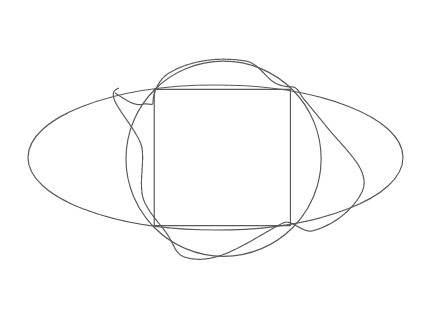
I drew a square and then making a ton of curves that touch its four vertices:
inscribed1.PNG

This shows that the square is inscribed in many curves.

Now what if I transformed (dilate, translate, rotate, or reflect) these curves? Well, those curves will also have inscribed squares. From this diagram, I rephrased the Toeplitz conjecture as such: When we make every possible transform on all the curves that have the square above as an inscribed square, they will map on to every other Jordan curve.

So I was thinking, does this make the Toeplitz conjecture easier to prove? I thought that my definition can help with using set notation.
 
Physics news on Phys.org
It is the other way around: Given any closed Jordan curve, is there always an inscribed square?

330px-Inscribed_square.svg.png


(copyright by Claudio Rocchini, Wikipedia, https://de.wikipedia.org/wiki/Toeplitz-Vermutung)

The black Jordan curve has many inscribed (= contains all 4 vertices) squares.

The already proven special cases (convex, piecewise smooth) make it hard to draw other examples. Plus the fact that it is still open after more than a century.
 
  • Like
Likes   Reactions: dextercioby
mevseinstein, note that your drawings are of the case of a strongly inscribed square, more restrictive than the ones meant in the conjecture, as explained by fresh42.

may i suggest you try warming up by attempting an easier case?, e.g. try to prove that a jordan curve always contains the vertices of some equilateral triangle. your Idea of using dilation and rotation are sufficient in this case, with some continuity arguments. or perhaps you already know how to do this.
 
Last edited:
MevsEinstein said:
Now what if I transformed (dilate, translate, rotate, or reflect) these curves?
I think that is only possible for "smooth" curves, and not for these "nowhere differentiable" curves (like fractal curves)
 
fresh_42 said:
It is the other way around: Given any closed Jordan curve, is there always an inscribed square?

View attachment 304723

(copyright by Claudio Rocchini, Wikipedia, https://de.wikipedia.org/wiki/Toeplitz-Vermutung)

The black Jordan curve has many inscribed (= contains all 4 vertices) squares.

The already proven special cases (convex, piecewise smooth) make it hard to draw other examples. Plus the fact that it is still open after more than a century.
Don't mean to nitpick, just to make sure we're using the same definitions:

A Jordan Curve is , in my understanding, close by definition; homeomorphic to the standard unit circle ( ## x \in \mathbb R^2 : || x||=1 ##)

I guess not every choice of homeomorphism will take inscribed squares to inscribed squares.
 
WWGD said:
Don't mean to nitpick, just to make sure we're using the same definitions:

A Jordan Curve is , in my understanding, close by definition; homeomorphic to the standard unit circle ( ## x \in \mathbb R^2 : || x||=1 ##)

I guess not every choice of homeomorphism will take inscribed squares to inscribed squares.
I didn't look it up (and of course don't remember the correct definition anymore). I just read the Wikipedia article on Toeplitz and it said that the cases "piecewise smooth" and "convex" are proven. That led me to the assumption that Jordan is closed and possibly of genus 1.
 
fresh_42 said:
I didn't look it up (and of course don't remember the correct definition anymore). I just read the Wikipedia article on Toeplitz and it said that the cases "piecewise smooth" and "convex" are proven. That led me to the assumption that Jordan is closed and possibly of genus 1.
This seems to be leading to Algebraic Geometry. Maybe @mathwonk can clarify here? IIRC, genus 0 curves are those that are parametrizable? Or am I way off? Edit: I thought genus applies to higher dimensional objects, not to curves.
 
WWGD said:
This seems to be leading to Algebraic Geometry. Maybe @mathwonk can clarify here? IIRC, genus 0 curves are those that are parametrizable? Or am I way off? Edit: I thought genus applies to higher dimensional objects, not to curves.
I don't care. I just wanted to say "without crossings" a bit more sophisticated. Now I look it up.

Jordan curve = continuous, injective image of [0,1].

This excludes crossings, but requires everything else to be mentioned: closed, rectifiable, 0-homotope, smooth, convex or whatever.
 

Similar threads

  • · Replies 1 ·
Replies
1
Views
2K
  • · Replies 33 ·
2
Replies
33
Views
3K
  • · Replies 26 ·
Replies
26
Views
5K
  • · Replies 3 ·
Replies
3
Views
2K
  • · Replies 2 ·
Replies
2
Views
4K
Replies
1
Views
2K
  • · Replies 33 ·
2
Replies
33
Views
8K
  • · Replies 12 ·
Replies
12
Views
2K
  • · Replies 5 ·
Replies
5
Views
2K
  • · Replies 2 ·
Replies
2
Views
2K