Rigid body orientation using Euler angles confusion

Click For Summary
The discussion revolves around confusion regarding the relationship between angles α and β and the Euler angles in a rigid body orientation problem. The provided solution states that α=θ+0.5π and β=ϕ, but the original poster struggles to understand this due to discrepancies in the expected orientation of the rod after rotations. It is clarified that a rotation about the Z-axis does not alter the rod's orientation but affects the X and Y axes. Ultimately, the lecturer acknowledged a mistake in the solution, leading to the conclusion that the thread may not be beneficial for others. The confusion highlights the complexities of understanding Euler angles in rigid body dynamics.
Tar
Messages
2
Reaction score
0
Hello,

Homework Statement


I'm given the following exercise:

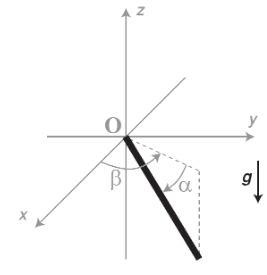
"A rod with neglected thickness exists. What is the relation between the α,β angles to Euler angles of orientation?
α is defined as the angle between the rod and its projection on the XY plane.
β is defined as the angle between the X-axis and the rod's projection on the XY plane.
(Note: We are using ZXZ Euler angles convention, having the following order of angles: ϕ,θ,ψ.)"
1iPlX.png


The answer is: α=θ+0.5π, β=ϕ
I don't understand why.

The Attempt at a Solution


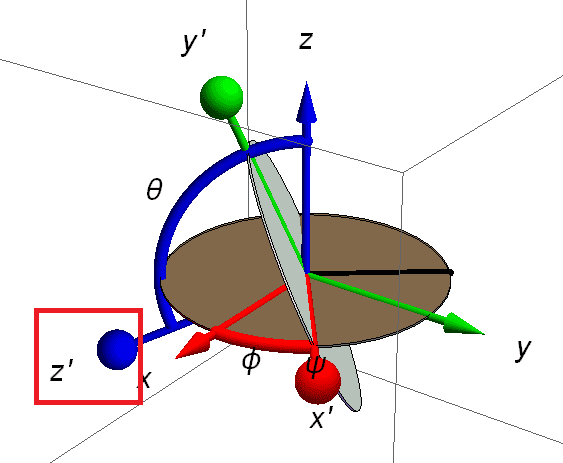
As far as I know, usually the body points in the e3 direction in the body frame. Initially the body frame points towards the original Z direction, after rotation of ϕ around the Z axis, and then rotation of θ around the x′ axis, we will receive the following:
0yPi6.png

Note that the new z′ axis doesn't point to where it should be (according to the answer) and ϕ doesn't represent the angle between z' axis' projection on the XY plane and X-axis.

What am I missing?

Thank you.

 
Physics news on Phys.org
Tar said:
As far as I know, usually the body points in the e3 direction in the body frame.
This is not clear from the statement of the problem, but let's assume that it is true. If e3 is the Z direction, a rotation about that axis by any angle will not change the orientation of the rod, but will change the orientation of the x and y axes to x' and y'. Now to get the rod below the x'y' plane, you will need angle θ greater than π/2. The solution says that's not the case. So either your assumption about the original orientation of the rod is incorrect or the solution is incorrect.

On edit: Welcome to PF.
:welcome:
 
kuruman said:
This is not clear from the statement of the problem, but let's assume that it is true. If e3 is the Z direction, a rotation about that axis by any angle will not change the orientation of the rod, but will change the orientation of the x and y axes to x' and y'. Now to get the rod below the x'y' plane, you will need angle θ greater than π/2. The solution says that's not the case. So either your assumption about the original orientation of the rod is incorrect or the solution is incorrect.

On edit: Welcome to PF.
:welcome:

You're right. the lecturer have verified again (for the 3rd time) and there's a mistake that he hadn't noticed on his first verification.

I think this thread should be deleted as it doesn't help anyone,

Thanks for your help.
 
Last edited:
The book claims the answer is that all the magnitudes are the same because "the gravitational force on the penguin is the same". I'm having trouble understanding this. I thought the buoyant force was equal to the weight of the fluid displaced. Weight depends on mass which depends on density. Therefore, due to the differing densities the buoyant force will be different in each case? Is this incorrect?

Similar threads

  • · Replies 18 ·
Replies
18
Views
2K
Replies
25
Views
2K
  • · Replies 1 ·
Replies
1
Views
2K
  • · Replies 12 ·
Replies
12
Views
3K
Replies
7
Views
3K
  • · Replies 1 ·
Replies
1
Views
1K
Replies
8
Views
5K
  • · Replies 7 ·
Replies
7
Views
2K
  • · Replies 4 ·
Replies
4
Views
2K