Math Amateur
Gold Member
MHB
- 3,920
- 48
I am reading Stephen Lovett's book, "Abstract Algebra: Structures and Applications" and am currently focused on Section 6.2: Rings of Fractions ...
I need some help with some remarks following Definition 6.2.4 ... ... ...
The remarks following Definition 6.2.4 reads as follows:
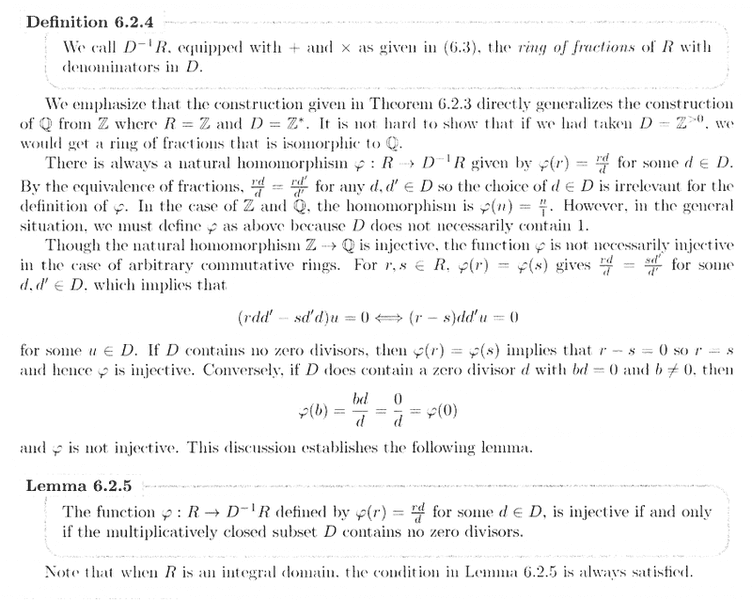
In the above text from Lovett we read the following:
" ... ... it is not hard to show that if we had taken ##D = { \mathbb{Z} }^{ \gt 0 }## we would get a ring of fractions that is that is isomorphic to ## \mathbb{Q}##. ... ... "Can someone please help me to understand this statement ... how is such an isomorphism possible ... in particular, how does one achieve a one-to-one and onto homomorphism from the positive integers to the negative elements of ##\mathbb{Q}## as well as the positive elements ...
Hope someone can help ... ...
Peter==============================================================================
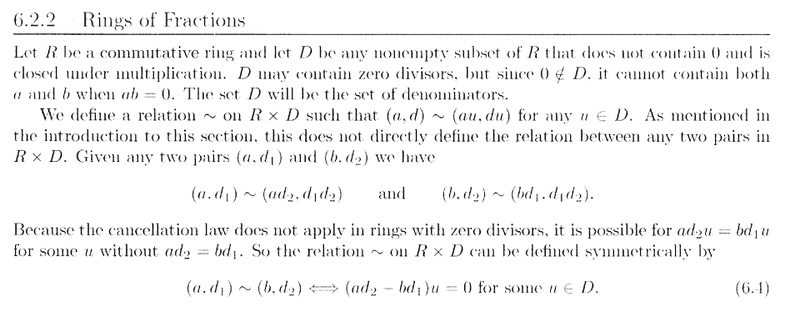
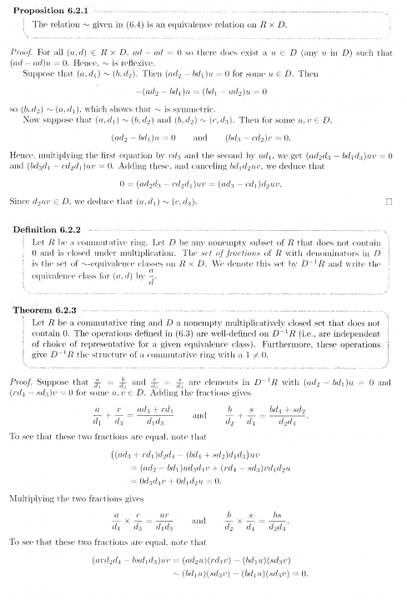
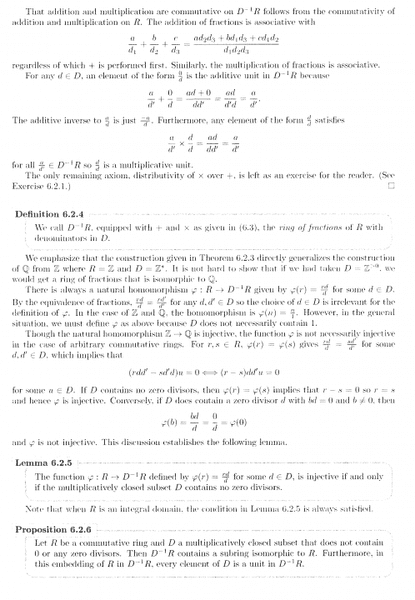
To enable readers to understand Lovett's approach to the rings of fraction construction, I am providing Lovett Section 6.2 up to an including the remarks following Definition 6.2.4 ... as follows:
I need some help with some remarks following Definition 6.2.4 ... ... ...
The remarks following Definition 6.2.4 reads as follows:
In the above text from Lovett we read the following:
" ... ... it is not hard to show that if we had taken ##D = { \mathbb{Z} }^{ \gt 0 }## we would get a ring of fractions that is that is isomorphic to ## \mathbb{Q}##. ... ... "Can someone please help me to understand this statement ... how is such an isomorphism possible ... in particular, how does one achieve a one-to-one and onto homomorphism from the positive integers to the negative elements of ##\mathbb{Q}## as well as the positive elements ...
Hope someone can help ... ...
Peter==============================================================================
To enable readers to understand Lovett's approach to the rings of fraction construction, I am providing Lovett Section 6.2 up to an including the remarks following Definition 6.2.4 ... as follows:
Attachments
-
 Lovett - Remarks on Rings of Fractions ... ....png56.3 KB · Views: 784
 -
 Lovett - 1 - Rings of Fractions - Section 6.2.2 - Part 1.png28.9 KB · Views: 750
 -
 Lovett - 2 - Rings of Fractions - Section 6.2.2 - Part 2 ... ... .png33 KB · Views: 685
 -
 Lovett - 3 - Rings of Fractions - Section 6.2.2 - Part 3 ... ... .png45.2 KB · Views: 692