Sekonda
- 201
- 0
Hey,
I have a question on a rocket in deep space (all external forces negligible), basically I'm doing something wrong the latter part of the question - maximizing the momentum via differentiation, here's the question:
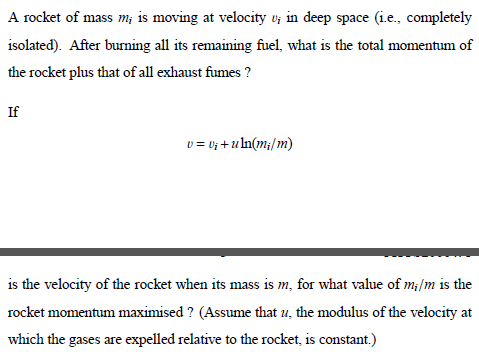
So the momentum at a given mass 'm' is :
[tex]p=mv_{i}+muln(\frac{m_{i}}{m})[/tex]
I attained a derivative of respects to 'm' as:
[tex]\frac{\partial p}{\partial m}=v_{i}+u(ln\frac{m_{i}}{m}-1)=0[/tex]
Giving 'm' as :
[tex]\LARGE m=m_{i}e^{\frac{v_{i}}{u}-1}[/tex]
Which is wrong according to the solutions unless I assume v(i)=0 which I don't think I should.
Where am I going wrong?
Thanks guys,
SK
I have a question on a rocket in deep space (all external forces negligible), basically I'm doing something wrong the latter part of the question - maximizing the momentum via differentiation, here's the question:
So the momentum at a given mass 'm' is :
[tex]p=mv_{i}+muln(\frac{m_{i}}{m})[/tex]
I attained a derivative of respects to 'm' as:
[tex]\frac{\partial p}{\partial m}=v_{i}+u(ln\frac{m_{i}}{m}-1)=0[/tex]
Giving 'm' as :
[tex]\LARGE m=m_{i}e^{\frac{v_{i}}{u}-1}[/tex]
Which is wrong according to the solutions unless I assume v(i)=0 which I don't think I should.
Where am I going wrong?
Thanks guys,
SK