Saturn V specific impulse issue in velocity modelling with Tsiolkovsky

Click For Summary

Discussion Overview

The discussion revolves around modeling the velocity of the Saturn V rocket using Tsiolkovsky's ideal rocket equation, with a focus on the implications of specific impulse and various factors affecting the model's accuracy. Participants explore theoretical aspects, potential errors in the modeling process, and the influence of external conditions such as gravity, air resistance, and launch trajectory.

Discussion Character

  • Exploratory
  • Technical explanation
  • Debate/contested
  • Mathematical reasoning

Main Points Raised

  • One participant questions the treatment of specific impulse in their model, suggesting it may vary with altitude and needs to be accounted for mathematically.
  • Another participant points out that the exhaust velocity should be calculated using the specific impulse at the surface, not at the rocket's current altitude, although they note this is a minor effect.
  • Several participants highlight the importance of considering gravitational pull, which acts downwards, and the non-vertical nature of the rocket's launch, complicating the interaction between acceleration and gravity.
  • Air resistance is mentioned as a significant factor that should not be neglected in the model, as it is proportional to atmospheric density and the square of the rocket's velocity.
  • One participant expresses uncertainty about how to incorporate the relationships between various factors and time into their equation.
  • Another participant confirms that the calculation discussed pertains to the first stage of the Saturn V rocket.
  • There is a discussion about the need for more data regarding the rocket's specific impulse, particularly in relation to air pressure changes during ascent.

Areas of Agreement / Disagreement

Participants express multiple competing views regarding the treatment of specific impulse and the factors influencing the rocket's velocity model. There is no consensus on the best approach to incorporate these factors into the equation.

Contextual Notes

Participants note limitations in the original model, including the dependence on altitude for gravitational effects, the need for accurate data on launch angle, and the complexities introduced by aerodynamic drag. These factors remain unresolved within the discussion.

unicornication
Messages
2
Reaction score
0
Hi!

I've been trying to model the Saturn V's velocity using Tsiolkovsky's ideal rocket equation, and in the process, I think I may have made a mistake with regards to the specific impulse?

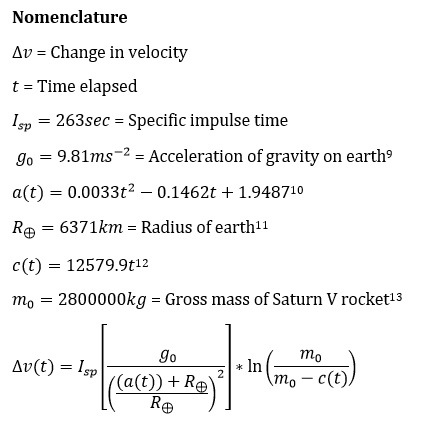
I've come up with the following equation, taking the change in gravity into account. (a(t) is the altitude function derived from actual values, with a very small error range, c(t) is the fuel consumption of the rocket per second)
bAsTv01.png

(note: what appear to be powers after the end of most lines are footnote references, apologies for the confusion!)

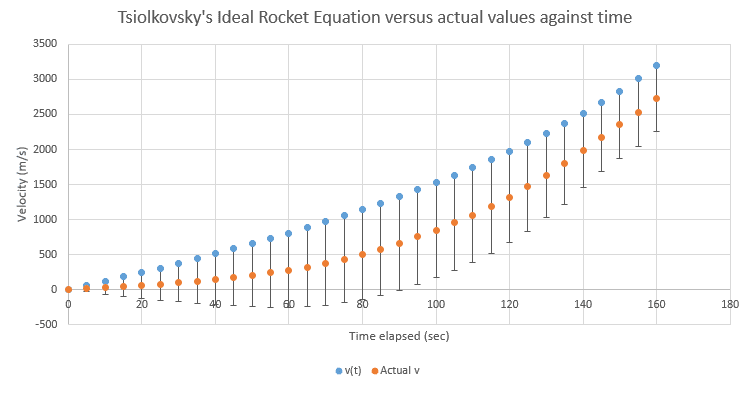
And this a plot of the model I created versus the actual values plotted against time-
Qn5lpxe.png


The percentage error here between the two sets of values vary from ~80% to ~14%, and the graph shape is vastly different.

I'd like to ask if there is a change in specific impulse? Or have I done anything else wrong in modelling the equation above?

I think specific impulse does change, but is there a mathematical equation by which I can rewrite this equation to take that into account?

Also, I apologize if I've made a stupid mistake, I'm a HS student doing some fun research, quite new to this!

Thank you very much!

edit: title was shortened, "Saturn V specific impulse issue in velocity modelling with Tsiolkovsky's equation against actual values?" was the original title
 
Last edited:
Engineering news on Phys.org
Some effects I don't see in your formula:
- the exhaust velocity is the specific impulse multiplied with g at the surface, not at the current position of the rocket. Anyway, that is a small effect
- gravity is pulling the rocket down, this gives -g acceleration in the vertical direction
- the rocket launch is not purely vertical, so the interaction between acceleration and gravity is not trivial
- air resistance is not negligible
- the specific impulse depends a bit on the air pressure

I assume your calculation is for the first stage only.
 
mfb said:
Some effects I don't see in your formula:
- the exhaust velocity is the specific impulse multiplied with g at the surface, not at the current position of the rocket. Anyway, that is a small effect
Of the effects you listed, this is the only one included in the original post. As you mentioned, this is a small effect compared to the others that you listed.unicornication, gravitation, a non-vertical launch, air resistance, and altitude-dependent specific impulse are much bigger effects than the one effect that listed by mfb that you did incorporate in your model.
 
D H said:
Of the effects you listed, this is the only one included in the original post.
What does the denominator do then? It looks like a modification of g to the gravitational acceleration at the current height.
 
I read your response incorrectly, and also the original post. You are correct, mfb. The relation between specific impulse in seconds and exhaust velocity is g0, not the value of g at altitude. That factor shouldn't be there.unicornication, where did you get that equation?
 
mfb said:
Some effects I don't see in your formula:
- gravity is pulling the rocket down, this gives -g acceleration in the vertical direction
- the rocket launch is not purely vertical, so the interaction between acceleration and gravity is not trivial
- air resistance is not negligible
- the specific impulse depends a bit on the air pressure

Hi mfb,
Thank you for your feedback, greatly appreciated!

Though, I'm kind of stuck as to what the relationships are between the variables you stated and, say, time- in other words, I'm not exactly sure how to factor these changes into the equation.

mfb said:
I assume your calculation is for the first stage only.

That is correct!

D H said:
unicornication, where did you get that equation?

Hi D H,
Thank you for your response, again, greatly appreciated! I thought about why the numbers are as large as they are and thought that the constant 9.81m/s gravity could be what's making the numbers as large as they are, and I knew that gravity changes with altitude, and so I thought that was a factor, apparently not! I got the equation http://www.mansfieldct.org/Schools/MMS/staff/hand/lawsgravaltitude.htm.
 
When a rocket lifts off, the direction of the initial trajectory is vertical, but as the rocket climbs, its trajectory assumes a shallower angle with respect to the horizontal so that the velocity of the rocket will send it into orbit.

The aerodynamic drag force on a rocket will be proportional to the density of the atmosphere (which also changes with altitude) and the square of the velocity of the rocket, among other factors.
 
unicornication said:
Though, I'm kind of stuck as to what the relationships are between the variables you stated and, say, time- in other words, I'm not exactly sure how to factor these changes into the equation.
For a purely vertical launch, gravity would just give another summand in the formula (downwards, of course). For a real launch, you need data about the angle between the rocket and gravity, and you have to keep track of horizontal and vertical velocity at the same time.

For aerodynamic drag, see SteamKing.

- the specific impulse depends a bit on the air pressure
I guess if you don't want to neglect this, you need more data about the rocket.
 

Similar threads

  • · Replies 21 ·
Replies
21
Views
1K
  • · Replies 2 ·
Replies
2
Views
3K
  • · Replies 5 ·
Replies
5
Views
2K
  • · Replies 2 ·
Replies
2
Views
1K
  • · Replies 7 ·
Replies
7
Views
8K
  • · Replies 8 ·
Replies
8
Views
5K
Replies
7
Views
2K
Replies
1
Views
3K
Replies
3
Views
2K
  • · Replies 2 ·
Replies
2
Views
3K