Schrodinger equation and Heisenberg equation of motion

Click For Summary

Discussion Overview

The discussion centers around the relationship between the Schrödinger equation and the Heisenberg equation of motion within the context of quantum field theory. Participants are exploring the mathematical derivation and implications of these equations, particularly in relation to specific equations and notation from Hatfield's book.

Discussion Character

  • Technical explanation
  • Mathematical reasoning
  • Debate/contested

Main Points Raised

  • One participant questions how to derive the Schrödinger equation from the Heisenberg equation of motion, expressing difficulty with an integral form of the Hamiltonian.
  • Another participant suggests using a specific equation (2.54) and notes that the Hamiltonian is conserved in the Heisenberg picture, implying that the integral can be evaluated at any time.
  • A different participant expresses confusion regarding the notation and the treatment of operators that are integrals, particularly in the context of commutation relations.
  • One participant attempts to clarify their understanding by rewriting the commutation relation and manipulating the integrals, seeking confirmation on the correctness of their mathematical steps.
  • Another participant provides a detailed explanation of the Hamiltonian's time independence and its implications for evaluating commutators, while also introducing a general formula for commutation relations involving multiple operators.

Areas of Agreement / Disagreement

Participants express varying levels of understanding and familiarity with the notation and mathematical treatment involved. There is no clear consensus on the derivation process or the handling of specific integrals and operators, indicating ongoing debate and exploration of the topic.

Contextual Notes

Participants highlight potential confusion regarding the notation and the treatment of integrals in the context of quantum field theory. There are unresolved questions about the correct application of commutation relations and the implications of the Hamiltonian's time independence.
Josh1079
Messages
45
Reaction score
0
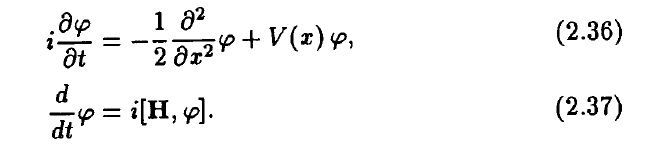
My question is that how does the Schrödinger equation arise from the Heisenberg equation of motion in the quantum field formalism.

blank.png

blank.png


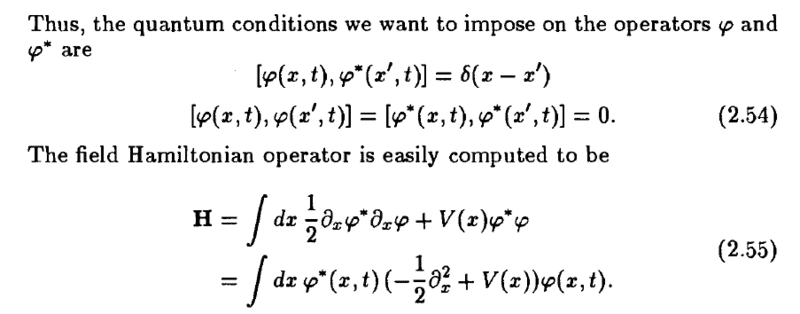
These are from Hatfield's book. So I'm having some difficulties to reproduce (2.36) by plugging (2.55) into (2.37) primarily because H is an integral.

Thanks!
 
Physics news on Phys.org
Just use (2.54). Note that ##\hat{H}## is conserved in the Heisenberg picture, i.e., you can evaluate the integral at time ##t## (it doesn't depend on ##t## after all anyway). That's why you only need the canonical equal-time commutation relations (2.54).
 
Hi vanhees, great to see you again! Sorry I don't really follow you this time. I was also trying to use (2.54) and I guess I was stuck because I'm not familiar with an operator that is an integral.

So first of all, for the right side of (2.37) I'm not sure whether [H, \phi] = (\int dx \phi^* h \phi) \phi - \phi (\int dx \phi^* h \phi) or \int dx \phi^* h \phi \phi - \int \phi dx \phi^* h \phi, where h = -\frac{1}{2} \partial^2_x + V(x). Furthermore, when the operators are in the form h \phi \phi, is it equal to simply (h\phi) \phi or is it (h\phi)\phi + \phi (h\phi)?
 
Wait, I think I get something now.

Is it like this?

[H, \phi] = H\phi - \phi H = \int dx' \phi^*(x') h \phi(x') \phi(x) - \phi(x) \int dx' \phi^*(x') h \phi(x')
= \int dx' \phi^*(x') h \phi(x') \phi(x) - \int dx' \phi(x) \phi^*(x') h \phi(x')
the phi(x) can be taken inside the integral since it's independent of x', then by (2.54),
= \int dx' \phi^*(x') \phi(x) h \phi(x') - \int dx' \phi(x) \phi^*(x') h \phi(x') = \int \delta (x' - x) h \phi(x') dx' = h \phi(x)

Did I make any mistakes in the math?
 
Last edited:
I'm not familiar with your notation, and it's also good to write out the arguments. First of all you have
$$\hat{H}=\int_{\mathbb{R}} \mathrm{d} x \hat{\varphi}^*(t,x) \left (-\frac{1}{2} \Delta +V(x) \right) \hat{\varphi}(t,x).$$
Now ##\hat{H}## is not explicitly time dependent and that implies that it is conserved:
$$\frac{\mathrm{d}}{\mathrm{d} t} \hat{H}=[\hat{H},\hat{H}]+\partial_t \hat{H}=0.$$
That implies that you can use any ##t## in evaluating ##\hat{H}## since ##\hat{H}## doesn't depend on it. Now you have
$$[\hat{H},\hat{\varphi}(t,x)]=\int_{\mathbb{R}} \mathrm{d} x' \left [\hat{\varphi}^*(t,x') \left (-\frac{1}{2} \Delta' +V(x') \right) \hat{\varphi}(t,x'),\hat {\varphi}(t,x) \right ].$$
Now you can just use the equal-time commutator relations given in #1 to show (2.37). You also need the general formula
$$[\hat{A},\hat{B} \hat{C}]=[\hat{A},\hat{C}] \hat{B}+\hat{C} [\hat{A},\hat{B}],$$
valid for any three operators ##\hat{A}##, ##\hat{B}##, and ##\hat{C}##.

It is allowed to use ##t## in the integral for ##\hat{H}## as the time argument of the fields since ##\hat{H}## doesn't depend on time as argued above, and that's why you can use the equal-time commutation relations to evaluate this commutator.
 
  • Like
Likes   Reactions: bhobba

Similar threads

  • · Replies 39 ·
2
Replies
39
Views
3K
  • · Replies 9 ·
Replies
9
Views
2K
  • · Replies 11 ·
Replies
11
Views
2K
  • · Replies 9 ·
Replies
9
Views
4K
  • · Replies 3 ·
Replies
3
Views
2K
  • · Replies 11 ·
Replies
11
Views
2K
  • · Replies 32 ·
2
Replies
32
Views
2K
  • · Replies 18 ·
Replies
18
Views
3K
  • · Replies 15 ·
Replies
15
Views
3K
  • · Replies 19 ·
Replies
19
Views
2K