SUMMARY
The discussion focuses on the derivation of the Schrödinger equation for a free particle in 3D space, specifically addressing the confusion surrounding the appearance of the term (i/ħ)². Participants clarify that this term arises from taking the second derivative of the exponential function e^(ax), where 'a' is a complex constant and 'x' is the independent variable. The conversation emphasizes the necessity of understanding first-year differential and integral calculus to grasp the underlying principles of the equation.
PREREQUISITES
- Understanding of first-year differential calculus
- Familiarity with integral calculus concepts
- Knowledge of complex numbers and their properties
- Basic understanding of the Schrödinger equation and quantum mechanics
NEXT STEPS
- Study the properties of Euler's number (e) and its applications in calculus
- Learn how to differentiate exponential functions, particularly e^(ax)
- Explore the derivation of the Schrödinger equation in quantum mechanics
- Investigate the role of complex constants in differential equations
USEFUL FOR
Students of quantum mechanics, physicists, and anyone looking to deepen their understanding of the mathematical foundations of the Schrödinger equation.
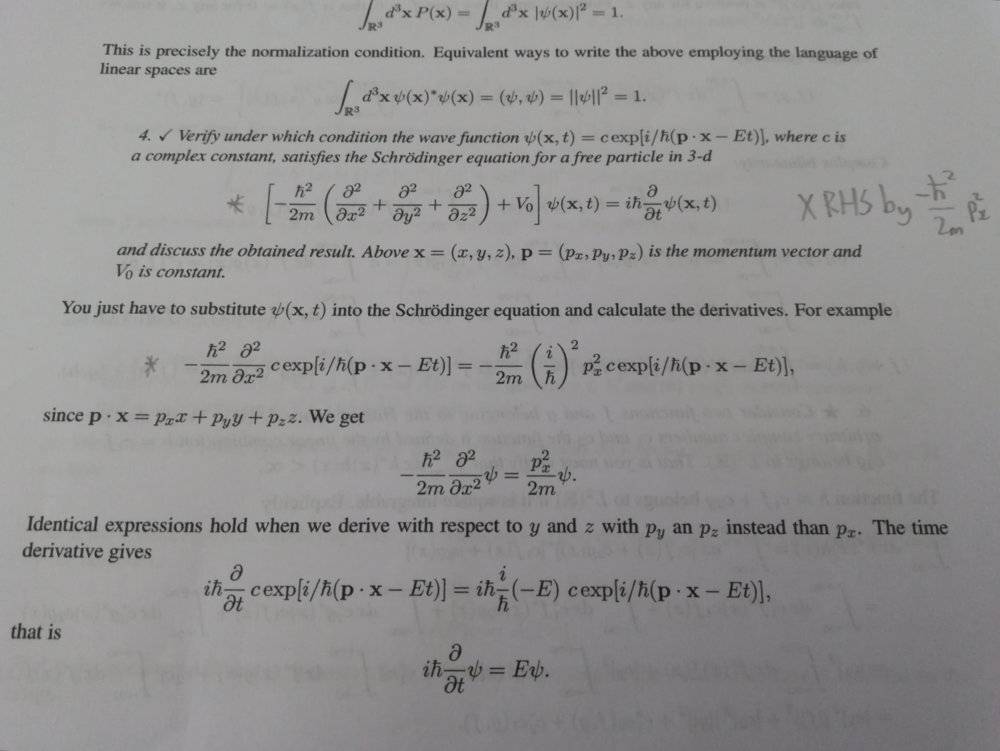
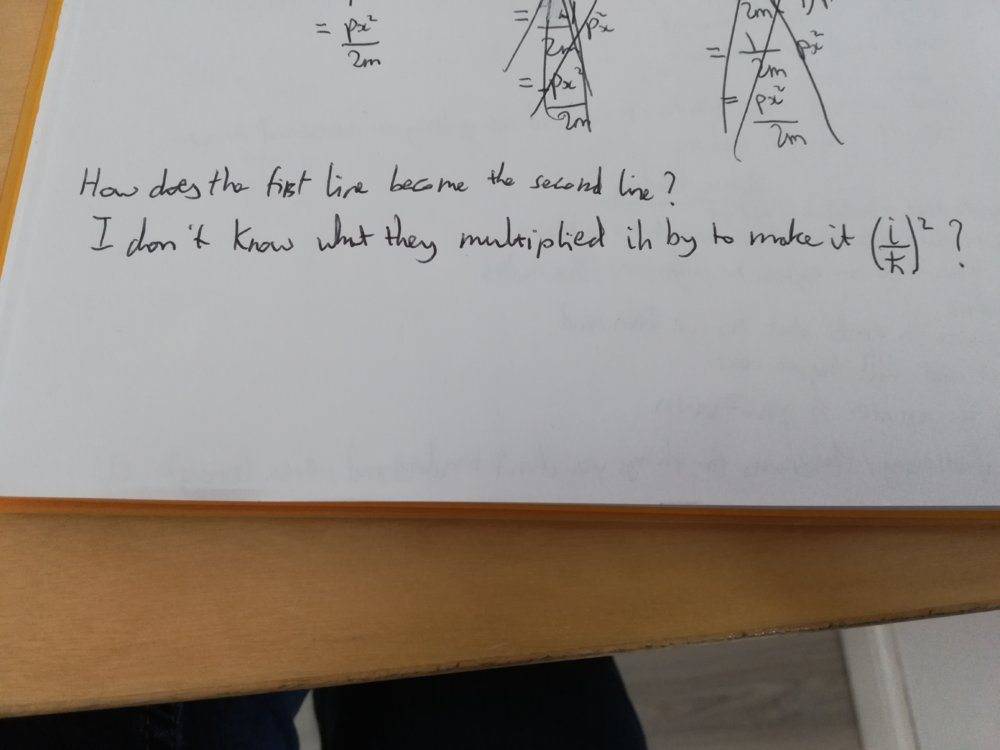 That should read, I don't know what they multiplied ih-bar by to make it (i/h-bar)^2?