Second order ordinary differential equation to a system of first order

Click For Summary
SUMMARY

The discussion focuses on converting a second-order ordinary differential equation into a system of first-order differential equations and expressing it in matrix form, referencing LM Hocking's book on Optimal Control. The user expresses confusion over discrepancies between their solution and the book's solution. It is concluded that the user's method is valid, with the primary difference being the definition of the variable x2, which affects the constants involved but does not alter the overall solution.

PREREQUISITES
  • Understanding of second-order ordinary differential equations
  • Familiarity with first-order differential equations
  • Knowledge of matrix representation of systems of equations
  • Basic concepts of optimal control theory
NEXT STEPS
  • Study the conversion process from second-order to first-order differential equations
  • Learn about matrix forms of differential equations
  • Explore the implications of variable definitions in differential equations
  • Review LM Hocking's Optimal Control for deeper insights on differential equations
USEFUL FOR

Students and professionals in mathematics, engineering, and physics who are working with differential equations, particularly those interested in optimal control theory and system dynamics.
LSMOG
Messages
62
Reaction score
0
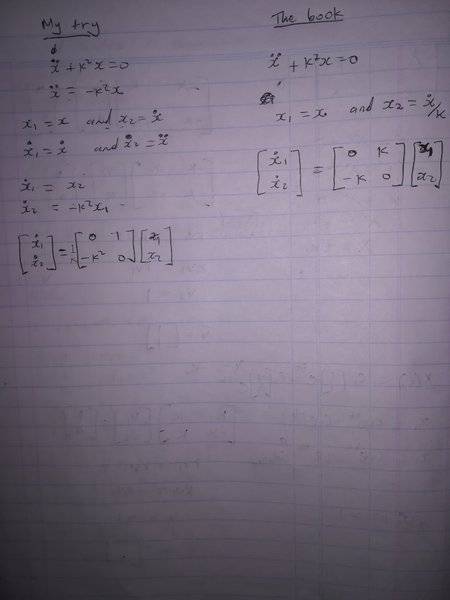
I tried to convert the second order ordinary differential equation to a system of first order differential equations and to write it in a matrix form. I took it from the book by LM Hocking on (Optimal control). What did I do wrong in this attachment because mine
IMG_20180525_211314.jpg
differs from the book?. I've attached both the book solution and mine. Thanks.
 

Attachments

  • IMG_20180525_211314.jpg
    IMG_20180525_211314.jpg
    19.6 KB · Views: 1,928
Physics news on Phys.org
LSMOG said:
I tried to convert the second order ordinary differential equation to a system of first order differential equations and to write it in a matrix form. I took it from the book by LM Hocking on (Optimal control). What did I do wrong in this attachment because mineView attachment 226158 differs from the book?. I've attached both the book solution and mine. Thanks.
I don't think there is anything wrong with your way (except for the ##\frac 1 k## you have penciled in front of the matrix in your equation). It still leads to the same solution to the differential equation. Your way does require fiddling with the constants a little more to get to that solution, which may be why your textbook gives the particular form you found there.
 
You didn't do anything wrong. Just that your definition of ##x_2## is different from that in the book.
When I do this I do it the same way you do, but perhaps the book author has some specific reason for his approach ?
 
Thanks very much
 

Similar threads

  • · Replies 2 ·
Replies
2
Views
3K
  • · Replies 2 ·
Replies
2
Views
4K
  • · Replies 7 ·
Replies
7
Views
4K
  • · Replies 2 ·
Replies
2
Views
3K
  • · Replies 5 ·
Replies
5
Views
2K
  • · Replies 2 ·
Replies
2
Views
4K
  • · Replies 1 ·
Replies
1
Views
2K
  • · Replies 5 ·
Replies
5
Views
3K
Replies
8
Views
6K
  • · Replies 11 ·
Replies
11
Views
2K