MHB Maximal Elements in a Bounded Set

  • Thread starter Thread starter ertagon2
  • Start date Start date
  • Tags Tags
    Sets
Click For Summary
SUMMARY

The discussion focuses on the concept of maximal elements in a bounded set, specifically analyzing the set S = {0, 1/2, 2/3, 3/4, ...} which is a subset of rational numbers (ℚ). The set is bounded above by 1, which serves as its least upper bound, yet 1 is not an element of S. Consequently, no element in S can be maximal, as for every element (1 - 1/(n+1)) in S, there exists a greater element (1 - 1/(n+2)) also within S.

PREREQUISITES
  • Understanding of bounded sets in mathematics
  • Familiarity with the concept of maximal elements
  • Knowledge of rational numbers (ℚ)
  • Basic comprehension of limits and sequences
NEXT STEPS
  • Study the properties of bounded sets in real analysis
  • Learn about the least upper bound (supremum) and its implications
  • Explore examples of maximal and minimal elements in various sets
  • Investigate the relationship between sequences and their limits
USEFUL FOR

Mathematics students, educators, and anyone interested in set theory and real analysis will benefit from this discussion, particularly those studying maximal elements and bounded sets.
ertagon2
Messages
36
Reaction score
0
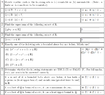
Could someone please check these questions? Please correct them if necessary, with an explanation if you could.
View attachment 7937
 

Attachments

  • maths52p1.png
    maths52p1.png
    18.3 KB · Views: 134
Physics news on Phys.org
Hi ertagon2,

Everything looks OK, except 5b. Think about the set $\displaystyle\left\{1-\frac{1}{n+1}\:\bigg|\: n\in\mathbb{N}\right\}$.
 
I agree with everything except 5.2. Consider an open interval.
 
castor28 said:
Hi ertagon2,

Everything looks OK, except 5b. Think about the set $\displaystyle\left\{1-\frac{1}{n+1}\:\bigg|\: n\in\mathbb{N}\right\}$.

I don't think I understand. Can you elaborate?
 
ertagon2 said:
I don't think I understand. Can you elaborate?
Hi ertagon2,

This is the set $\displaystyle S=\left\{0,\frac12,\frac23,\frac34,\ldots\right\}\subset\mathbb{Q}$. This set is bounded above (by $1$). In fact, $1$ is the least upper bound of $S$, but it is not an element of $S$.

No element of $S$ can be maximal, because, for each element $\left(1 - \dfrac{1}{n+1}\right)\in S$, $\left(1 - \dfrac{1}{n+2}\right)$ is greater and also an element of $S$.
 
If there are an infinite number of natural numbers, and an infinite number of fractions in between any two natural numbers, and an infinite number of fractions in between any two of those fractions, and an infinite number of fractions in between any two of those fractions, and an infinite number of fractions in between any two of those fractions, and... then that must mean that there are not only infinite infinities, but an infinite number of those infinities. and an infinite number of those...

Similar threads

  • · Replies 3 ·
Replies
3
Views
5K
  • · Replies 18 ·
Replies
18
Views
3K
  • · Replies 5 ·
Replies
5
Views
2K
  • · Replies 3 ·
Replies
3
Views
2K
  • · Replies 5 ·
Replies
5
Views
2K
  • · Replies 2 ·
Replies
2
Views
2K
  • · Replies 7 ·
Replies
7
Views
2K
  • · Replies 17 ·
Replies
17
Views
2K
  • · Replies 20 ·
Replies
20
Views
2K
  • · Replies 3 ·
Replies
3
Views
2K