Should the Feynman graph for muon decay include an arrow on the W boson?

Click For Summary
SUMMARY

The discussion centers on the representation of the W boson in the Feynman graph for muon decay. Participants clarify that while the W boson is not a fermion and typically does not require an arrow, including one can represent charge flow. Both diagrams discussed are identical, and the choice of representation is largely a matter of clarity and convention. The consensus is that while it is not necessary to include an arrow on the W boson, doing so can aid in distinguishing charge and momentum flow.

PREREQUISITES
  • Understanding of Feynman diagrams and their components
  • Knowledge of particle physics, specifically muon decay processes
  • Familiarity with the concept of charge flow in particle interactions
  • Basic principles of Quantum Field Theory
NEXT STEPS
  • Study the role of charge flow in Feynman diagrams
  • Read "Quantum Field Theory" by Mandl and Shaw, focusing on Section 4.4
  • Explore Feynman's perturbation theory and its implications for diagram representation
  • Investigate the significance of arrows in fermion representations within Feynman diagrams
USEFUL FOR

Particle physicists, students of Quantum Field Theory, and anyone interested in the nuances of Feynman diagram representations in particle decay processes.

nonequilibrium
Messages
1,412
Reaction score
2
Hello,

The Feynman graph of muon decay is
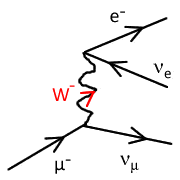
attachment.php?attachmentid=45391&stc=1&d=1332436463.gif

and I asked my professor if we could also write
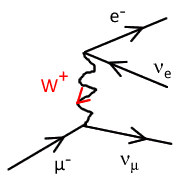
attachment.php?attachmentid=45392&stc=1&d=1332436463.gif

and he said no, because then out of nothingness an electron and an (anti)electron-neutrino would appear and send out a boson to the muon.

However, I was not very convinced, so I wanted to double check here. Thank you!
 

Attachments

  • muon_decay.gif
    muon_decay.gif
    2.5 KB · Views: 992
  • muon_decay2.gif
    muon_decay2.gif
    2.5 KB · Views: 605
Physics news on Phys.org
Those diagrams are identical. Because the W^+ is the antiparticle of the W^-, the direction of the momentum in the Feynman graph relates them. Your professor is really just choosing the option that makes the most sense from the point of view of cause and effect.
 
But if they're identical, isn't his choice illusory?
 
The W doesn't get an arrow. It's not a fermion. Simple as that.
 
mr. vodka said:
But if they're identical, isn't his choice illusory?

As a practical matter we only have to consider one of those diagrams, not both. The first makes complete sense as a decay process. The second has a stranger interpretation. There is a certain about of bias, completely reasonable in my opinion, to choose the first. From the point of view of getting a number out at the end of a computation, it doesn't matter. Feynman was quite fond of the interpretation of an antiparticle as the particle traveling backwards in time. It is probably the case that always drawing diagrams with particles traveling forwards in time could avoid some confusion at some point, but it is not necessary if you're completely consistent.
 
Vanadium 50 said:
The W doesn't get an arrow. It's not a fermion. Simple as that.

Actually, that's not correct. The arrow on the W boson represents "charge flow". And it is fine to include it, even though it is not a fermion. Indeed, when you have charged bosons, it is useful to include arrows to make sure to distinguish charge and momentum flow in a Feynman diagram (it could lead to minus signs).

The point is that (as fzero correctly mentioned) both of these diagrams are identical diagrams! Remember that in Feynman's perturbation theory (with the +i\epsilon in the propagator) a single Feynman Diagram represents an infinite number of graphs where things happen in various time-order. The choice of Feynman propagator then picks out the correct time-ordered contributions. Feynman diagrams are more slick than many people give them credit for!

A nice description of this is in the relatively older text, "Quantum Field Theory" by Mandl and Shaw (see, for example, Sec 4.4 of the "Revised Edition").
 
But it's normal not to include the arrow because it's completely unnecessary - and confusing - as you point out, it's one diagram, not two. And without the arrow, it's explicitly one diagram. I don't ever think I have seen anyone stick an arrow on the W in this process. Ever.

Fermions, however, must have arrows, or, as you say, you will drop a minus sign.
 

Similar threads

  • · Replies 6 ·
Replies
6
Views
2K
  • · Replies 3 ·
Replies
3
Views
3K
  • · Replies 0 ·
Replies
0
Views
2K
  • · Replies 7 ·
Replies
7
Views
2K
  • · Replies 4 ·
Replies
4
Views
4K
  • · Replies 3 ·
Replies
3
Views
3K
  • · Replies 10 ·
Replies
10
Views
4K
  • · Replies 13 ·
Replies
13
Views
5K
  • · Replies 5 ·
Replies
5
Views
2K
  • · Replies 4 ·
Replies
4
Views
4K