Show that angle AXC=angle ACB; geometric construction

Click For Summary

Discussion Overview

The discussion revolves around a geometric construction problem involving triangle ABC and the angles AXC and ACB. Participants are exploring the relationships between these angles through various geometric constructions and reasoning, including the use of perpendiculars and tangents.

Discussion Character

  • Exploratory
  • Technical explanation
  • Debate/contested
  • Mathematical reasoning

Main Points Raised

  • Participants outline the steps for constructing triangle ABC and the necessary geometric elements, including perpendiculars and circles.
  • Some participants propose that to show $\angle AXC = \angle ACB$, reasons must be provided, indicating a need for justification in the geometric relationships.
  • There is a discussion about the relationship between angles, with references to the right triangle properties and the circumcircle, leading to the assertion that $\angle AXC$ can be expressed in terms of other angles.
  • Several participants express confusion over the reasoning required to establish the equality of angles and seek clarification on theorems or properties used in their arguments.
  • One participant mentions the property of equality as a basis for concluding that if two angles are equal to a third angle, they are equal to each other.

Areas of Agreement / Disagreement

Participants generally agree on the need for reasoning to support the claim that $\angle AXC = \angle ACB$, but there is no consensus on the specific justifications or theorems that apply. The discussion remains unresolved regarding the clarity and correctness of the reasoning provided.

Contextual Notes

Participants express uncertainty about the relationships between the angles and the geometric properties involved, indicating that assumptions about the construction and theorems may not be fully articulated or agreed upon.

mathlearn
Messages
331
Reaction score
0
Looks like this question is going to make a long thread. :) This is what the problem states

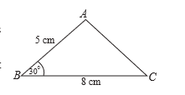
"Use only a straight edge with a cm/mm scale and a pair of compasses to do the following constructions. Draw your construction lines clearly.

View attachment 5914

(i) Construct the triangle ABC according to the measurements shown in the given sketch.

(ii) Construct a perpendicular from A to BC and name the point it meets BC as D.

(iii) Construct the circle that passes through the points A, C and D.

(iv) Construct the tangent to this circle at the point C, and name the point at which it meets AD produced as X.

(v) Show that $\angle$AXC = $\angle$ACB."

Using the pair of compass and a straight edge,
(i) Construct the triangle ABC according to the measurements shown in the given sketch.

2ir27o8.jpg


Then,
(ii) Construct a perpendicular from A to BC and name the point it meets BC as D.

29awlzl.jpg


After That,
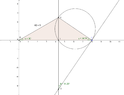
(iii) Construct the circle that passes through the points A, C and D.
4fu96q.jpg


Thereafter,
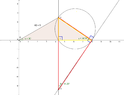
(iv) Construct the tangent to this circle at the point C, and name the point at which it meets AD produced as X.
fp2gsh.jpg


Thereafter, The question states to mark the point where the tangent and AD produced as 'X'.Now can you help me to state, $\angle$AXC = $\angle$ACB. and I want to know verify the rest is done correctly. :) The updated diagram,

(v) Show that $\angle$AXC = $\angle$ACB.
2m3s8t1.jpg


Many thanks :)
 

Attachments

  • Untitled.png
    Untitled.png
    950 bytes · Views: 127
Mathematics news on Phys.org
mathlearn said:
Now can you help me to state, $\angle AXC = \angle ACB$.
You have just stated it. Do you need to prove it? Note that a circumcircle around a right triangle has the hypotenuse as a diameter; therefore, $XC\perp AC$.
 
Yes the reasons must be given for the angles to be equal .Not getting It so far , An explanation with little detail would help :)
 
$$\angle{ACD}=90^\circ-\angle{CAD}$$

$$\angle{AXC}=\,?$$
 
greg1313 said:
$$\angle{ACD}=90^\circ-\angle{CAD}$$

$$\angle{AXC}=\,?$$

Hmm. True but the problem states To give reasons why $\angle AXC = \angle ACB$, not $\angle{ACD}$

As the given sketch looks a little bit difficult to refer, This sketch would help

View attachment 5917

This sketch looks easy to refer , and do you notice how $\angle AXC = \angle ACB$, in the sketch ; Now help me to state the reasons , please do your best to give a detailed reply really quick :)
 

Attachments

  • su47Q (1).png
    su47Q (1).png
    16.9 KB · Views: 121
Last edited:
mathlearn said:
True but the problem states To give reasons why $\angle AXC = \angle ACB$, not $\angle{ACD}$
What's the difference?

You've been told that $\angle{ACD}=90^\circ-\angle{CAD}$. It is left to note that $\angle{AXC}=90^\circ-\angle{CAD}$ because $AC\perp CX$.
 
mathlearn said:
Hmm. True but the problem states To give reasons why $\angle AXC = \angle ACB$, not $\angle{ACD}$

My apologies, (Smile)

greg1313 said:
$$\angle{ACD}=90^\circ-\angle{CAD}$$

$$\angle{AXC}=\,?$$

Evgeny.Makarov said:
You've been told that $\angle{ACD}=90^\circ-\angle{CAD}$. It is left to note that $\angle{AXC}=90^\circ-\angle{CAD}$ because $AC\perp CX$.

Oh! consider the two $$\triangle$$ ADC & $$\triangle$$ AXC

So that,
Evgeny.Makarov said:
You've been told that $\angle{ACD}=90^\circ-\angle{CAD}$. It is left to note that $\angle{AXC}=90^\circ-\angle{CAD}$ because $AC\perp CX$.

View attachment 5918

Am I correct ? :) What theorem was used to gain this approach?

Many Thanks :)
 

Attachments

  • su47Q (1).png
    su47Q (1).png
    16.7 KB · Views: 119
Last edited:
You have not written any reasoning except "Consider two triangles", so it's difficult to say whether you are correct.

Also please note that the forum rules prohibit asking for help in private messages.
 
Oh! I'm sorry (Doh)

Evgeny.Makarov said:
You have not written any reasoning except "Consider two triangles", so it's difficult to say whether you are correct.

So considering the two triangles ADC & ACX,

$$\angle{ACD}=90^\circ-\angle{CAD}$$ & $$\angle{AXC}=90^\circ-\angle{CAD} $$

(v) Show that ∠AXC = ∠ACB.

$$\therefore$$ $$\angle{ACD}=\angle{AXC}$$

And Is there any theorem being used here?

Many Thanks (Smile)
 
  • #10
mathlearn said:
$$\angle{ACD}=90^\circ-\angle{CAD}$$ & $$\angle{AXC}=90^\circ-\angle{CAD} $$

$$\therefore$$ $$\angle{ACD}=\angle{AXC}$$

And Is there any theorem being used here?
Yes. The theorem that is used here says: For all numbers $x$, $y$ and $z$, if $x=z$ and $y=z$, then $x=y$. It's a basic property of equality.
 
  • #11

Attachments

  • Capture.PNG
    Capture.PNG
    1.6 KB · Views: 116

Similar threads

  • · Replies 4 ·
Replies
4
Views
2K
  • · Replies 8 ·
Replies
8
Views
2K
  • · Replies 6 ·
Replies
6
Views
2K
  • · Replies 5 ·
Replies
5
Views
3K
  • · Replies 1 ·
Replies
1
Views
1K
  • · Replies 2 ·
Replies
2
Views
2K
  • · Replies 1 ·
Replies
1
Views
2K
  • · Replies 1 ·
Replies
1
Views
2K
  • · Replies 1 ·
Replies
1
Views
3K
Replies
1
Views
3K