Graduate SiC Vertical MOSFET channel length modulation

  • Thread starter Thread starter bonkgeek
  • Start date Start date
Click For Summary
The discussion focuses on the representation of channel length modulation in vertical MOSFETs, particularly how increased drain voltage affects performance. Unlike lateral MOSFETs, vertical MOSFETs have the drain positioned away from the channel, which influences current flow and pinch-off behavior. The speaker presents a vertical MOSFET design, highlighting its unique geometry where current flows vertically from source to drain. Vertical MOSFETs are primarily utilized in SiC power applications due to their superior voltage withstand capabilities. Understanding these differences is crucial for effective application in power electronics.
bonkgeek
Messages
2
Reaction score
3
Hello , Thank you readind me
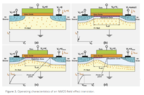
I wonder how to represent the reduction in channel length(pinch off seen in lateral MOSFET) for vertical mosfets due to the increase in drain voltage because the drain is at the back, away from the creation of the channel position.
 

Attachments

Physics news on Phys.org
Welcome to PF.

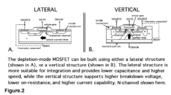
Your diagrams only seem to show lateral MOSFETs. Can you show a typical vertical MOSFET geometry and say where it is used? I have not used them yet.
 
Thanks
I am presenting a vertical MOSFET, where the drain is situated in a different plane compared to the source and gate. In this configuration, the current flows vertically from the source to the drain.
This design contrasts with the lateral MOSFET, which you can learn more about by referring to examples available HERE https://www.mks.com/n/mosfet-physics.
Vertical MOSFETs are predominantly used in SiC power MOSFETs, as their vertical structure enables the component to exhibit strong voltage withstand capability.
 

Attachments

  • LATERAL MOSFET.PNG
    LATERAL MOSFET.PNG
    52.7 KB · Views: 132
  • lateral vs vertical.PNG
    lateral vs vertical.PNG
    35.9 KB · Views: 127
I do not have a good working knowledge of physics yet. I tried to piece this together but after researching this, I couldn’t figure out the correct laws of physics to combine to develop a formula to answer this question. Ex. 1 - A moving object impacts a static object at a constant velocity. Ex. 2 - A moving object impacts a static object at the same velocity but is accelerating at the moment of impact. Assuming the mass of the objects is the same and the velocity at the moment of impact...

Similar threads

  • · Replies 4 ·
Replies
4
Views
4K
  • · Replies 4 ·
Replies
4
Views
4K
  • · Replies 3 ·
Replies
3
Views
18K
  • · Replies 3 ·
Replies
3
Views
22K
  • · Replies 1 ·
Replies
1
Views
18K
Replies
7
Views
3K
  • · Replies 1 ·
Replies
1
Views
4K
  • · Replies 1 ·
Replies
1
Views
4K
  • · Replies 1 ·
Replies
1
Views
1K
  • · Replies 20 ·
Replies
20
Views
4K