High School What is the Area of a Sierpinski Triangle?

Click For Summary
SUMMARY

The area of a Sierpinski Triangle approaches zero as iterations increase, due to the removal of smaller triangles at each step. The Hausdorff dimension of the Sierpinski Triangle is calculated as log(3)/log(2) ≈ 1.585, indicating its fractal nature, which lies between one and two dimensions. While the area becomes negligible, the perimeter increases indefinitely with each iteration, demonstrating the unique properties of fractals. This distinction between area and dimension is crucial for understanding the Sierpinski Triangle's mathematical significance.

PREREQUISITES
  • Understanding of fractals and their properties
  • Familiarity with Hausdorff dimension concepts
  • Basic knowledge of geometric series and limits
  • Mathematical notation for logarithms and dimensions
NEXT STEPS
  • Study the properties of fractals in detail, focusing on the Sierpinski Triangle
  • Learn about Hausdorff dimension and its applications in fractal geometry
  • Explore geometric series and their convergence in mathematical contexts
  • Investigate other fractals, such as the Cantor set, for comparative analysis
USEFUL FOR

Mathematicians, students studying fractal geometry, educators teaching geometric concepts, and anyone interested in the properties of infinite series and dimensions.

Cheesycheese213
Messages
55
Reaction score
8
TL;DR
I got a bit confused on how they were supposed to be measured (maybe fractal dimensions too?)
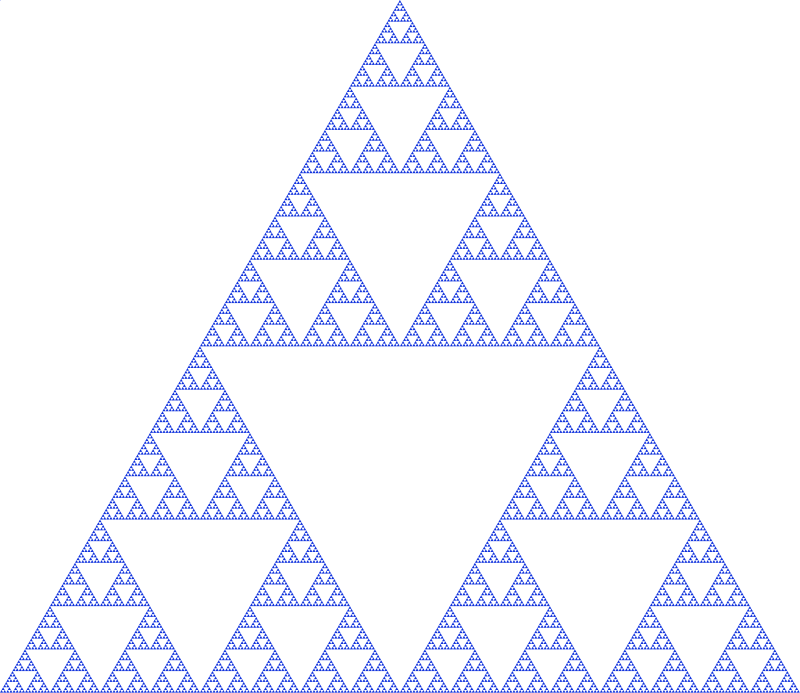
I was trying to find some sort of pattern in the triangle (below) to graph it or find some equation, and I thought maybe measuring something would be a good idea.
1556065123684.png


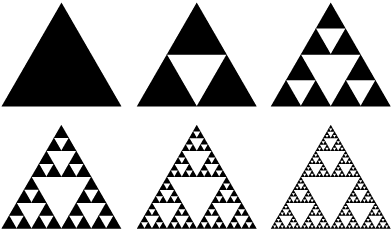
I was okay just calculating the area for the first few iterations, but then I got confused on how I was supposed to represent like an infinite term? Because the ones that have a fixed number of little triangles all have (I think) area since they stop subdividing, so I could get those numbers.
242379


But from what I think I read the actual fractal that goes on forever wouldn't have an area since it would just be never ending lines? Also, there's the Hausdorff/fractal dimension which is saying it's between 1D and 2D, so then is there no way to "measure" it (like as area/length/volume) when it is the actual infinite fractal?

If so, would the graph just be always approaching zero, or would it eventually become zero since it's only made up of lines?
Thanks!
 
Mathematics news on Phys.org
I have trouble to understand you-
Cheesycheese213 said:
But from what I think I read the actual fractal that goes on forever wouldn't have an area since it would just be never ending lines?
It doesn't have an area, since the the sequence of area left tends to zero. This doesn't have to do with lines.
Also, there's the Hausdorff/fractal dimension which is saying it's between 1D and 2D, so then is there no way to "measure" it (like as area/length/volume) when it is the actual infinite fractal?
The dimension is ##\log_23##. What do you mean by measure it? How do you measure the dimension of a line?
If so,...
If what?
... would the graph just be always approaching zero, or would it eventually become zero since it's only made up of lines?
Thanks!
Maybe you can read the Wikipedia article and point out what you don't understand.
 
  • Like
Likes Cheesycheese213
Cheesycheese213 said:
I was trying to find some sort of pattern in the triangle (below) to graph it or find some equation, and I thought maybe measuring something would be a good idea.

View attachment 242377

I was okay just calculating the area for the first few iterations, but then I got confused on how I was supposed to represent like an infinite term? Because the ones that have a fixed number of little triangles all have (I think) area since they stop subdividing, so I could get those numbers.

View attachment 242379

But from what I think I read the actual fractal that goes on forever wouldn't have an area since it would just be never ending lines? Also, there's the Hausdorff/fractal dimension which is saying it's between 1D and 2D, so then is there no way to "measure" it (like as area/length/volume) when it is the actual infinite fractal?

If so, would the graph just be always approaching zero, or would it eventually become zero since it's only made up of lines?
Thanks!
The point about a Sierpinski Triangle (or Gasket) isn't about its area -- it's about the sum of the perimeters of the remaining triangles. In your first figure (upper left), the perimeter is 3, assuming the triangle is 1 unit on each side. In the second figure, four triangles are formed, with the middle one removed. The three remaining triangles are 1/2 unit on a side, and there are three of them, so the sum of the perimeters is 3*3*1/2 = 9/4 = 3 * 3/2.
In the next step, each of the three triangles of the second step has its middle triangle removed, resulting in a sum of perimeters of 27/4 = 9/2 * 3/2.
Each step produces a sum of perimeters that it 3/2 times the sum of the previous step.

As more triangles are formed, the limit of the areas of all the remaining triangles approaches zero, but the sum of perimeters increases without bound.
 
  • Like
Likes Cheesycheese213
fresh_42 said:
Maybe you can read the Wikipedia article and point out what you don't understand.

Sorry for like making no sense I got myself super confused!

On Wikipedia it says
For integer number of dimensions d, when doubling a side of an object, 2d copies of it are created, i.e. 2 copies for 1-dimensional object, 4 copies for 2-dimensional object and 8 copies for 3-dimensional object. For the Sierpinski triangle, doubling its side creates 3 copies of itself. Thus the Sierpinski triangle has Hausdorff dimension log(3)/log(2) = log23 ≈ 1.585, which follows from solving 2d = 3 for d.

The area of a Sierpinski triangle is zero (in Lebesgue measure). The area remaining after each iteration is 3/4 of the area from the previous iteration, and an infinite number of iterations results in an area approaching zero.


I'm really sorry if it's like dumb, but I think I'm confused about whether the dimension and the area is related or are they totally different things? Sorry and thanks again!
 
Mark44 said:
The point about a Sierpinski Triangle (or Gasket) isn't about its area -- it's about the sum of the perimeters of the remaining triangles. In your first figure (upper left), the perimeter is 3, assuming the triangle is 1 unit on each side. In the second figure, four triangles are formed, with the middle one removed. The three remaining triangles are 1/2 unit on a side, and there are three of them, so the sum of the perimeters is 3*3*1/2 = 9/4 = 3 * 3/2.
In the next step, each of the three triangles of the second step has its middle triangle removed, resulting in a sum of perimeters of 27/4 = 9/2 * 3/2.
Each step produces a sum of perimeters that it 3/2 times the sum of the previous step.

As more triangles are formed, the limit of the areas of all the remaining triangles approaches zero, but the sum of perimeters increases without bound.
Thank you so much!
 
Cheesycheese213 said:
I'm really sorry if it's like dumb, but I think I'm confused about whether the dimension and the area is related or are they totally different things?
They are different things. For example the area of a square can be one, but if part of a three dimensional space, its volume is zero. The area is the volume in two dimension, the length the volume in one dimension. The area of the Sierpinski triangle is zero, it has no measurable content. The dimension is a mathematically defined quantity which turns out to be ##\log_23##. It is a bit artificial to cover those special objects which fractals are. The triangle lives in the plane, but its area vanishes at infinity. What's left is more than a line which would have had a certain finite length, but less than an area; somewhere in between the two.
 
  • Like
Likes Cheesycheese213
Oh thanks that makes so much more sense!
 
The setup is that length is seen as a 1d measure , are is a 2d measure. In order to have D-Day n-dimensional measure, an object must have dimension d or higher.Edit: in these types of constructions; see also fat Cantor sets which have empty interior but non-zero length. You can do similar with a triangle.
 
  • Like
Likes Cheesycheese213

Similar threads

  • · Replies 3 ·
Replies
3
Views
2K
  • · Replies 4 ·
Replies
4
Views
2K
  • · Replies 20 ·
Replies
20
Views
4K
  • · Replies 1 ·
Replies
1
Views
2K
  • · Replies 2 ·
Replies
2
Views
2K
Replies
1
Views
2K
  • · Replies 7 ·
Replies
7
Views
2K
  • · Replies 7 ·
Replies
7
Views
1K
  • · Replies 10 ·
Replies
10
Views
2K
  • · Replies 1 ·
Replies
1
Views
2K