Sign problem in the rocket equation

Click For Summary
SUMMARY

The discussion centers on the rocket equation, specifically the relationship between the mass ejected by the rocket (##\Delta m##) and the change in the mass of the rocket (##\Delta M##). Participants clarify that ##\Delta m = -\Delta M## is correct because the rocket loses mass while ejecting fuel, which must be represented as equal and opposite quantities. The analogy of two glasses of water is used to illustrate that a decrease in mass in one context corresponds to an increase in another, reinforcing the necessity of the negative sign in the equation.

PREREQUISITES
  • Understanding of the rocket equation and its components
  • Familiarity with momentum conservation principles
  • Basic knowledge of mass flow in physics
  • Ability to interpret mathematical notation in physics
NEXT STEPS
  • Study the derivation of the rocket equation in detail
  • Explore momentum conservation in variable mass systems
  • Learn about the implications of mass ejection on rocket propulsion
  • Investigate vector notation in physics for clearer momentum representation
USEFUL FOR

Students of physics, aerospace engineers, and anyone interested in understanding the dynamics of rocket propulsion and mass flow in variable systems.
Leo Liu
Messages
353
Reaction score
156
Homework Statement
A quiz question
Relevant Equations
##\vec p_1=\vec p_f##
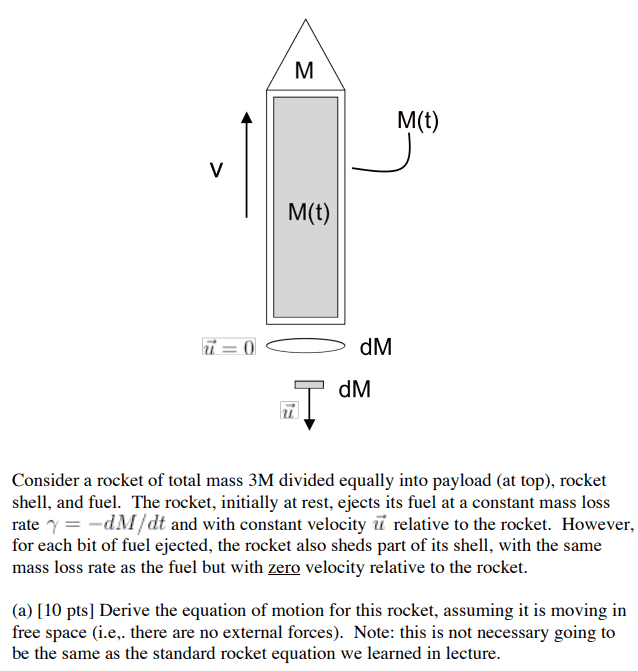
Question:
1605453226652.png

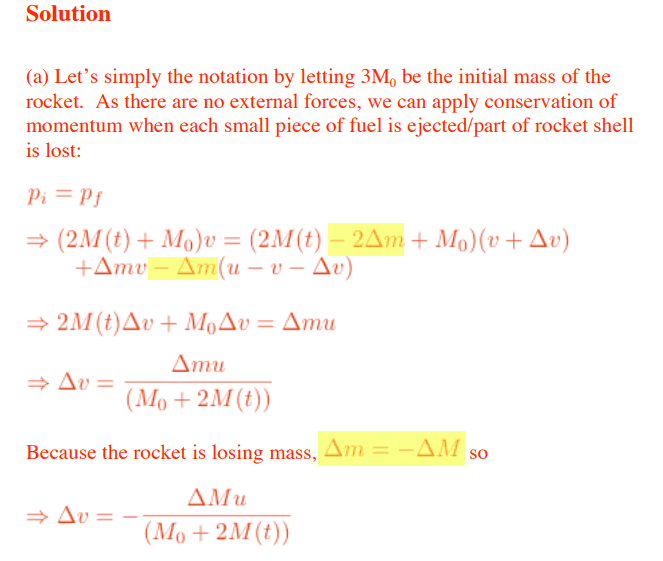
Solution:
1605453240747.png

Issue:
I would like to know why ##\Delta m=-\Delta M## rather than ##=\Delta M## if minus signs have been used in the second equation. Thank you.
 
Physics news on Phys.org
Leo Liu said:
I would like to know why ##\Delta m=-\Delta M## rather than ##=\Delta M## if minus signs have been used in the second equation. Thank you.
I assume that ##\Delta m## is the mass ejected and ##\Delta M## is the change in the mass of the rocket. They must be equal and opposite. If they were equal, then the rocket would be ejecting mass and gaining that mass - which is not right.
 
  • Like
Likes   Reactions: Leo Liu
Note that positive momentum is taken to be in the direction of the forward motion of the rocket. Does the quantity ##u - v - \Delta v## represent the velocity of the ejected fuel in the forward direction or the rearward direction? Thus, should the final momentum of the ejected fuel (in the forward direction) be written as ##+\Delta m (u - v - \Delta v)## or as ##-\Delta m (u - v - \Delta v)##? [As @PeroK noted, ##\Delta m## represents the mass of the ejected fuel. So, ##\Delta m## is positive.]
 
  • Like
Likes   Reactions: Leo Liu
Hello. Thanks for your reply.
TSny said:
Does the quantity u−v−Δv represent the velocity of the ejected fuel in the forward direction or the rearward direction?
It probably means backward.
TSny said:
Thus, should the final momentum of the ejected fuel (in the forward direction) be written as +Δm(u−v−Δv) or as −Δm(u−v−Δv)?
The second one I guess since the momentum of the fuel points "upward". Yet would the answer change if I wrote the velocities in the vector notation?
 
PeroK said:
I assume that ##\Delta m## is the mass ejected and ##\Delta M## is the change in the mass of the rocket. They must be equal and opposite. If they were equal, then the rocket would be ejecting mass and gaining that mass - which is not right.
Could you tell me why this substitution is valid even if it makes the rocket seem as if it is gaining mass ##(2M(t)+2dM+M_0)(v+dv)##?
 
Leo Liu said:
Could you tell me why this substitution is valid even if it makes the rocket seem as if it is gaining mass ##(2M(t)+2dM+M_0)(v+dv)##?
Why does the rocket seem to be gaining mass?
 
PeroK said:
Why does the rocket seem to be gaining mass?
The reason is that the second term 2dM seems to be positive. But I get it now.

I am afraid that I still don't quite understand why we cannot make ##\Delta m=\Delta M##. Does the reason have something to do with ##-\Delta m(u-v-\Delta v)##?
 
Leo Liu said:
The reason is that the second term 2dM seems to be positive. But I get it now.

I am afraid that I still don't quite understand why we cannot make ##\Delta m=\Delta M##.

You can do that. That means that the rocket is gaining mass. That's a different problem, where the rocket is bombarded by particles. In this problem the rocket is losing mass.
 
I don't know if this analogy will help. Suppose we have two glasses of water. The mass of water in the first glass is denoted by ##M## and the mass in the second glass is denoted by ##m##. Suppose I pour a little water from the first glass into the second glass.

The change in mass of water in the first glass would be denoted ##\Delta M##. Since the mass of water in the first glass decreases, ##\Delta M## is a negative number.

The change in mass of water in the second glass would be denoted ##\Delta m##. Since the mass of water in the second glass increases, ##\Delta m## is a positive number.

The equation ##\Delta m = \Delta M## cannot be correct since it says that a negative number equals a positive number. The correct equation is ##\Delta m = -\Delta M##.
 
  • Informative
Likes   Reactions: Leo Liu
  • #10
TSny said:
The change in mass of water in the first glass would be denoted ##\Delta M##. Since the mass of water in the first glass decreases, ##\Delta M## is a negative number.

The change in mass of water in the second glass would be denoted ##\Delta m##. Since the mass of water in the second glass increases, ##\Delta m## is a positive number..
I find this analogy very helpful. Many thanks!
 
  • #11
In my opinion, the diagram in the first post is incorrect in how it writes the mass of the ejected fuel. The mass of the ejected fuel is ##dm##, which equals ##-dM##.

1605467759209.png
 
  • Informative
Likes   Reactions: Leo Liu

Similar threads

  • · Replies 3 ·
Replies
3
Views
2K
  • · Replies 47 ·
2
Replies
47
Views
3K
  • · Replies 2 ·
Replies
2
Views
1K
  • · Replies 10 ·
Replies
10
Views
2K
  • · Replies 14 ·
Replies
14
Views
2K
  • · Replies 1 ·
Replies
1
Views
2K
  • · Replies 42 ·
2
Replies
42
Views
6K
  • · Replies 4 ·
Replies
4
Views
2K
  • · Replies 3 ·
Replies
3
Views
1K
Replies
2
Views
2K