Simple Acoustics Question -- Which neighbor hears the other better?

  • Context: High School 
  • Thread starter Thread starter alex282
  • Start date Start date
  • Tags Tags
    Acoustics Sound
Click For Summary
SUMMARY

In a scenario involving two individuals, Person 1 in Apartment 1 and Person 2 in an alley, Person 1 hears Person 2 better due to reduced background noise in the enclosed space of the apartment. The principle of reciprocity applies, indicating that sound propagation is generally equal in both directions, but local noise levels significantly affect the hearing experience. Factors such as the volume of speech and the acoustics of the environment play crucial roles in sound perception. Understanding these dynamics can help in assessing acoustic interactions in similar settings.

PREREQUISITES
  • Basic understanding of sound wave propagation
  • Familiarity with the concept of signal-to-noise ratio
  • Knowledge of acoustic principles, particularly reciprocity
  • Awareness of environmental factors affecting sound, such as background noise
NEXT STEPS
  • Research "acoustic diode" technology for advanced sound control
  • Study the Rayleigh reciprocity relation in acoustics
  • Explore the impact of background noise on sound perception
  • Investigate the effects of speech volume and pitch on communication clarity
USEFUL FOR

Acoustics enthusiasts, sound engineers, urban planners, and anyone interested in understanding sound transmission in residential environments.

alex282
Messages
23
Reaction score
1
TL;DR
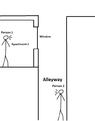
Person 1 is in Apartment 1
Person 2 is in the alley between two blocks of apartments

If both people speak at the same volume, which one hears the other better?
There are two blocks of apartments separated by a narrow alleyway. Person 1 is in the middle of the room in Apartment 1 (first floor if you are in the UK and second floor if you are in the USA!) and Person 2 is on the ground outdoors in the alleyway.

If both people speak at the same volume, pitch and have the same hearing ability, which statement is the most accurate;
a) Person 1 hears Person 2 better.
b) Person 2 hears Person 1 better.
c) Person 1 and Person 2 hear each other equally as well.

If the answer is a) or b), how significant is the difference to which one person hears the other?

What is the simple explanation for the answer?I have almost zero knowledge of acoustics but I am inclined to assume that Person 1 will hear Person 2 slightly better due to the path of the soundwaves, at least I hope this is the case and my neighbours do not hear me as clearly as I hear them when in the alleyway adjacent to my window :smile:
 

Attachments

  • sound.png
    sound.png
    6.6 KB · Views: 218
Physics news on Phys.org
alex282 said:
Person 1 is in Apartment 1
Person 2 is in the alley between two blocks of apartments
If both people speak at the same volume, which one hears the other better?
Person 1 hears Person 2 better. Because person 2 will have more local background noise than will person 1 in a more closed space.
 
  • Like
Likes   Reactions: sophiecentaur and phinds
Baluncore said:
Person 1 hears Person 2 better. Because person 2 will have more local background noise than will person 1 in a more closed space.
The principle of reciprocity is a pretty good one in radio communications and it should also apply in acoustics. However, as @Baluncore says, it will be mainly a matter of signal to noise (or interference) ratio at each end.
 
Yes, what they said.

Much depends on what, if any, other sounds are and where they come from. Also how loudly each is speaking and how good their hearing is. If everything is the same (reciprocal), then the sound waves normally should propagate identically regardless of direction.

However, there are special materials, or circumstances, where that isn't true. You can search for "acoustic diode" or similar to learn more.

https://phys.org/news/2013-11-acoustic-diode.html
 
The Rayleigh reciprocity relation, described in his book "Theory of Sound". For radio waves we can use the Rayleigh-Carson reciprocity theorem.
 
  • Like
Likes   Reactions: sophiecentaur
Another confounding influence would be the gender of the participants, and their personal relationship.
 
  • Haha
Likes   Reactions: DaveE
There is another answer to this question. It will be the grumpier / older neighbour who is disturbed first. :wink:
 

Similar threads

  • · Replies 31 ·
2
Replies
31
Views
4K
  • · Replies 12 ·
Replies
12
Views
4K
  • · Replies 16 ·
Replies
16
Views
4K
  • · Replies 24 ·
Replies
24
Views
5K
Replies
17
Views
3K
  • · Replies 83 ·
3
Replies
83
Views
18K
  • · Replies 4 ·
Replies
4
Views
3K
  • · Replies 2 ·
Replies
2
Views
2K
  • · Replies 2 ·
Replies
2
Views
3K
  • · Replies 32 ·
2
Replies
32
Views
6K