Math Amateur
Gold Member
MHB
- 3,920
- 48
Example 1 in James Munkres' book, Topology (2nd Edition) reads as follows:
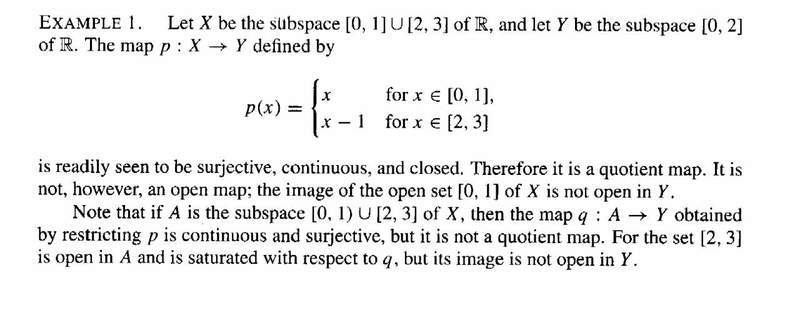
Munkres states that the map p is 'readily seen' to be surjective, continuous and closed.
My problem is with showing (rigorously) that it is indeed true that the map p is continuous and closed.
Regarding the continuity of a function Munkres says the following on page 102:
--------------------------------------------------------------------------
Let X and Y be topological spaces. A function f \ : \ X \to Y is said to be continuous if for each open subset V of Y, the set f^{-1} (V) is an open subset of X.
---------------------------------------------------------------------------
Yes ... fine ... but how do we use such a definition to prove or demonstrate the continuity of p in the example?
Can someone show me how we use the definition (or some theorems) in practice to demonstrate/ensure continuity?
I have a similar issue with showing p to be a closed map.
On page 137 Munkres writes the following:
--------------------------------------------------------------------------
A map p "is said to be a closed map if for each closed set A of X the set p(A) is closed in Y"
---------------------------------------------------------------------------
Again, I understand the definition, I think, but how do we use it to indeed demonstrate/prove the closed nature of the particular map p in Munkres example?
Hope someone can help clarify the above issues?
Peter
Munkres states that the map p is 'readily seen' to be surjective, continuous and closed.
My problem is with showing (rigorously) that it is indeed true that the map p is continuous and closed.
Regarding the continuity of a function Munkres says the following on page 102:
--------------------------------------------------------------------------
Let X and Y be topological spaces. A function f \ : \ X \to Y is said to be continuous if for each open subset V of Y, the set f^{-1} (V) is an open subset of X.
---------------------------------------------------------------------------
Yes ... fine ... but how do we use such a definition to prove or demonstrate the continuity of p in the example?
Can someone show me how we use the definition (or some theorems) in practice to demonstrate/ensure continuity?
I have a similar issue with showing p to be a closed map.
On page 137 Munkres writes the following:
--------------------------------------------------------------------------
A map p "is said to be a closed map if for each closed set A of X the set p(A) is closed in Y"
---------------------------------------------------------------------------
Again, I understand the definition, I think, but how do we use it to indeed demonstrate/prove the closed nature of the particular map p in Munkres example?
Hope someone can help clarify the above issues?
Peter
