Simply supported beam with a spring support in the middle - deflection

Click For Summary
SUMMARY

The discussion focuses on calculating the maximum deflection of a simply supported beam with a spring support in the middle under a uniformly distributed load (UDL). The derived formula for deflection is $$\delta_{t}=\frac{5FL^{3}}{384EI+5kL^{3}}$$, which yielded a calculated deflection of 6.1928 mm, while Finite Element Analysis (FEA) provided a result of 5.1796 mm. The discrepancy is attributed to the incorrect treatment of the UDL in relation to the spring support, suggesting that the conversion of load to distributed load may not be appropriate. The discussion also references a successful application of the same principles to a concentrated force scenario.

PREREQUISITES
  • Understanding of beam deflection theory
  • Familiarity with spring mechanics and stiffness calculations
  • Knowledge of Finite Element Analysis (FEA) principles
  • Proficiency in algebra for solving equations related to structural mechanics
NEXT STEPS
  • Study the derivation of deflection formulas for beams under various loading conditions
  • Learn about the influence of spring supports on beam deflection
  • Explore Finite Element Analysis (FEA) software for structural simulations
  • Investigate methods for solving statically indeterminate beams
USEFUL FOR

Structural engineers, civil engineering students, and professionals involved in beam design and analysis will benefit from this discussion, particularly those working with spring-supported structures and UDL scenarios.

FEAnalyst
Messages
348
Reaction score
149
TL;DR
How to calculate the maximum deflection of a simply supported beam with spring support in the middle when it's subjected to uniformly distributed load ?
Hi,

I'd like to calculate the maximum deflection of a simply supported beam with spring support in the middle and UDL (uniformly distributed load) acting on the whole beam:
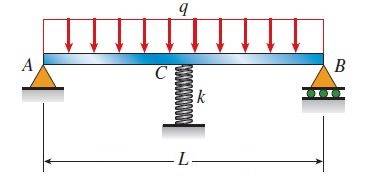
beam scheme.JPG


Here's my derivation, starting from the known formula for maximum deflection of a simply supported beam with UDL and no spring: $$\delta_{b}=\frac{5 \left( \frac{F}{L} \right) L^{4}}{384EI}$$ $$k_{b}=\frac{F}{\delta_{b}}=\frac{384EI}{5L^{3}}$$ $$k_{t}=k_{b}+k_{s}=\frac{384EI}{5L^{3}}+k_{s}$$ $$\delta_{t}=\frac{F}{k_{t}}=\frac{5FL^{3}}{384EI+5kL^{3}}$$

The problem is that when I substitute the data: ##F=2000 \ N##, ##L=500 \ mm##, ##E=210 \ GPa##, ##I=\frac{a^{4}}{12}=\frac{12^{4}}{12}=1728 \ mm^{4}##, ##k=100 \ \frac{N}{mm}##

the result is: $$\delta_{t}=\frac{5 \cdot 2000 \cdot 500^{3}}{384 \cdot 210000 \cdot 1728+5 \cdot 100 \cdot 500^{3}}=6.1928 \ mm$$

while from FEA, I get: ##5.1796 \ mm## and I believe this result is correct. What's wrong with my formula ?

Interestingly, I got a very good agreement for the same case with a concentrated force in the middle instead of UDL (using the same approach, just a different base formula for the deflection of the beam). Does it mean that the ##q=\frac{F}{L}## conversion is incorrect here ? How should I treat it then ?
 
Last edited:
Engineering news on Phys.org
Well, I guess that I could use one of the standard methods to calculate the deflection of this statically indeterminate beam from scratch but I don’t know how to treat the spring. Also, the aforementioned simple approach based on the known formula for the deflection of a beam without a spring works well for the case with concentrated force in the middle so it seems that it’s just a matter of properly accounting for the UDL. Unless this simplified approach won’t work with UDL but I hope it’s not the case.
 
Lnewqban said:
Would this approach to a different situation be useful to yours?

https://mathalino.com/reviewer/strength-materials/problem-709-propped-beam-spring-support
Thank you very much. Using this approach, I get: $$\delta=\frac{5qL^{4}}{384EI}=8.9705 \ mm$$ $$\delta - \delta_{s}=\delta_{R}$$ $$8.9705- \frac{R}{k}=\frac{RL^{3}}{48EI}$$ $$8.9705- \frac{R}{100}=\frac{R \cdot 500^{3}}{48 \cdot 210000 \cdot 1728}$$ $$R=522.26 \ N$$ $$\delta_{s}=\frac{R}{k}=\frac{522.26}{100}=5.2226 \ mm$$ so pretty close to the simulation result. I also substituted everything and rearranged the equation to get a single formula: $$\delta_{s}=\frac{5qL^{4}}{384EI+8kL^{3}}$$
 
  • Like
Likes   Reactions: Lnewqban and jack action
You should have 4 equations to work with:

$$ \uparrow^+ \sum F = R_A - wL -k y|_{x=L/2}+R_B = 0 $$

$$ \circlearrowright^+ \sum_{A} M = k y|_{x=L/2} \frac{L}{2}+ wL \frac{L}{2} - R_BL = 0 $$

Elastic Eqn's:
$$ EI \theta = \frac{R_A x^2 }{2} -\frac{w x^3}{6} + C_{\theta} \tag{slope}$$

$$ EI y = \frac{R_A x^3 }{6} -\frac{w x^4}{24} + C_{\theta}x + C_y \tag{deflection}$$

with conditions:

##y|_{x=0} = 0##

##\theta|_{x=L/2} = 0 ##

by evaluating ## y|_{x=L/2}## I believe you can combine all these to solve the system.
 
Last edited:
When I solve the system I get:

$$y_c=−\frac{5}{8}\left( \frac{wL^4}{ 48EI+kL^3} \right) \approx−5.22~ \rm{mm} $$

$$ R_A=R_B=\frac{1}{2}(ky_c+wL) \approx 738.9 ~\rm{N} $$

$$ Fc=−ky_c \approx 522.2 ~\rm{N} $$

EDIT: I found an algebra error. I see this agrees with the result in #5
 
Last edited:

Similar threads

  • · Replies 13 ·
Replies
13
Views
5K
  • · Replies 4 ·
Replies
4
Views
5K
  • · Replies 8 ·
Replies
8
Views
3K
  • · Replies 2 ·
Replies
2
Views
3K
  • · Replies 4 ·
Replies
4
Views
2K
Replies
4
Views
6K
Replies
5
Views
2K
Replies
4
Views
3K
  • · Replies 4 ·
Replies
4
Views
2K
  • · Replies 3 ·
Replies
3
Views
2K