Frank Einstein
- 166
- 1
Hello everyone. I am dealing with a stochastic optimization problem with three sources of uncertainty and I am using generalized polynomial chaos to solve this problem. The level with I am working is 1 (l=1). There are 3^3=27 realizations to make. I want to use instead a Smolyak reduced grid since in the future I will have to deal with more dimensions. My sources are the following: https://web.stanford.edu/~paulcon/slides/Oxford_2012.pdf and https://www.sciencedirect.com/science/article/pii/S0021999116301516.
My problem is as follows: The material says that the points which should be used and their weight can be described the following way:
(LaTex notation)
$A(l, d)= \sum_{l+1 \leq |i| \leq l+1} (-1)^{l+d-|i|} {d-1 \choose l+d-|i|}(U^{i_1} \otimes ... \otimes U^{i_d})
(Regular notation)
∑(l+1≤|i|≤l+d) (-1)(l+d-|i|) (d-1 l+d-|i|)(Ui1⊗...⊗Uid)
Where d is the number of random variables, 3, l is the level, 1, |i| is the graded lexicographic order, (Ui1⊗...⊗Uid) are the tensor product of the nodes for each dimension and (d-1 l+d-|i|) is a binomial coefficient.
Also, μ=f(ξ(1)ξ(2))°(ω), which means that the mean of the process is equal to the sum of all the realizations multiplied by their weight.
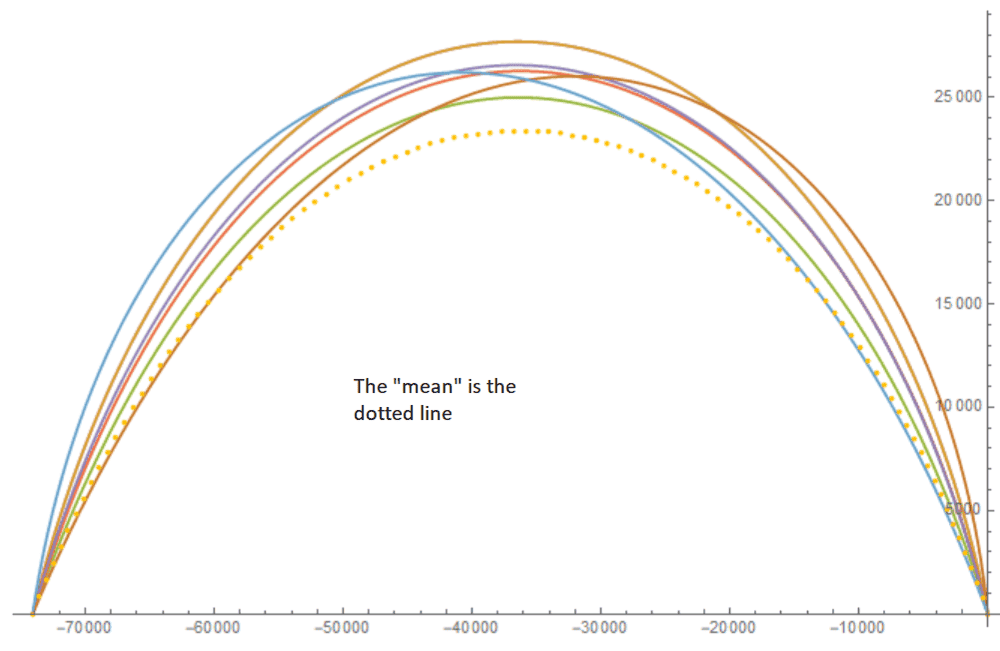
Then, if l+1=2 and l+d =4, I should add all the terms which are listed in the lexicographic matrix with |i|=2, 3 and 4. However, since the terms which have a zero as one of the index don't have nodes, these are discarted, leaving me with (1 1 1), (2 1 1) and (1 1 2), which in total produce 7 realizations. However, if I use these realizations, my mean looks signifficantly different from the realizations as can be seen in the figure.
For what I have read, the amount of realizations that should be used is way higher than 7; however, I cannot find where my mistake is.
Any answer is appreciaded.
Thanks.
My problem is as follows: The material says that the points which should be used and their weight can be described the following way:
(LaTex notation)
$A(l, d)= \sum_{l+1 \leq |i| \leq l+1} (-1)^{l+d-|i|} {d-1 \choose l+d-|i|}(U^{i_1} \otimes ... \otimes U^{i_d})
(Regular notation)
∑(l+1≤|i|≤l+d) (-1)(l+d-|i|) (d-1 l+d-|i|)(Ui1⊗...⊗Uid)
Where d is the number of random variables, 3, l is the level, 1, |i| is the graded lexicographic order, (Ui1⊗...⊗Uid) are the tensor product of the nodes for each dimension and (d-1 l+d-|i|) is a binomial coefficient.
Also, μ=f(ξ(1)ξ(2))°(ω), which means that the mean of the process is equal to the sum of all the realizations multiplied by their weight.
Then, if l+1=2 and l+d =4, I should add all the terms which are listed in the lexicographic matrix with |i|=2, 3 and 4. However, since the terms which have a zero as one of the index don't have nodes, these are discarted, leaving me with (1 1 1), (2 1 1) and (1 1 2), which in total produce 7 realizations. However, if I use these realizations, my mean looks signifficantly different from the realizations as can be seen in the figure.
For what I have read, the amount of realizations that should be used is way higher than 7; however, I cannot find where my mistake is.
Any answer is appreciaded.
Thanks.