Solution Attached: Download Now!

  • Thread starter Thread starter dorothy
  • Start date Start date
  • Tags Tags
    Kinematic
Join the discussion
Ask a follow-up here, or get your own question answered by working scientists, mathematicians and engineers — people, not an autocomplete.
Real named experts · corrections over time · the nuance an AI answer skips
17 replies · 2K views
dorothy
Messages
39
Reaction score
1
Homework Statement
Hi everyone, because I am on vacation right now. So, I'm prepping for the topic of kinematics. I've done some exercises(not homework or graded assignments!!) , but since the teacher hasn't taught it yet, I don't know if the answers are right, so I hope someone here can help me check the answers. Thanks! ☺️
Relevant Equations
v = u+at
s = ut + 1/2 at ^2
v^2 = u^2+2as
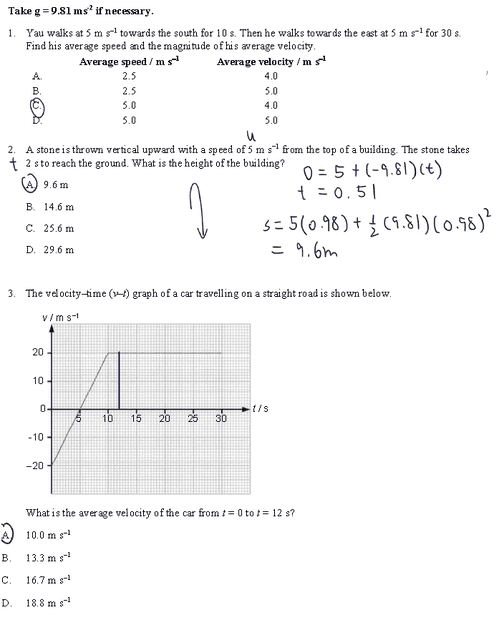
The attached pdf is my solution. Thank you!
1649702357362.png
 

Attachments

Last edited by a moderator:
Physics news on Phys.org
mjc123 said:
All the answers for question 3 are wrong.

I think so coz I found the avg. velocity to be 11.7 .
Except Q3, do I get the questions(question1-30) all correct? thanks
 
dorothy said:
I think so coz I found the avg. velocity to be 11.7 .
Except Q3, do I get the questions(question1-30) all correct? thanks
The average speed is 11.7 m/s, not the average velocity. Do you know the difference between the two? Question 1 supposedly tests whether you do.

Aside from that, I wonder why the choices in the two parts of question 1 come in identical pairs. I suppose this makes it more likely to get the right answer by flipping a coin.
 
kuruman said:
The average speed is 11.7 m/s, not the average velocity. Do you know the difference between the two? Question 1 supposedly tests whether you do.

Aside from that, I wonder why the choices in the two parts of question 1 come in identical pairs. I suppose this makes it more likely to get the right answer by flipping a coin.
for Q3, it should be ''avg. velocity: [(5)(-20)÷2 +(2+7)(20)÷2]÷12 = 3.3 m/s'', right?
 
kuruman said:
The average speed is 11.7 m/s, not the average velocity. Do you know the difference between the two? Question 1 supposedly tests whether you do.

Aside from that, I wonder why the choices in the two parts of question 1 come in identical pairs. I suppose this makes it more likely to get the right answer by flipping a coin.
Besides Q3, do I get all correct in Q1-Q30? thanks
 
dorothy said:
for Q3, it should be ''avg. velocity: [(5)(-20)÷2 +(2+7)(20)÷2]÷12 = 3.3 m/s'', right?
That's okay, but it's not a good way to write things. You ought to explicitly mention the (signed) area under the graph and the total time.

I would also have a criticism of these questions. It would make much more sense to me to calculate the displacement at ##t= 12 \ s##. That's the key point. Also, that at ##t = 10 \ s## the object is back where it was at ##t = 0 \ s##.

IMO, that's the sort of information that it's important to get from a graph like that.
 
PeroK said:
That's okay, but it's not a good way to write things. You ought to explicitly mention the (signed) area under the graph and the total time.

I would also have a criticism of these questions. It would make much more sense to me to calculate the displacement at ##t= 12 \ s##. That's the key point. Also, that at ##t = 10 \ s## the object is back where it was at ##t = 0 \ s##.

IMO, that's the sort of information that it's important to get from a graph like that.
i see , thanks
 
dorothy said:
Besides Q3, do I get all correct in Q1-Q30? thanks
I can only speak for myself when I say that I am disinclined to go over all 30 of these questions, find the answers to all and then report back which are correct and which are not. If you have difficulties with a specific question, please post it stating why you answered it the way you did and I will be happy to help you.
 
  • Like
Likes   Reactions: nasu, PeroK, gmax137 and 1 other person
kuruman said:
I can only speak for myself when I say that I am disinclined to go over all 30 of these questions, find the answers to all and then report back which are correct and which are not. If you have difficulties with a specific question, please post it stating why you answered it the way you did and I will be happy to help you.
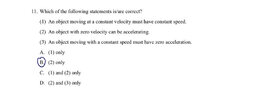
I’m sorry. May I know whether my ans is correct or not? I think (1) & (3) are wrong because velocity and acceleration get direction(vectors) while speed doesn’t(scalar). Thank you.
 

Attachments

  • 57B00410-57F0-41BC-B38A-720FC76401E0.jpeg
    57B00410-57F0-41BC-B38A-720FC76401E0.jpeg
    16.6 KB · Views: 131
kuruman said:
I can only speak for myself when I say that I am disinclined to go over all 30 of these questions, find the answers to all and then report back which are correct and which are not. If you have difficulties with a specific question, please post it stating why you answered it the way you did and I will be happy to help you.
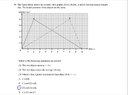
I would like to ask Q19 as well. Thanks.
(2) is correct because A&B have the same total displacement and they finish it with the same time 10s so the two objects have the same avg. velocity.

(3) is correct because at t=1s, the slope of A is greater than the slope of B, which means A has a greater acceleration than B at t=1s.
 

Attachments

  • 1159393B-72CB-4566-B6C7-D65E9E0E5075.jpeg
    1159393B-72CB-4566-B6C7-D65E9E0E5075.jpeg
    42.5 KB · Views: 140
dorothy said:
I’m sorry. May I know whether my ans is correct or not? I think (1) & (3) are wrong because velocity and acceleration get direction(vectors) while speed doesn’t(scalar). Thank you.
Your reasoning is incorrect. The easiest way to show that a statement is incorrect is by providing counterexamples.
1. An object moving at constant velocity must have constant speed. This asserts that ALL objects moving at constant velocities have constant speed. To argue that this is incorrect, you must provide an example of an object moving at constant velocity the speed of which is clearly changing with time. Can you think of one? If you can, then the statement is false.
2. An object with zero velocity can be accelerating. Unlike the previous statement this asserts that an object with zero velocity may or may not be accelerating. Can you provide an example where an object with zero velocity IS NOT accelerating and another example where an object with zero velocity IS accelerating? If you can, then the statement is true.
3. An object moving with a constant speed must have zero acceleration. This asserts that ALL objects moving at constant speed have zero acceleration. To argue that this is incorrect, you must provide an example of an object that moves at constant speed the acceleration of which is clearly not zero. Can you think of one? If you can, then the statement is false.
 
  • Like
Likes   Reactions: PeroK
dorothy said:
I would like to ask Q19 as well. Thanks.
(2) is correct because A&B have the same total displacement and they finish it with the same time 10s so the two objects have the same avg. velocity.

(3) is correct because at t=1s, the slope of A is greater than the slope of B, which means A has a greater acceleration than B at t=1s.
Your reasoning is correct here. Why do you think that choice 1 is incorrect? What is your argument that the two objects do not meet at t = 5 s?
 
kuruman said:
Your reasoning is correct here. Why do you think that choice 1 is incorrect? What is your argument that the two objects do not meet at t = 5 s?
coz their displacement are not equal
 
dorothy said:
coz their displacement are not equal
I don't disagree with you, but what evidence do you have to support your assertion? As a beginner, you must get into the habit of supporting your assertions using the evidence that you are given.

So what is the evidence that the displacements are different?
 
kuruman said:
I don't disagree with you, but what evidence do you have to support your assertion? As a beginner, you must get into the habit of supporting your assertions using the evidence that you are given.

So what is the evidence that the displacements are different?
since the area of A from t=0s to t=5s and the area of B from t=0s to t=5s are different.