popopopd
- 12
- 0
if we do picard's iteration of nth order linear ODE in the vector form, we can show that nth order linear ODE's solution exists.
 (5)
(5)
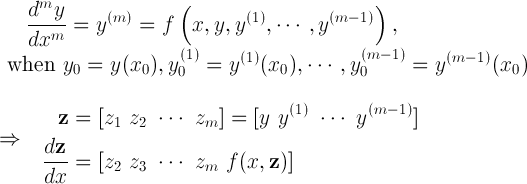 (17)
(17)
example)
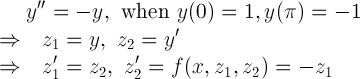 (21)
(21)
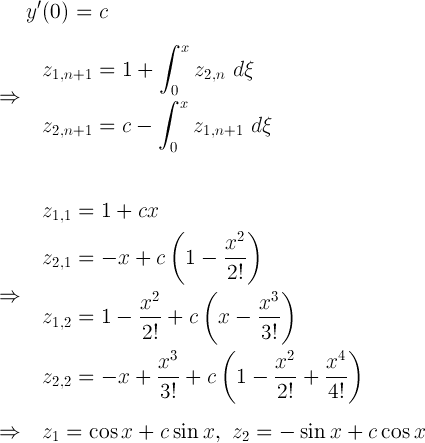 (22)
(22)
(http://ghebook.blogspot.ca/2011/10/differential-equation.html)I found that without n number of initial conditions, the solution will not be unique because we assume initial conditions are some arbitrary constants. (example 22)
If we do picard's iteration without any initial conditions,
y(n-1)=y0(n-1)+∫y(n)dx
y(n-2)=y0(n-2)+∫y(n-1)dx
=y(n-2)=y0(n-2)+∫y0(n-1)+∫y(n)dx
.
.
.
iteration goes on and on until the error is sufficiently decreased.
if we assume each initial conditions are some arbitrary constants, we can sort out the solution function y w.r.t constants after sufficient number of iteration is done. Then it will look like,
y (c0 c1 c2 - - - - - - )[y1 y2 y3 y4 y5 - - - - - - ] <-- (should be vertical)which is in the form of y = c1y1+c2y2+c3y3 . . .
Since function space is vector space, solutions span n dimensional vector space.
is this correct?
If not, how can we show that solution space has n number of basis?
Also, how are we sure that general solutions are 'always' linearly independent? ---------------------------------------------------------------------------------------------------------------------------
Also, I have two questions about Strum Liouville 2nd order ODE.1. if we look at the Strum-Liouville 2nd order ODEs, there is an eigenvalue term within the equation. it seems like we are introducing one more constant to the equation, which imposes a restriction to find a solution (n+1 constants with n initial conditions).
[m(x)y']'+[λr(x)-q(x)]y
=m(x)[y''+P(x)y'+Q(x)y]
=m(x)[y''+P(x)y'+(λr(x)-q(x))]
=0
∴ [y''+P(x)y'+(λr(x)-q(x))]=0
if we do Picard's iteration, then we have one more constant λ along with n constants..2. I don't understand how eigenvalue directly influence the solutions of 2nd order ODE
example)
(http://ghebook.blogspot.ca/2011/10/differential-equation.html)I found that without n number of initial conditions, the solution will not be unique because we assume initial conditions are some arbitrary constants. (example 22)
If we do picard's iteration without any initial conditions,
y(n-1)=y0(n-1)+∫y(n)dx
y(n-2)=y0(n-2)+∫y(n-1)dx
=y(n-2)=y0(n-2)+∫y0(n-1)+∫y(n)dx
.
.
.
iteration goes on and on until the error is sufficiently decreased.
if we assume each initial conditions are some arbitrary constants, we can sort out the solution function y w.r.t constants after sufficient number of iteration is done. Then it will look like,
y (c0 c1 c2 - - - - - - )[y1 y2 y3 y4 y5 - - - - - - ] <-- (should be vertical)which is in the form of y = c1y1+c2y2+c3y3 . . .
Since function space is vector space, solutions span n dimensional vector space.
is this correct?
If not, how can we show that solution space has n number of basis?
Also, how are we sure that general solutions are 'always' linearly independent? ---------------------------------------------------------------------------------------------------------------------------
Also, I have two questions about Strum Liouville 2nd order ODE.1. if we look at the Strum-Liouville 2nd order ODEs, there is an eigenvalue term within the equation. it seems like we are introducing one more constant to the equation, which imposes a restriction to find a solution (n+1 constants with n initial conditions).
[m(x)y']'+[λr(x)-q(x)]y
=m(x)[y''+P(x)y'+Q(x)y]
=m(x)[y''+P(x)y'+(λr(x)-q(x))]
=0
∴ [y''+P(x)y'+(λr(x)-q(x))]=0
if we do Picard's iteration, then we have one more constant λ along with n constants..2. I don't understand how eigenvalue directly influence the solutions of 2nd order ODE
Last edited: