Solve Circle Radius Given Trapezoid Height & Length

Join the discussion
Registration is free. Ask a follow-up in this thread, or start your own.
4 replies · 3K views
Jeppe1
Messages
2
Reaction score
0
I don't know if this can be calculated.
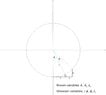
I have tried for hours and days to isolate/calculate the radius and angles of the circle in order to be able to calculate length 1. I have tried using cos/sin-relation formulas and triangle formas - but Iam stuck. Any hints would be greatly appreciated. The task is one i have put on my self for cutting out a wooden plate. I have made the cut - but by approximation :-)

View attachment 3333
 

Attachments

  • Can this be calculated.JPG
    Can this be calculated.JPG
    28.1 KB · Views: 154
Mathematics news on Phys.org
Hi Jeppe,

Unfortunately, without more information, the four unknowns cannot be determined.
 
Draw horizontal lines through the points where the lines $h_1$ and $h_2$ meet the circle. That will give you a pair of right-angled triangles. You can then use Pythagoras to get the equations $$(r-h_1)^2 + l_1^2 = r^2,$$ $$(r-h_2)^2 + (l_1+l_2)^2 = r^2.$$ After a bit of algebra (expanding those brackets), the equations reduce to $$h_1^2 - 2rh_1 + l_1^2 = 0,\qquad (*)$$ $$h_2^2 - 2rh_2 + l_1^2 + 2l_1l_2 + l_2^2.$$ Subtract the first of those equations from the second: $$h_2^2 - h_1^2 - 2r(h_2 - h_1) + 2l_1l_2 + l_2^2 = 0.$$ Solve that for $l_1$: $$l_1 = \frac{(h_2 - h_1)(2r - h_1 - h_2) - l_2^2}{2l_2}.$$ Substitute that expression for $l_1$ into the equation labelled (*) and you will have a quadratic equation (admittedly quite a messy one) for $r$ in terms of $h_1$, $h_2$ and $l_2$.

Edit (@Euge): I am assuming that the horizontal blue line is meant to be tangential to the circle. That should determine the configuration, shouldn't it?
 
Opalg said:
Edit (@Euge): I am assuming that the horizontal blue line is meant to be tangential to the circle. That should determine the configuration, shouldn't it?

Yes, in that case it does. We would then have $\tan \phi_1 = \frac{\ell_1}{r-h_1}$ and $\tan (\phi_1 + \phi_2) = \frac{\ell_1 + \ell_2}{r-h_2}$, so then

$$\tan \phi_2 = \frac{\tan (\phi_1 + \phi_2) - \tan \phi_1}{1 + \tan (\phi_1 + \phi_2) \tan \phi_1} = \frac{(r - h_2)\ell_1 - (r - h_1)(\ell_1 + \ell_2)}{(r - h_1)(r - h_2) + \ell_1(\ell_1 + \ell_2)}.$$

Since $r$ and $\ell_1$ have been determined, it now follows that the entire configuration is determined.
 
Wow - that was fast ! - I will get working on the quadratic!
Thanks and thanks again! - best forum and page ever :)