Solve Geometry Exercise - Who is Smart?

  • Thread starter Thread starter shirel
  • Start date Start date
  • Tags Tags
    Exercise Geometry
Click For Summary

Discussion Overview

The discussion revolves around a geometry exercise involving angles, triangles, and circle properties. Participants explore various proofs and approaches to solve the problem, including both geometric and analytic methods.

Discussion Character

  • Exploratory
  • Technical explanation
  • Debate/contested
  • Mathematical reasoning

Main Points Raised

  • Some participants express that the problem can be approached through different proofs, though the specifics are not universally agreed upon.
  • One participant argues that there is no relationship between certain lengths in the problem, suggesting that moving points does not affect others.
  • Another participant questions how to maintain certain angles while altering lengths, indicating a need for clarification on the geometric relationships involved.
  • Several participants discuss the identification of similar triangles, with one expressing difficulty in recognizing which triangles are similar.
  • One participant mentions a geometric proof involving the midpoint of a segment and proposes that proving this midpoint relationship simplifies the problem.
  • Another participant provides an analytic proof, detailing a coordinate system and equations to demonstrate the midpoint relationship and its implications for the problem.

Areas of Agreement / Disagreement

Participants do not reach a consensus on the best approach to the problem, with multiple competing views and methods presented. Some agree on certain geometric properties, while others challenge the relationships between the elements involved.

Contextual Notes

There are unresolved assumptions regarding the geometric configuration and the relationships between angles and lengths. The discussion includes references to specific angles and triangle congruence without full clarity on their implications.

shirel
Messages
38
Reaction score
0
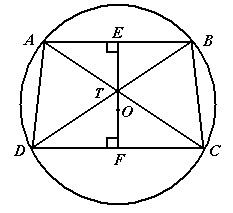
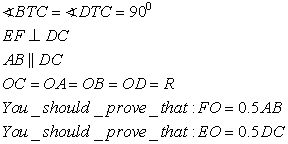
It is a nice question.
It has a few different kinds of proofes.

targil.gif

win.PNG


So who is smart here? :wink:
 
Last edited:
Mathematics news on Phys.org
While I don't claim to be 'smart', I am at least knowledgeable enough to recognize that this has nothing to do with "Tensor Analysis and Differential Geometry". I am moving this thread to "General Math".
 
Clearly, neither propositions is true. For example, you can lengthen EO by moving A and B up the circle a bit without changing DC. There's no relationship between them at all.
 
Moo Of Doom said:
Clearly, neither propositions is true. For example, you can lengthen EO by moving A and B up the circle a bit without changing DC. There's no relationship between them at all.

How do you do that, without changing angles BTC and DTC? (From the figure, I'm assuming ATC and BTD are straight lines, though it doesn't explicitly say that).

Proof: join A, B, C, D to O, then use the facts that a chord subtends equal angles at any point on the circumference, and the angle at the centre is twice the angle at the circumference, to get lots of similar triangles.
 
Thanks...
I just couldn't find which triangles are similar..
 
Last edited:
AlephZero said:
How do you do that, without changing angles BTC and DTC? (From the figure, I'm assuming ATC and BTD are straight lines, though it doesn't explicitly say that).

Haha, I read that ATC=BTD < 90 for some reason. I think all those angle symbols got me dyslexic. The picture didn't help correct this misreading.
 
shirel said:
Thanks...
I just couldn't find which triangles are similar..

See attachement.
1. The angle at the bottom right is 45 by symmetry (the angles at point T are 90).
2. The angle at the centre is twice 45 = 90.
3. The two angles [itex]\alpha[/itex] are equal
4 The two lengths are both [itex]R \sin \alpha[/itex] where R is the radius of the circle.
 

Attachments

  • geom.gif
    geom.gif
    3.8 KB · Views: 523
I haven't seen alephzero's solution yet because it's still "pending approval".

I looked at this problem and realized that if you can prove that the mid point of OT is also the mid-point of EF then the rest was trivial. But then I couldn't seem to see an easy geometric proof for that mid-point result. I did however find a very easy analytic proof of this.
 
What happened to that Aleph's attachment, it seems to have spent a very long time (several days) "pending approval.

Anyway I may as well post my non-geometric proof.

Lets assume we have already done the basics and shown that angle ATE equals angle BTE equals 45 degrees. (Radius bisects chord therefore triangles ATE and BTE are congruent etc).

1. Take a coordinate reference at "O", with x-axis parallel to AB.

2. Denote the distance OT as a. The midpoint of OT is clearly (0,a/2).

3. The system is similar to one with circle having equation x^2 + y^2 = 1 and line DE having equation y = x + a.

4. The coordinates of "D" and "E" are therefore given by the simultaneous solutions of equation set :

x^2 + y^2 = 1 and y = x + a

5. Solving the above for "y" gives :

y^2 - ay - (1- a^2)/2 = 0

y1, y2 = a/2 +/- sqrt(...)

6. Clearly (y1+y1)/2 = a/2, so the midpoint of OT is coincident with the midpoint of EF.

That's pretty much it. From there it's fairly trivial to show that length OF equals length ET equals one half of length AB.
 
Last edited:

Similar threads

  • · Replies 10 ·
Replies
10
Views
2K
  • · Replies 2 ·
Replies
2
Views
3K
  • · Replies 10 ·
Replies
10
Views
2K
  • · Replies 30 ·
2
Replies
30
Views
11K
  • · Replies 14 ·
Replies
14
Views
4K
  • · Replies 11 ·
Replies
11
Views
4K
  • · Replies 1 ·
Replies
1
Views
2K
Replies
1
Views
2K
  • · Replies 12 ·
Replies
12
Views
3K
  • · Replies 8 ·
Replies
8
Views
3K