Discussion Overview
The discussion revolves around a combinatorial problem involving handshakes at a party attended by n couples. Participants explore how many handshakes occur when each person shakes hands with everyone except their partner, seeking to derive a general formula for the total number of handshakes exchanged.
Discussion Character
- Exploratory
- Mathematical reasoning
- Homework-related
Main Points Raised
- One participant asks for help with the problem of counting handshakes at a party with n couples, specifying that no one shakes hands with their partner.
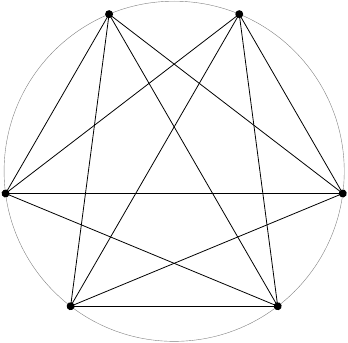
- Another participant provides a specific example with 3 couples and inquires about the total number of handshakes and how to generalize the findings.
- Some participants calculate that each person shakes hands with 4 others and propose a method to find the total number of handshakes, suggesting a formula of 6 x 4 / 2 = 12 for the example given.
- A participant proposes a formula of \(\frac{n\cdot (n-2)}{2}\) for the number of handshakes, where n represents the number of persons at the party.
- Another participant corrects the previous statement, clarifying that n should represent the number of couples, leading to a revised formula of \(\frac{2n\cdot (2n-2)}{2}\) for the number of handshakes.
Areas of Agreement / Disagreement
Participants express differing views on the correct formula for calculating handshakes, with some proposing \(\frac{n\cdot (n-2)}{2}\) and others suggesting \(\frac{2n\cdot (2n-2)}{2}\). The discussion remains unresolved regarding which formula is correct.
Contextual Notes
There is a potential confusion regarding the definitions of n, whether it refers to the number of persons or the number of couples, which affects the formulation of the handshake count.