Solving Force Analysis: Understanding Vertical and Horizontal Forces

  • Thread starter Thread starter GBE111
  • Start date Start date
  • Tags Tags
    Analysis Force
Click For Summary
To determine the horizontal force (Fx) from a vertical force (Fy) acting on a bracket, one must analyze the torque about the pivot point, ensuring the net torque equals zero for a static object. The relationship between torque and force is established by the equation torque = force x distance, allowing for the calculation of force as force = torque/distance. The discussion emphasizes the importance of resolving total torque based on the dimensions and applied forces in the system. It highlights that the pivot point cannot apply torque itself, complicating the force analysis. Understanding these principles is crucial for accurately translating vertical forces into horizontal forces in rigid body mechanics.
GBE111
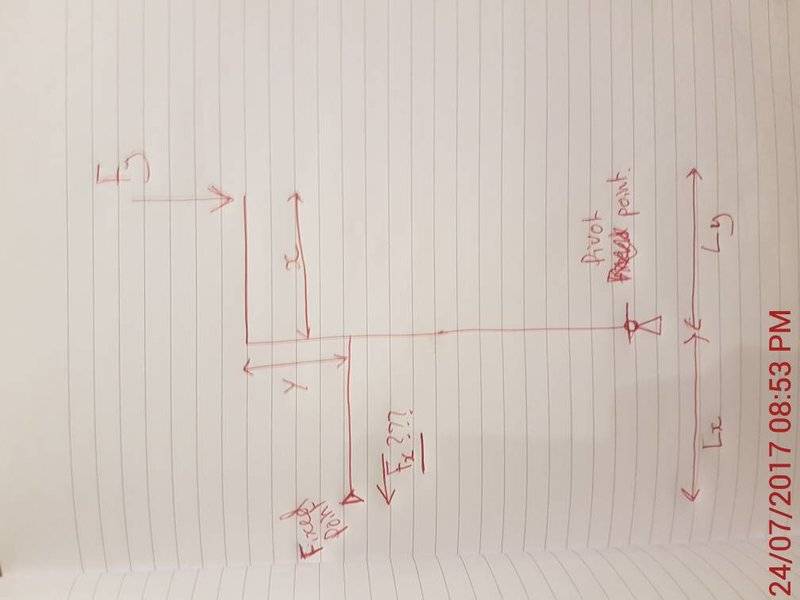
Hi, I'm trying to figure out the forces Fx in the drawing I have uploaded. If I have a vertical force Fy acting on the bracket I have drawn. I know from experience that this force is going to pull my bracket horizontally but I can't figure out how I work out a horizontal force from a vertical one? Please help??
20170724_205348.jpg
 
Engineering news on Phys.org
Since you're dealing with a rigid body with one pivot point you will want to resolve the total torque about the pivot. These will be functions of the dimensional parameters and the applied forces. Since the object is static the net torque is zero.
 
  • Like
Likes Dr.D
GBE111 said:
Hi, I'm trying to figure out the forces Fx in the drawing I have uploaded. If I have a vertical force Fy acting on the bracket I have drawn. I know from experience that this force is going to pull my bracket horizontally but I can't figure out how I work out a horizontal force from a vertical one? Please help??

View attachment 207735
 
Can I translate the torque into force? As the fixings I have at Fx are rated in kN?
 
The problem with working with forces is that there are more unknown forces than force equations since the pivot point is applying a force. However the pivot point cannot apply a torque about itself by the nature of it being a pivot point. Now your diagram does not show the total length in the y direction but calling that L, the total torque (which adds to 0) is (taking the CCW direction as positive) (and as I read the diagram):
0 = F_x \cdot (L-y) - F_y \cdot x
and the units assuming distances are in meters is kNm as you indicated the forces are give in kiloNewtons.

A Torque times the perpendicular distance off center by which it acts. In a more general setting one can express it in terms of cross products but units will end up being force times distance.
 
GBE111 said:
Can I translate the torque into force?
Yes.
torque = force x distance, so force = torque/distance
The distance being the distance from the pivot, perpendicular to the line of action of the force.
Examples below. (Lxd is the torque caused by the load.)

bracket.png
 
Had my central air system checked when it sortta wasn't working. I guess I hadn't replaced the filter. Guy suggested I might want to get a UV filter accessory. He said it would "kill bugs and particulates". I know UV can kill the former, not sure how he thinks it's gonna murder the latter. Now I'm finding out there's more than one type of UV filter: one for the air flow and one for the coil. He was suggesting we might get one for the air flow, but now we'll have to change the bulb...

Similar threads

  • · Replies 3 ·
Replies
3
Views
4K
  • · Replies 4 ·
Replies
4
Views
5K
  • · Replies 11 ·
Replies
11
Views
3K
  • · Replies 3 ·
Replies
3
Views
2K
  • · Replies 7 ·
Replies
7
Views
910
  • · Replies 36 ·
2
Replies
36
Views
4K
Replies
4
Views
2K
  • · Replies 13 ·
Replies
13
Views
2K
  • · Replies 28 ·
Replies
28
Views
2K
Replies
3
Views
1K