Solving Max Distance Between Supports for 2m Beam w/ Yield & Tensile Strengths

Click For Summary
SUMMARY

The forum discussion centers on calculating the maximum distance between supports for a 2m beam with specific yield and tensile strengths. The user, Nemo, initially calculated deflection using the formula $$Maximum Deflection = \frac{wl^{3}}{48EI}$$ and later derived the maximum distance between supports using the flexural strength formula $$\sigma_{fs}=\frac{3F_{f}L}{2bd^{2}}$$. With a yield stress of 40 MPa and a safety factor of two, Nemo determined that the maximum distance between supports is approximately 234.86 mm. This calculation incorporates the beam's dimensions and the applied load of 10 kg.

PREREQUISITES
  • Understanding of beam mechanics and deflection calculations
  • Familiarity with flexural strength and bending stress formulas
  • Knowledge of material properties such as yield stress and tensile strength
  • Basic proficiency in algebra for solving equations
NEXT STEPS
  • Study the derivation of bending stress formulas in beam theory
  • Learn about the relationship between yield stress and safety factors in structural engineering
  • Explore the application of Young's Modulus in deflection calculations
  • Investigate different cross-sectional shapes and their impact on moment of inertia
USEFUL FOR

Structural engineers, mechanical engineers, and students studying material mechanics will benefit from this discussion, particularly those focused on beam design and load calculations.

Nemo1
Messages
62
Reaction score
0
Hi Community,

I have this question which I have been able to partially answer.
Part 1: From samples, we measured the Flexure Modulus of a material and was asked to solve for the deflection of the material at a $1m$ span and $1kg$ which I used $$Maximum Deflection = \frac{wl^{3}}{48EI}$$
$W$ $=$ $weight$ $in$ $Kg$ $times$ $9.81mm/s^2$, $l$ $=$ $length$, $E$ $=$ $Flexure$ $Modulus$ & $I$ $=$ $Moment$ $of$ $inertia$

This bit I get:)

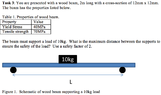
The next question has me stumped:confused:; Given a beam $2m$ long with a cross section of 12x12mm with a yield stress of $40MPa$ and a tensile Strength of $70MPa$ with a safety factor of two what is the maximum distance between the supports?

I am after a pointer in the right direction, can I somehow derive the formula above to solve?

Cheer Nemo.
 
Mathematics news on Phys.org
Nemo said:
Hi Community,

I have this question which I have been able to partially answer.
Part 1: From samples, we measured the Flexure Modulus of a material and was asked to solve for the deflection of the material at a $1m$ span and $1kg$ which I used $$Maximum Deflection = \frac{wl^{3}}{48EI}$$
$W$ $=$ $weight$ $in$ $Kg$ $times$ $9.81mm/s^2$, $l$ $=$ $length$, $E$ $=$ $Flexure$ $Modulus$ & $I$ $=$ $Moment$ $of$ $inertia$

This bit I get:)

The next question has me stumped:confused:; Given a beam $2m$ long with a cross section of 12x12mm with a yield stress of $40MPa$ and a tensile Strength of $70MPa$ with a safety factor of two what is the maximum distance between the supports?

I am after a pointer in the right direction, can I somehow derive the formula above to solve?

Cheer Nemo.

Hi Nemo! ;)

It seems some information is missing.
To figure out any boundaries, we need to know the expected load (or point force) on the beam.
Is that given? (Wondering)
 
Yes, sorry, it was ten Kilograms as the load.

Cheers Nemo
 
Nemo said:
Yes, sorry, it was ten Kilograms as the load.

Cheers Nemo

With a yield stress of $40 \text{ MPa}$, it takes a force of $40\text{ MPa} \times (12\text{ mm})^2 = 5760\text{ N}$ before permanent deformation occurs.
That corresponds to $576\text{ kg}$.

A point load of $10 \text{ kg}$ is nowhere near.
Something is missing here. (Worried)
 
I like Serena said:
With a yield stress of $40 \text{ MPa}$, it takes a force of $40\text{ MPa} \times (12\text{ mm})^2 = 5760\text{ N}$ before permanent deformation occurs.
That corresponds to $576\text{ kg}$.

A point load of $10 \text{ kg}$ is nowhere near.
Something is missing here. (Worried)

This is the question:
View attachment 5589

I have been able to find the safety factor by:
$$\sigma_{w}=\frac{\sigma_{y}}{n}=\frac{40MPa}{2}=20MPa$$

I looked at trying to find the Young's Modulus from the tensile and yield stress given via the secant modulus, but I don't think that is the right approach.

If I had the Young's Modulus then I would use $$Maximum$ $Deflection=\frac{Wl^{3}}{48EI}$$ Formula and set the deflection to $0$ and solve for the length $l$.

Here is where I am confused, there must be a method to solve using only the information shown.

P.s. Many thanks for your help so far Serena.:D

Cheers Nemo
 

Attachments

  • Screen Shot 2016-05-16 at 8.23.31 PM.png
    Screen Shot 2016-05-16 at 8.23.31 PM.png
    25 KB · Views: 136
Nemo said:
This is the question:I have been able to find the safety factor by:
$$\sigma_{w}=\frac{\sigma_{y}}{n}=\frac{40MPa}{2}=20MPa$$

I looked at trying to find the Young's Modulus from the tensile and yield stress given via the secant modulus, but I don't think that is the right approach.

If I had the Young's Modulus then I would use $$Maximum$ $Deflection=\frac{Wl^{3}}{48EI}$$ Formula and set the deflection to $0$ and solve for the length $l$.

Here is where I am confused, there must be a method to solve using only the information shown.

P.s. Many thanks for your help so far Serena.:D

Cheers Nemo

You should have a formula for the bending stress $\sigma_{bend}$ in a beam.
Can you find one?

It should be something like:
$$\sigma_{bend} = \frac{M}{S}$$
where $M$ is the moment in the beam, and $S$ depends on the profile of the beam.

The maximum moment in a beam under a point load $W$ in the center is:
$$M_{max} = \frac{WL}{4}$$
where $L$ is the length of the beam.

For a rectangular beam, as we have here, we have:
$$S = \frac{bh^2}{6}$$
where $b$ is the width of the beam and $h$ is the height of the beam.
 
So I think I have solved this:

Using the flexural Strength Formula:

$$\sigma_{fs}=\frac{3F_{f}L}{2bd^{2}}$$

I was able to then plugin my numbers and solve for $L$

$$20=\frac{3 \cdot 10 \cdot 9.81 \cdot L}{2 \cdot 12 \cdot 12^{2}}$$

$$L=\frac{25600}{109}=234.8623853mm$$ which is the distance they have to be apart.

Thanks again for your help Serena.

Cheers Nemo
 
Nemo said:
So I think I have solved this:

Using the flexural Strength Formula:

$$\sigma_{fs}=\frac{3F_{f}L}{2bd^{2}}$$

I was able to then plugin my numbers and solve for $L$

$$20=\frac{3 \cdot 10 \cdot 9.81 \cdot L}{2 \cdot 12 \cdot 12^{2}}$$

$$L=\frac{25600}{109}=234.8623853mm$$ which is the distance they have to be apart.

Thanks again for your help Serena.

Cheers Nemo

Yep. That's the correct formula and it matches what I wrote. (Nod)
 

Similar threads

  • · Replies 4 ·
Replies
4
Views
2K
  • · Replies 8 ·
Replies
8
Views
2K
  • · Replies 5 ·
Replies
5
Views
3K
  • · Replies 1 ·
Replies
1
Views
7K
Replies
19
Views
34K
  • · Replies 6 ·
Replies
6
Views
15K
  • · Replies 2 ·
Replies
2
Views
20K
  • · Replies 12 ·
Replies
12
Views
41K
Replies
4
Views
4K
Replies
20
Views
14K