Solving Space Junk Momentum Problem

  • Thread starter Thread starter quickclick330
  • Start date Start date
  • Tags Tags
    Space
Click For Summary
SUMMARY

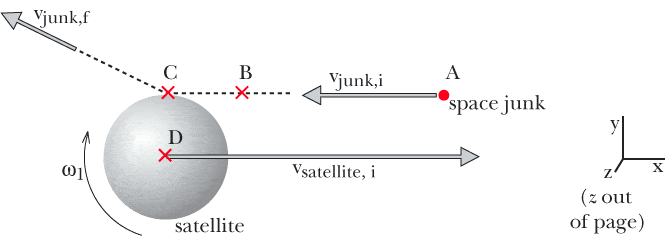
The discussion centers on calculating the final momentum of a spherical satellite after a collision with a piece of space junk. The satellite, with a radius of 4.7 m and mass of 195 kg, initially moves at a velocity of < 2700, 0, 0 > m/s, while the space junk, weighing 4.1 kg, approaches at < -2100, 0, 0 > m/s. Post-collision, the space junk moves at < -1200, 490, 0 > m/s. The conservation of momentum and energy principles are essential for solving the problem, leading to the equations necessary for determining the final velocities and angular momentum.

PREREQUISITES
  • Understanding of conservation of momentum and energy principles
  • Familiarity with vector mathematics in physics
  • Knowledge of angular momentum calculations
  • Ability to solve systems of equations
NEXT STEPS
  • Study the conservation of momentum in elastic and inelastic collisions
  • Learn about angular momentum and its conservation in rotational systems
  • Explore vector decomposition techniques for momentum calculations
  • Practice solving complex collision problems using numerical methods
USEFUL FOR

Physics students, aerospace engineers, and professionals involved in satellite dynamics and collision analysis will benefit from this discussion.

quickclick330
Messages
82
Reaction score
0
A spherical satellite of radius 4.7 m and mass M = 195 kg is originally moving with velocity = < 2700, 0, 0 > m/s, and is originally rotating with an angular speed = 2 radians/second, in the direction shown in the diagram. A small piece of space junk of mass m = 4.1 kg is initially moving toward the satellite with velocity= < -2100, 0, 0 > m/s. The space junk hits the edge of the satellite at location C as shown in the diagram, and moves off with a new velocity = < -1200, 490, 0 > m/s. Both before and after the collision, the rotation of the space junk is negligible.
32814.gif

MOMENTUM
After the collision, what is the final momentum of the satellite?

i tried this...

system: junk and satellite

so pf = pi

pjunk-f + psat-f = pjunk-i + psat-i

psat-f = (pjunk-i + psat-i)/ pjunk-f
= ((mjunk*vjunk-i) + (msat*vsat-i))/ (mjunk*vjunk-f)

= ((4.1 kg *<-2100,0,0> m/s) + (195 kg * <2700, 0 0> m/s))/ (<-1200, 490,0> m/s * 4.1 kg)

= <-437, 0 , 0>what am i missing/doing wrong? thanks!
 
Physics news on Phys.org
Here you have to use conservation of momentum and energy. You can wright three equations.
1) MsVsi -MjVji = MsVsf*cos(theta1) - MjVjf*cos(theta2){ x-components of momentums]
2) MsVsf*sin(theta1) = MjVjf*sin(theta2) [y-components of momentums]
3) 1/2*MsVsi^2 + 1/2*Is*wsi^2 + 1/2*MjVji^2 = 1/2*MsVsf^2 + 1/2*Is*wf^2 +1/2*MjVjf^2. [ conservation of energy]
In this we know Ms, Mj, Vsi , Vji , wsi and (theta2). Now we have to find Vsf, Vjf, Wsf and (theta1). Can you try further?
 
Last edited:
Are you not interested in this problem? Realy it is a very good porblem. If you find it difficult to do all these calculations at a stretch, do in steps. If you stuck up take help.
 

Similar threads

  • · Replies 2 ·
Replies
2
Views
2K
  • · Replies 1 ·
Replies
1
Views
10K
Replies
2
Views
8K
Replies
7
Views
2K
  • · Replies 13 ·
Replies
13
Views
1K
  • · Replies 42 ·
2
Replies
42
Views
6K
  • · Replies 6 ·
Replies
6
Views
3K
  • · Replies 9 ·
Replies
9
Views
4K
  • · Replies 17 ·
Replies
17
Views
1K
Replies
1
Views
2K