Solving the Liquid Density Puzzle

Click For Summary

Homework Help Overview

The discussion revolves around a problem involving the density of a liquid and its relationship to cubes that are partially submerged. The original poster attempts to determine the dimensions and density of the cubes based on given mass and volume relationships.

Discussion Character

  • Exploratory, Assumption checking, Conceptual clarification

Approaches and Questions Raised

  • Participants explore the implications of Archimedes' principle regarding the density of the liquid and its relationship to the submerged cubes. Questions arise about the assumptions made in the original poster's calculations and whether there are alternative methods to approach the problem.

Discussion Status

Some participants have provided insights related to the principles of buoyancy and density, suggesting that the original poster's method of calculating total volume and mass may be valid. However, there is no explicit consensus on the best approach to solve the problem, and further exploration of assumptions is ongoing.

Contextual Notes

Participants note the importance of understanding the relationship between the submerged volume of the cubes and the density of the liquid, indicating that assumptions about the setup may need to be revisited.

Chewy0087
Messages
368
Reaction score
0
[Solved] Liquid Density Puzzle

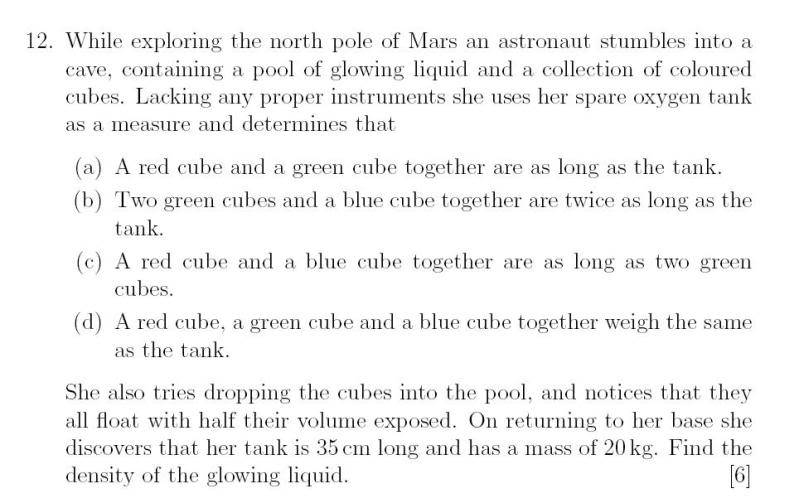
Homework Statement


physicsproblem.jpg


The Attempt at a Solution


I think there's an assumption here that I'm missing, firstly I worked out how big each cube was by setting up simple simultaneous equations which gave me;

Green = 0.21m Red = 0.14m & Blue = 0.28m

And also Green + Red + Blue = 20kg. From here I'm stuck, I've thought about putting them all together giving me a volume of;

21^3 * 10^-6 + 14^3 * 10^-6 + 28^3 * 10-^6
=9261 +10^-6 + 2744 *10^-6 + 21952 * 10^-6
= 33957 * 10^-6 = 3.3957 * 10^-2 m³

Giving them all a density of 20 / that, but I'm sure it's a dead end =|, can anyone else see a better way of doing this?/An assumption that I'm missing?

thanks a lot in advance.
 
Last edited:
Physics news on Phys.org
From Archimedes' principle, the fact that the cubes are all exactly half-submerged suggests that the glowing liquid is twice as dense as a cube. (Do you understand why?)
 
Hmmm, would that be because half of the volume of the cube of the liquid can support the whole of the cube? :O

However, even given that, how would you work the density of the cube out? Or still do it my way by putting them all together?

Thanks a bunch for the help >.< but i really need to understand this
 
Chewy0087 said:
Hmmm, would that be because half of the volume of the cube of the liquid can support the whole of the cube? :O

Yes. This conclusion follows directly from Archimedes' principle, which states that the volume of liquid displaced has a weight that is equal to the weight of the portion of the object submerged.

Chewy0087 said:
However, even given that, how would you work the density of the cube out? Or still do it my way by putting them all together?

Considering that you have the total mass and the total volume of the cubes, your method seems good. I can't think of a better way off the top of my head.
 
Thanks again, you rock :P
 

Similar threads

  • · Replies 13 ·
Replies
13
Views
8K
  • · Replies 14 ·
Replies
14
Views
3K
  • · Replies 9 ·
Replies
9
Views
4K
Replies
3
Views
2K
  • · Replies 1 ·
Replies
1
Views
6K
  • · Replies 2 ·
Replies
2
Views
2K
  • · Replies 5 ·
Replies
5
Views
7K
Replies
6
Views
2K
Replies
2
Views
13K
  • · Replies 5 ·
Replies
5
Views
2K