Solving the Representation of d/dq: Mistake in Reasoning?

  • Context: Undergrad 
  • Thread starter Thread starter Spin One
  • Start date Start date
  • Tags Tags
    Representation
Click For Summary
SUMMARY

The discussion centers on the representation of the derivative operator d/dq in quantum mechanics, specifically addressing a misunderstanding regarding the delta function and its derivative. The participant initially assumes that the derivative of the delta function behaves similarly to the delta function itself, leading to a contradiction in the canonical commutation relation pq - qp = iħ. The correct interpretation reveals that the derivative of the delta function, denoted as δ'(x), has distinct properties, specifically that it integrates to -f'(0) rather than f(0). This clarification resolves the initial confusion regarding the scalar matrix representation of d/dq.

PREREQUISITES
  • Understanding of quantum mechanics and operators, particularly the momentum operator iħd/dq.
  • Familiarity with the properties of the delta function and its derivative in distribution theory.
  • Knowledge of canonical coordinates and commutation relations in quantum mechanics.
  • Basic grasp of matrix representations in quantum mechanics.
NEXT STEPS
  • Study the properties of the delta function and its derivative in detail, focusing on distribution theory.
  • Explore the implications of canonical commutation relations in quantum mechanics.
  • Learn about matrix representations of operators in quantum mechanics, particularly in the context of position and momentum.
  • Investigate the role of generalized functions in quantum mechanics and their applications.
USEFUL FOR

Quantum mechanics students, physicists, and researchers interested in operator theory and the mathematical foundations of quantum mechanics.

Spin One
Messages
4
Reaction score
0
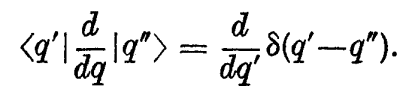
When considering the position representation of a system with one degree of freedom endowed with canonical co-ordinates and momenta q and p, Dirac deduces that:
upload_2018-8-22_9-43-41.png

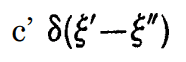
which is the representation of d/dq in "matrix" form. But the derivative of a delta function is, I assume (from the definition of the delta function), of the form
upload_2018-8-22_9-45-32.png
, with ξ' and ξ" interchanged for q' and q", since the gradient of the delta function will be 0 everywhere except at q'=q", where it will be undefined.
So the representation of d/dq is a scalar "matrix" in the q representation(from the definition)
But the momentum operator is just iħd/dq, meaning it is a scalar matrix too.
q is of course also a scalar matrix (since the representation is built upon it), and since scalar matrices commute, we get that:
pq-qp=0, which contradicts the quantum condition pq-qp=iħ.

There must be a mistake in my line of reasoning, and I would much appreciate it if someone can point it out.
 

Attachments

  • upload_2018-8-22_9-43-41.png
    upload_2018-8-22_9-43-41.png
    2.8 KB · Views: 776
  • upload_2018-8-22_9-45-32.png
    upload_2018-8-22_9-45-32.png
    1.3 KB · Views: 483
Physics news on Phys.org
Spin One said:
But the derivative of a delta function is, I assume (from the definition of the delta function), of the form
upload_2018-8-22_9-45-32-png.png
, with ξ' and ξ" interchanged for q' and q", since the gradient of the delta function will be 0 everywhere except at q'=q", where it will be undefined.
This is an incorrect assumption. The derivative of the delta distribution is different from the delta distribution itself. Instead of having the property
$$
\int f(x) \delta(x) dx = f(0)
$$
as the delta distribution, it has the property
$$
\int f(x) \delta'(x) dx = - \int f'(x) \delta(x) dx = -f'(0).
$$
 

Attachments

  • upload_2018-8-22_9-45-32-png.png
    upload_2018-8-22_9-45-32-png.png
    1.3 KB · Views: 409
  • Like
Likes   Reactions: bhobba
Orodruin said:
This is an incorrect assumption. The derivative of the delta distribution is different from the delta distribution itself. Instead of having the property
$$
\int f(x) \delta(x) dx = f(0)
$$
as the delta distribution, it has the property
$$
\int f(x) \delta'(x) dx = - \int f'(x) \delta(x) dx = -f'(0).
$$
Oh ok, thanks! I see now how my intuition was wrong, since taking the δ function in the sense of a limit of a proper function, the derivative must be 0 at δ(0), +∞ at δ(-ε) and -∞ at δ(+ε). In that case, will the representation of d/dq be a "matrix" (of the generalized kind) with only two diagonals just above and just below the main diagonal having a non-zero value?
 
Last edited:

Similar threads

  • · Replies 19 ·
Replies
19
Views
3K
  • · Replies 3 ·
Replies
3
Views
2K
  • · Replies 19 ·
Replies
19
Views
4K
  • · Replies 5 ·
Replies
5
Views
4K
  • · Replies 4 ·
Replies
4
Views
3K
  • · Replies 1 ·
Replies
1
Views
2K
  • · Replies 9 ·
Replies
9
Views
4K
  • · Replies 12 ·
Replies
12
Views
4K
  • · Replies 14 ·
Replies
14
Views
19K
  • · Replies 7 ·
Replies
7
Views
4K