Solving word problems using derivatives

  • Context: Undergrad 
  • Thread starter Thread starter Danatron
  • Start date Start date
  • Tags Tags
    Derivatives
Click For Summary

Discussion Overview

The discussion revolves around solving word problems using derivatives, particularly in the context of calculus and its applications in physics. Participants explore various aspects of understanding derivatives, their applications in motion problems, and study strategies for exam preparation.

Discussion Character

  • Homework-related
  • Technical explanation
  • Conceptual clarification

Main Points Raised

  • One participant seeks guidance on study materials for calculus problems, expressing confusion over the subject matter.
  • Another participant suggests that typical first-year undergraduate calculus textbooks cover applications of derivatives, specifically mentioning the use of the first derivative to find maximum values in motion problems.
  • A participant questions which aspect of the problem is most challenging for the original poster, suggesting that understanding the question, the mathematics, or the physical intuition could be the source of difficulty.
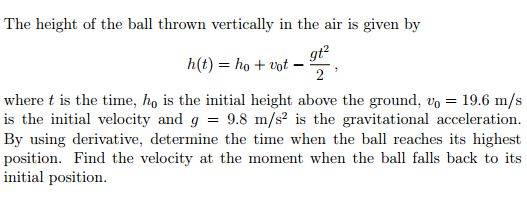
  • It is noted that the derivative of the height function h(t) represents velocity, which can be used to determine when the object reaches the ground.
  • Discussion includes a question about differentiating a term (h0) using the chain rule, with a response clarifying that h0 and v0 are constants, and the independent variable is time (t).
  • Another participant emphasizes the relationship between position, velocity, and acceleration functions, suggesting that understanding these concepts is essential for solving related problems.

Areas of Agreement / Disagreement

Participants generally agree on the importance of understanding derivatives and their applications in physics problems. However, there is no consensus on specific study materials or methods, as individual needs and difficulties vary.

Contextual Notes

Participants express varying levels of understanding regarding calculus concepts and their applications, indicating potential gaps in foundational knowledge or study resources. The discussion reflects a range of approaches to learning and problem-solving in calculus and physics.

Danatron
Messages
25
Reaction score
0
Hi Guys,

I am revising for an exam i have this week, the last module on my subject was calculus. I did not understand it entirely.

I have posted a pic below of a typical problem i can expect to encounter, would anybody be able to point me in the right direction to study material that could teach me how to solve problems like this? my lecture is very vague and study material even vaguer.
XoDC2Jj.jpg
 
Physics news on Phys.org
Applications of derivatives, found in typical first-year undergraduate Calculus textbooks. h(t) takes the shape (as a cartesian graph) of a parabola with vertex as a maximum. The positive root will be the time when the ball reaches the ground. You can use the first derivative of h, equate this derivative to zero, solve this for t, and that is the time when h is the maximum.
 
Which part of the problem is most difficult to you? Conceptually understanding what the question is asking? Or is it the math? Or is it the physical intuition?

The best way to study for exams is different for everybody. It's hard to point you in the direction of the study material if I don't know what you want to study. Do you want to study calculus (how to take derivatives, etc.)? Or do you want to study kinematics?

It might be useful to just find some books with a lot of practice problems similar in difficulty to the ones you will encounter. Have you tried working through the problems in your textbook? Usually introductory physics textbooks will have a lot of practice problems you can do.
 
  • Like
Likes   Reactions: 1 person
Also note that dh/dt is a velocity function, so you can use it to determine the velocity for when t is the positive root (meaning, the ball hits the ground).
 
symbolipoint said:
Also note that dh/dt is a velocity function, so you can use it to determine the velocity for when t is the positive root (meaning, the ball hits the ground).

How to differentiate that h0 term? Chain rule?
 
You want to find the relative maximum, a value of t where the derivative of the position function is equal to zero, and the second derivative is negative, then, as mentioned, determine the value of h(t) just before it reaches the positive zero.
 
Arka420 said:
How to differentiate that h0 term? Chain rule?

h[itex]_{0}[/itex] and v[itex]_{0}[/itex] are just constants; the independent variable in the equation is t.
 
Reember that h (t)= s (t) this is called the position function.

The derivative h`(t)=v (t) this is called the velocity function

The derivative of h'(t) is h''(t) where h''(t)=a (t) this is called the acceleration function.


Use all 3 functions to solve specific given statements. Understand what it means by position, velocity, and acceleration.
 

Similar threads

  • · Replies 17 ·
Replies
17
Views
2K
  • · Replies 13 ·
Replies
13
Views
3K
  • · Replies 5 ·
Replies
5
Views
2K
  • · Replies 6 ·
Replies
6
Views
1K
  • · Replies 19 ·
Replies
19
Views
5K
  • · Replies 1 ·
Replies
1
Views
2K
  • · Replies 7 ·
Replies
7
Views
4K
  • · Replies 7 ·
Replies
7
Views
3K
  • · Replies 0 ·
Replies
0
Views
1K
  • · Replies 27 ·
Replies
27
Views
2K