Some questions about bases and the decimal system.

  • Context: Undergrad 
  • Thread starter Thread starter Logical Dog
  • Start date Start date
  • Tags Tags
    Bases System
Click For Summary

Discussion Overview

The discussion revolves around the understanding of number representation in the decimal system, particularly focusing on the concept of bases, the process of converting numbers between bases, and the implications of division in this context. Participants express confusion regarding the relationship between base representation and division, as well as the significance of coefficients in base notation.

Discussion Character

  • Exploratory
  • Conceptual clarification
  • Debate/contested

Main Points Raised

  • Some participants express confusion about the number of digits in the decimal system, with one noting that there are 10 digits, including 0.
  • Participants discuss the concept that when using a base between 1-10, new digits are not needed, and question whether coefficients must be less than the base.
  • There is uncertainty about the process of dividing numbers and converting them to other bases, with one participant recalling that 372 expressed in base 10 can be represented as a sum of powers of 10.
  • Some participants question the purpose of dividing a number already expressed in base 10, leading to discussions about the meaning of coefficients as remainders in division.
  • One participant suggests that the book could have used a simpler representation, such as repeated addition, to illustrate the concept of base 10.
  • Another participant introduces base-16 and base-64 as examples of other bases, noting their respective digits.
  • There is a mention of the specific digits used in base-64, with some participants providing a list of characters used in this base.

Areas of Agreement / Disagreement

Participants generally express confusion and uncertainty about the concepts discussed, with no clear consensus reached on the purpose of division in base representation or the best way to illustrate these concepts.

Contextual Notes

Some participants highlight limitations in understanding the relationship between division and base representation, as well as the potential for misunderstanding the significance of coefficients in different bases.

Logical Dog
Messages
362
Reaction score
97
Hello.

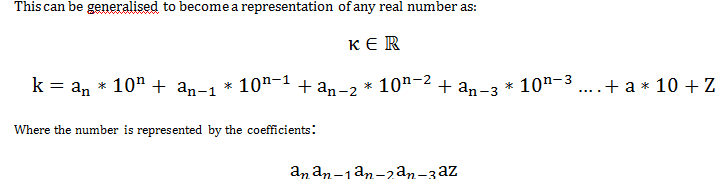
This is how every number in the decimal system is expressed:
imejYaS.png


I had understood this topic earlier but as I was revising it today I have become confused somewhat.

I know that for the decimal system, we have 9 digits.

ub4RD54.png


I understand this:

- When we use a base between 1-10, we do not need to come up with new digits.

- in the illustration one above, if the base is x, the coefficient a can only be less than x? Am I correct?

- I am confused as to how to divide numbers and change them to other bases, I seem to have forgotten basic division.

I understand 372 expressed in base 10 is 3*10*10 +7*10 + 2

But what I don't get is this, 372 is already expressed in base 10 when we divide it by 10?

I am really confused. All numbers are intuitively expressed in base 10 before we convert them to other bases..but division by the same base in the same form seems to give the same number.
 
Physics news on Phys.org
in the book I am using there is an example using 372, the author divides by 10 to reinforce the point about how the coefficients a an-1 an-2 are also the remainders of succcesful division.

But, 372 is already expressed in base 10 form when he divides, so, what is the point>
 
Bipolar Demon said:
in the book I am using there is an example using 372, the author divides by 10 to reinforce the point about how the coefficients a an-1 an-2 are also the remainders of succcesful division.

But, 372 is already expressed in base 10 form when he divides, so, what is the point>
The point is to illustrate what base 10 means - the expression as the sum of powers of 10.
 
  • Like
Likes   Reactions: Logical Dog
Instead of 372, the book could have used 1+1+1+1+1+1+1+1+1+1+1+1+1+1+1+1+1+1+1+1+1+1+1+1+1+1+1+1+1+1+1+1+1+1+1+1+1+1+1+1+1+1+1+1+1+1+1+1+1+1+1+1+1+1+1+1+1+1+1+1+1+1+1+1+1+1+1+1+1+1+1+1+1+1+1+1+1+1+1+1+1+1+1+1+1+1+1+1+1+1+1+1+1+1+1+1+1+1+1+1+1+1+1+1+1+1+1+1+1+1+1+1+1+1+1+1+1+1+1+1+1+1+1+1+1+1+1+1+1+1+1+1+1+1+1+1+1+1+1+1+1+1+1+1+1+1+1+1+1+1+1+1+1+1+1+1+1+1+1+1+1+1+1+1+1+1+1+1+1+1+1+1+1+1+1+1+1+1+1+1+1+1+1+1+1+1+1+1+1+1+1+1+1+1+1+1+1+1+1+1+1+1+1+1+1+1+1+1+1+1+1+1+1+1+1+1+1+1+1+1+1+1+1+1+1+1+1+1+1+1+1+1+1+1+1+1+1+1+1+1+1+1+1+1+1+1+1+1+1+1+1+1+1+1+1+1+1+1+1+1+1+1+1+1+1+1+1+1+1+1+1+1+1+1+1+1+1+1+1+1+1+1+1+1+1+1+1+1+1+1+1+1+1+1+1+1+1+1+1+1+1+1+1+1+1+1+1+1+1+1+1+1+1+1+1+1+1+1+1+1+1+1+1+1+1+1+1+1+1+1+1+1+1+1+1+1+1+1+1+1+1+1+1+1+1+1+1+1+1+1+1+1+1+1+1+1+1+1+1+1+1+1+1+1+1+1+1+1+1+1+1+1 everywhere. This representation works in every base, but I think the problem is obvious. It is easier to write "372" (using the decimal system) even if the topic is about the meaning of this chain of symbols.
 
  • Like
Likes   Reactions: Logical Dog
Bipolar Demon said:
Hello.

This is how every number in the decimal system is expressed:
imejYaS.png


I had understood this topic earlier but as I was revising it today I have become confused somewhat.

I know that for the decimal system, we have 9 digits.
ub4RD54.png
Not quite -- there are 10 digits. Don't forget that 0 is a digit.
Bipolar Demon said:
I understand this:

- When we use a base between 1-10, we do not need to come up with new digits.

- in the illustration one above, if the base is x, the coefficient a can only be less than x? Am I correct?
Yes. Another base that is commonly used in computer programming, is base-16, or hexadecimal. In this base, there are 16 digits: 0, 1, 2, 3, 4, 5, 6, 7, 8, 9, A, B, C, D, E, and F.

Another base that is used on the web is base-64, which has 64 digits. I won't list these because I don't know them offhand.
Bipolar Demon said:
- I am confused as to how to divide numbers and change them to other bases, I seem to have forgotten basic division.

I understand 372 expressed in base 10 is 3*10*10 +7*10 + 2

But what I don't get is this, 372 is already expressed in base 10 when we divide it by 10?

I am really confused. All numbers are intuitively expressed in base 10 before we convert them to other bases..but division by the same base in the same form seems to give the same number.
?
If you divide 372 by 10, you get 37 plus a remainder of 2. That's not the same as 372.
Maybe what you're thinking is how you can "peel off" the digits by dividing by the base.
372 / 10 is 37 with remainder 2
37 /10 is 3 with remainder 7
3/10 is 0 with remainder 3
The remainders, in reverse order, are 3 ... 7... 2
 
  • Like
Likes   Reactions: Igael and Logical Dog
Mark44 said:
Another base that is used on the web is base-64, which has 64 digits. I won't list these because I don't know them offhand.
A-Z, a-z, 0-9, '+' and '/'.
 
mfb said:
Instead of 372, the book could have used 1+1+1+1+1+1+1+1+1+1+1+1+1+1+1+1+1+1+1+1+1+1+1+1+1+1+1+1+1+1+1+1+1+1+1+1+1+1+1+1+1+1+1+1+1+1+1+1+1+1+1+1+1+1+1+1+1+1+1+1+1+1+1+1.

Mark44 said:
With regard to '+' and '/' as the digits with indexes 62 and 63, not necessarily. See https://en.wikipedia.org/wiki/Base64#Variants_summary_table

mathman said:
The point is to illustrate what base 10 means - the expression as the sum of powers of 10.

Ok, thanks.
 

Similar threads

  • · Replies 1 ·
Replies
1
Views
1K
  • · Replies 5 ·
Replies
5
Views
3K
  • · Replies 13 ·
Replies
13
Views
3K
  • · Replies 4 ·
Replies
4
Views
2K
  • · Replies 3 ·
Replies
3
Views
1K
  • · Replies 53 ·
2
Replies
53
Views
4K
  • · Replies 22 ·
Replies
22
Views
2K
Replies
4
Views
2K
  • · Replies 2 ·
Replies
2
Views
2K
Replies
9
Views
4K