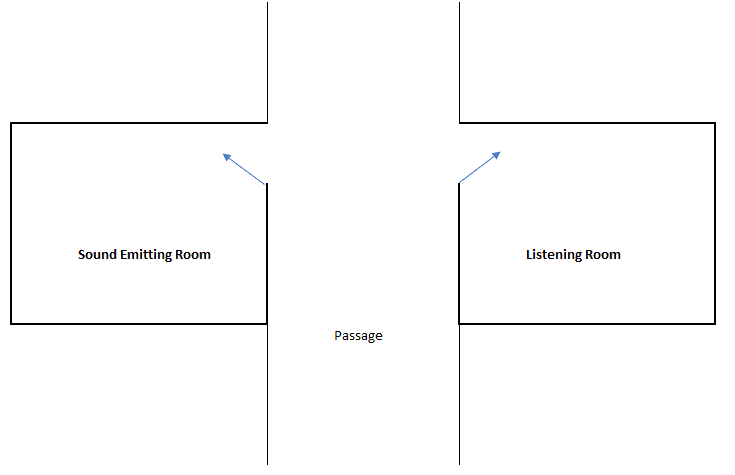
Discussion Overview
The discussion revolves around the effects of closing doors in two identical rooms on the audibility of sound emitted from one room to another. Participants explore the implications of door closure on sound transmission, considering theoretical and practical aspects of sound propagation and reciprocity principles.
Discussion Character
- Exploratory
- Technical explanation
- Debate/contested
- Mathematical reasoning
Main Points Raised
- Some participants propose that closing the door of the listening room would have a greater effect on sound reduction than closing the door of the emitting room.
- Others argue that reciprocity, as described by the Rayleigh-Carson Reciprocity Theorem, suggests that the overall sound loss should be the same regardless of which door is closed.
- A later reply questions the applicability of reciprocity under certain real-world conditions, particularly with high-frequency sounds and sound-absorbing walls.
- One participant suggests that ambient noise levels at the two locations could influence perceived audibility, even if the received sound power remains constant.
- Another participant discusses the importance of the order of door closure in relation to sound power levels and attenuation, indicating that the first door may be more critical in certain scenarios.
- Mathematical examples are provided to illustrate how sound power levels change with different door attenuations, highlighting the complexity of sound transmission between the rooms.
Areas of Agreement / Disagreement
Participants express differing views on the impact of closing each door, with some supporting the reciprocity principle while others challenge its applicability in practical scenarios. The discussion remains unresolved, with multiple competing perspectives on the topic.
Contextual Notes
Participants note that assumptions about sound frequency, door attenuation, and ambient noise levels are critical to the discussion, and these factors may influence the outcomes in real-world applications.