puyandeh
- 2
- 0
- TL;DR
- I'm designing an RF-gated thermionic DC electron gun in CST. PIC simulations require 900 mA cathode emission to extract 5 mA average current. Should the gun's space-charge limit be 900 mA or 5 mA?
I'm designing an RF-gated thermionic DC electron gun. If you're not familiar with RF-gating concept, please take a look at this paper https://www.mdpi.com/2571-712X/8/3/68. I'm doing particle tracking and particle in cell simulation in CST Studio Suite. The gun must operate in space-charge limit; meaning that it should control the output current of the cathode (if we remain in pure thermionic gun concept).
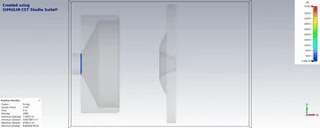
The difference in RF-gated gun is, unlike regular thermionic guns, we are extracting bunches at the very early stage of emission by a coaxial cavity. To explain simply, right after cathode, there is a thin gap of oscillating field with a specific RF voltage. The electric field is oscillating back and forth so at some time, electrons emitted from cathode can pass the thin gap and enter the main DC area of our gun and at some time, they're decelerated back to the cathode. In this technique, we can control particle emission and have bunches instead of continuous emission. Something like this animation (simulation is not optimised yet. That's why you see it diverging due to space-charge forces in the bunch itself),
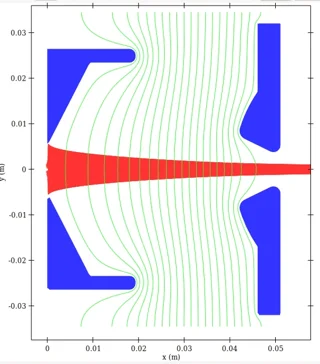
The problem I have, is the space-charge limit control in my gun. For simulating particle emission and bunch formation in RF-gating, I must use PIC-solver in CST studio which emits millions of electrons at a time and tracks them individually. But this solver does not provide space-charge limit calculation of my gun. For that purpose, I must use the TRK-solver, where electron trajectories in one plane is drawn in the gun as shown in Figure below.
My problem is at this stage: according to my simulation results, the cathode emission must be 900 mA so that I can extract bunches with average current of 5 mA at the exit of the gun. My question is, should I set the space-charge limit of my gun 900 mA or 5 mA? In my opinion, it should be 900 mA because otherwise cathode emission less than that results another average current. But at the same time I think I am wrong because in the DC area of the gun we always have 5 mA average current (i.e., 5 mA bunches are extracted out of the RF-gated area and enter the DC acceleration area of the gun). So space-charge limit should be 5 mA. And that's where I'm confused.
IMPORTANT NOTE: The RF gap between cathode and DC region is very thin in order of 100 micrometer.
The difference in RF-gated gun is, unlike regular thermionic guns, we are extracting bunches at the very early stage of emission by a coaxial cavity. To explain simply, right after cathode, there is a thin gap of oscillating field with a specific RF voltage. The electric field is oscillating back and forth so at some time, electrons emitted from cathode can pass the thin gap and enter the main DC area of our gun and at some time, they're decelerated back to the cathode. In this technique, we can control particle emission and have bunches instead of continuous emission. Something like this animation (simulation is not optimised yet. That's why you see it diverging due to space-charge forces in the bunch itself),
The problem I have, is the space-charge limit control in my gun. For simulating particle emission and bunch formation in RF-gating, I must use PIC-solver in CST studio which emits millions of electrons at a time and tracks them individually. But this solver does not provide space-charge limit calculation of my gun. For that purpose, I must use the TRK-solver, where electron trajectories in one plane is drawn in the gun as shown in Figure below.
My problem is at this stage: according to my simulation results, the cathode emission must be 900 mA so that I can extract bunches with average current of 5 mA at the exit of the gun. My question is, should I set the space-charge limit of my gun 900 mA or 5 mA? In my opinion, it should be 900 mA because otherwise cathode emission less than that results another average current. But at the same time I think I am wrong because in the DC area of the gun we always have 5 mA average current (i.e., 5 mA bunches are extracted out of the RF-gated area and enter the DC acceleration area of the gun). So space-charge limit should be 5 mA. And that's where I'm confused.
IMPORTANT NOTE: The RF gap between cathode and DC region is very thin in order of 100 micrometer.