Spaceship drive using symmetrical frame dragging?

  • Context: Undergrad 
  • Thread starter Thread starter Valerian_cincon
  • Start date Start date
Click For Summary
SUMMARY

The discussion centers on the theoretical concept of a spaceship utilizing symmetrical frame dragging from two counter-rotating masses to achieve propulsion. Participants clarify that this setup does not constitute a true drive, as it violates the conservation of momentum principles established in general relativity. The conversation references the Gravity Probe B experiment, which demonstrated that frame dragging does not induce motion on objects at rest relative to the source. Ultimately, the consensus is that the proposed mechanism is akin to a complex catapult rather than a viable propulsion system.

PREREQUISITES
  • Understanding of general relativity and its principles, particularly conservation of momentum.
  • Familiarity with frame dragging and its implications in astrophysics.
  • Knowledge of the Sagnac effect and its relevance to rotating systems.
  • Basic concepts of angular momentum and linear momentum in physics.
NEXT STEPS
  • Study the principles of general relativity, focusing on momentum conservation.
  • Research the Gravity Probe B experiment and its findings on frame dragging.
  • Explore the Sagnac effect and its applications in modern physics.
  • Investigate numerical simulations of complex systems in general relativity.
USEFUL FOR

This discussion is beneficial for physicists, aerospace engineers, and students of general relativity seeking to understand the limitations of theoretical propulsion systems based on frame dragging and momentum conservation.

Valerian_cincon
Messages
9
Reaction score
1
So... It is about a spaceship.

The setup is a spaceship with 2 rotating mass (opposite rotation) positioned left and right of the ship center.

The rotating mass inflict frame dragging around them so also on the ship, and they add at the center of the ship.
Inducing the frame to drag under the ship making it moving forward ?

To my understanding it convert angular momentum to linear momentum ?
And then it would propagate trough structural integrity.

Can this be called a reaction less drive ?
(as no matter/radiation is ejected or impacted to/from exterior)
 

Attachments

  • dragged ship.PNG
    dragged ship.PNG
    18.9 KB · Views: 72
Physics news on Phys.org
Valerian_cincon said:
To my understanding it convert angular momentum to linear momentum ?
They are separately conserved so you already know that something is wrong with this line of thought.

You aren't bringing the rotating masses along with the ship so you don't have a drive, you have an unusually complicated catapult.
 
  • Like
Likes   Reactions: Vanadium 50 and phinds
Nugatory said:
You aren't bringing the rotating masses along with the ship so you don't have a drive, you have an unusually complicated catapult.
And one that would almost certainly be technically ("engineeringly" to make up a word) impossible with anything like our current level of technology. Anything strong enough to produce thrust such as you describe for a catapult would have to be a black hole or a neutron star.
 
Valerian_cincon said:
The rotating mass inflict frame dragging around them so also on the ship, and they add at the center of the ship.
Inducing the frame to drag under the ship making it moving forward ?
No. Frame dragging does not induce any motion on objects at rest relative to the center of mass of the source. Or, more generally, on objects orbiting the source. Read up on Gravity Probe B, which detected the frame dragging due to the Earth's rotation: this did not change the orbits of the probe satellites at all, it only induced a precession in gyroscopes carried inside the satellites.
 
  • Informative
Likes   Reactions: phinds and Valerian_cincon
Nugatory said:
you have an unusually complicated catapult.
Not even that. See my post #4 just now.
 
PeterDonis said:
No. Frame dragging does not induce any motion on objects at rest relative to the center of mass of the source. Or, more generally, on objects orbiting the source. Read up on Gravity Probe B, which detected the frame dragging due to the Earth's rotation: this did not change the orbits of the probe satellites at all, it only induced a precession in gyroscopes carried inside the satellites.
Thanks you.

I also found this article that is very clear about my misconception about frame-dragging.
As you said, there is no body dragging at all.

Frame-dragging: meaning, myths, and misconceptions​

L. Filipe O. Costa, José Natário

at point 3, page 11, 12 and figure 2.
https://arxiv.org/pdf/2109.14641
 
  • Like
Likes   Reactions: PAllen
My apologies I am back again with what is supposedly a silly misunderstanding.

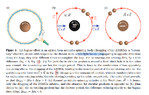
Based on the previously cited paper, figure 1.

And particularly the different time delay for light or a particle for a revolution in opposite direction around the rotating mass. (Sagnac effect)

Taking again the previous setup of spaceship with 2 opposite rotating mass and with the structural integrity to bring the mass with you.

So around each mass, you start with the cancelling action-reaction of synchronous emission in both opposite direction. Then at a full circle, you have the action-reaction from the light/particle arriving from direction n°1, and you have it sooner than from the opposite direction.

During this little time delay difference... The ship move forward right ?

And then stop when the light/particle arriving from direction n°2 arrive with its action/reaction to cancel it.
 

Attachments

  • fig1.PNG
    fig1.PNG
    51.4 KB · Views: 65
Last edited:
Valerian_cincon said:
Taking again the previous setup of spaceship with 2 opposite rotating mass and with the structural integrity to bring the mass with you.
This setup is not stable; the ship would need to be firing rockets to stay in between the two rotating masses. Your analysis assumes that the only force on the ship is the counter-rotating light pulses, but it's not.
 
PeterDonis said:
This setup is not stable; the ship would need to be firing rockets to stay in between the two rotating masses. Your analysis assumes that the only force on the ship is the counter-rotating light pulses, but it's not.
My apologies, I failed to clearly describe the setup.

The rotating mass would be flywheel inside the ship. And such mechanically maintained in position.

I know its not blackhole level mass and the effect of frame dragging would be extremely weak.
But I am not discussing practicality for a real drive.

I am for now, focused on "is there theoretically a temporary non-zero movement there ?".

From your answer I will interpret that it is a yes.
 
  • #10
Valerian_cincon said:
The rotating mass would be flywheel inside the ship. And such mechanically maintained in position.
In which case there has to be a force exerted on the ship that is equal and opposite to the force exerted on the flywheel to keep it in position. Which, again, invalidates your analysis.

Valerian_cincon said:
From your answer I will interpret that it is a yes.
Your interpretation is wrong. Saying that your analysis is invalid is not the same as saying that there is movement of the ship.
 
  • #11
Valerian_cincon said:
From your answer I will interpret that it is a yes.
You are not thinking clearly. What you have described is a self-contained, closed system. An elementary consequence of conservation of momentum is that there is no way for a self-contained, closed system to give itself nonzero momentum.
 
  • Like
Likes   Reactions: russ_watters
  • #12
PeterDonis said:
You are not thinking clearly. What you have described is a self-contained, closed system. An elementary consequence of conservation of momentum is that there is no way for a self-contained, closed system to give itself nonzero momentum.
But the non zero momentum is temporary. As soon as the counter-rotating light/particle arrive after delta_ts after the co-rotating light/particle, then the momentum go back to zero.

So the momentum is conserved, after a delay.
Still no ? Then I will stop here.
 
Last edited:
  • #13
Valerian_cincon said:
the non zero momentum is temporary
So what? Conservation of momentum doesn't have an asterisk on it that says it can be broken as long as it's temporary.

Valerian_cincon said:
As soon as the counter-rotating light/particle arrive after delta_ts after the co-rotating light/particle, then the momentum go back to zero.
Again, you're assuming that your analysis is correct. It isn't, for the reasons I've already given.
 
  • #14
Do the ship is at rest in a frame fixed to the distant stars, have non-zero angular momentum ?
OR
Do the ship has zero angular momentum and have non-zero angular velocity in a coordinate system fixed to the distant stars ?
 
  • #15
Valerian_cincon said:
Do the ship is at rest in a frame fixed to the distant stars, have non-zero angular momentum ?
No. As you've specified the scenario, the two rotating masses are counter-rotating, so the total angular momentum of the ship as a closed system is zero.

Valerian_cincon said:
OR
Do the ship has zero angular momentum and have non-zero angular velocity in a coordinate system fixed to the distant stars ?
Not as you've specified the scenario, no. This sort of thing is only possible for an object that is in the gravitational field of a single rotating mass (where the mass is much, much, much larger than the object).
 
  • Like
Likes   Reactions: russ_watters
  • #16
PeterDonis said:
No. As you've specified the scenario, the two rotating masses are counter-rotating, so the total angular momentum of the ship as a closed system is zero.
Yes, in classical physics at the scale of the whole ship.

However, I expected the Sagnac effect to still be present from frame dragging, at least away from the ship center line / the plane of symmetry.

At the plane of symmetry, the effect would disappear because there the frame-dragging from the two rotating mass would cancel each other.
 
  • #17
Valerian_cincon said:
However, I expected the Sagnac effect to still be present from frame dragging, at least away from the ship center line / the plane of symmetry.
So the co-rotating pulses arrive back at their start points sooner than the counter-rotating ones. This would induce the central mass to move forward, yes, but also induce the rotating masses and/or the optical guides to move backwards. The opposite happens when the counter-rotating pulses arrive. Thus your ship wouldn't move, just bend and straighten very slightly.
 
  • #18
Ibix said:
This would induce the central mass to move forward, yes, but also induce the rotating masses and/or the optical guides to move backwards.
But this can't happen in the OP's scenario, because the OP specified that all of these things are held together--"mechanically maintained in position". They're not free bodies.
 
  • #19
PeterDonis said:
But this can't happen in the OP's scenario, because the OP specified that all of these things are held together--"mechanically maintained in position". They're not free bodies.
Yeah, but that cannot be perfectly rigid, so it may flex. In order to conserve momentum it pretty much has to, I think. Unless there's some momentum carried away by asymmetric gravitational radiation, which I suppose is possible.
 
  • #20
Ibix said:
that cannot be perfectly rigid, so it may flex
In principle, yes, that's true. However, how it will flex will depend not just on the forces exerted by the light pulses, but on the other mechanical forces that already exist in the system (which will not be zero). Any correct analysis has to include those as well.

Ibix said:
Unless there's some momentum carried away by asymmetric gravitational radiation
That's a whole other can of worms that I don't think we want to open in this thread. :wink: Off the top of my head I'm not sure there would be any if the rotating masses were axisymmetric, but trying to analyze that in detail is way, way beyond "B" level (or even "I" level).
 
  • #21
I think I was moderated down to "B" level, when I posted I asked for graduate level.

As a microelectronic engineer I was educated in electromagnetism. (5 year post-high school)
However, I was never educated about general relativity.
On the side I am reading a (300 pages) general relativity lesson from a master in "astonomy, astrophysic and space engineering" But it is a lot of self-study for 1 query about frame-dragging interaction.

I think that seeing the paper I cited my interest was clearly not B level.

At least, I un-learned my mis-conception about frame-dragging, no body dragging.
 
Last edited:
  • #22
Valerian_cincon said:
I think I was moderated down to "B" level, when I posted I asked for graduate level.
That is correct. However, even at "A" level I don't know if there are any resources that address your scenario directly. Nor are there any known exact solutions. A correct analysis would require numerical simulation of the scenario. That's well beyond what we can feasibly address in a PF thread.

Valerian_cincon said:
As a microelectronic engineer I was educated in electromagnetism. (5 year post-high school)
However, I was never educated about general relativity.
That means you don't really have the background for an "A" level discussion on this topic. "I" level, perhaps.

Valerian_cincon said:
On the side I am reading a (300 pages) general relativity lesson from a master in "astonomy, astrophysic and space engineering"
Can you be more specific?
 
  • #26
Propellers in Space!

Let's sweep away the clutter. As described, this device violates conservation of momentum. Since momentum in GR is conserved, no amount of tossing in frame-dragging or Sagnac or whatever will change this.
 

Similar threads

  • · Replies 1 ·
Replies
1
Views
2K
  • · Replies 8 ·
Replies
8
Views
2K
  • · Replies 2 ·
Replies
2
Views
2K
  • · Replies 3 ·
Replies
3
Views
2K
  • · Replies 5 ·
Replies
5
Views
2K
  • · Replies 8 ·
Replies
8
Views
4K
  • · Replies 5 ·
Replies
5
Views
5K
  • · Replies 1 ·
Replies
1
Views
2K
  • · Replies 11 ·
Replies
11
Views
3K
  • · Replies 25 ·
Replies
25
Views
2K