MHB Speed of Perigee: Find Satellite Velocity at 750 km

  • Thread starter Thread starter cbarker1
  • Start date Start date
  • Tags Tags
    Speed
Click For Summary
SUMMARY

The discussion focuses on calculating the velocity of an Earth satellite at perigee, specifically at 750 km above the Earth's surface, given its apogee speed of 6,800 m/s at 2,400 km. Participants confirm that conservation of energy can be applied, utilizing the equation \(E=E_p + E_k = -\frac{GMm}{r} + \frac{1}{2} mv^2\). The gravitational parameter \(\mu=GM=3.986004418(9)\times 10^{14}\text{ m}^3\text{s}^{-2}\) is also referenced as essential for the calculations. The discussion emphasizes the need to compute both potential and kinetic energy at perigee and apogee to derive the satellite's speed at perigee.

PREREQUISITES
  • Understanding of gravitational potential energy and kinetic energy equations
  • Familiarity with the conservation of energy principle
  • Knowledge of gravitational parameters, specifically \(\mu=GM\)
  • Basic understanding of orbital mechanics
NEXT STEPS
  • Research the application of conservation of energy in orbital mechanics
  • Learn how to calculate satellite velocities using energy equations
  • Explore the significance of gravitational parameters in satellite motion
  • Study the relationship between apogee, perigee, and satellite speed
USEFUL FOR

Aerospace engineers, physics students, and anyone interested in satellite dynamics and orbital mechanics will benefit from this discussion.

cbarker1
Gold Member
MHB
Messages
345
Reaction score
23
Dear Everybody,

How to get started for this problem?
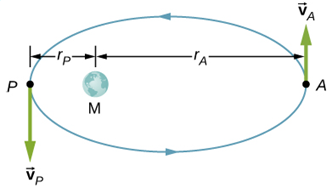
An Earth satellite has its apogee at 2,400 km above the surface of Earth and perigee at 750 km above the surface of Earth. At apogee its speed is 6,800 m/s. What is its speed at perigee (in m/s)? Earth's radius is 6,370 km (see the figure below, which is not drawn to scale)
11-3-p-056.png

Thanks,
Cbarker1
 
Mathematics news on Phys.org
Can we apply conservation of energy?
$$E=E_p + E_k = -\frac{GMm}{r} + \frac 12 mv^2$$
 
yes. We can use the conservation of energy.
 
Cbarker1 said:
yes. We can use the conservation of energy.

Good.
So what's stopping you from getting the answer?
 
:confused:

We need to find the potential energy and the kinetic energy at both the perigee and the apogee.
That should give us an equation from which we can find the answer. (Thinking)
 
I like Serena said:
:confused:

We need to find the potential energy and the kinetic energy at both the perigee and the apogee.
That should give us an equation from which we can find the answer. (Thinking)
Do we need to find "M"?
 
Cbarker1 said:
Do we need to find "M"?

I think we need to look it up.
More specifically $\mu=GM=3.986004418(9)\times 10^{14}\text{ m}^3\text{s}^{-2}$. See wiki.
 
conservation of momentum ...

$mv_Ar_A = mv_Pr_p$
 

Similar threads

  • · Replies 12 ·
Replies
12
Views
4K
  • · Replies 1 ·
Replies
1
Views
3K
  • · Replies 2 ·
Replies
2
Views
2K
Replies
3
Views
2K
Replies
5
Views
3K
Replies
7
Views
5K
Replies
1
Views
4K
  • · Replies 11 ·
Replies
11
Views
4K
  • · Replies 12 ·
Replies
12
Views
21K
  • · Replies 2 ·
Replies
2
Views
3K