Split epimorphisms in Bland's Rings and Their Modules

  • Level: Undergrad 
  • Thread starter Math Amateur
  • Start date
  • Tags Tags
    Split
4 replies · 2K views · last reply
Math Amateur
Gold Member
MHB
Messages
3,920
Reaction score
48
I am reading Paul E. Bland's book "Rings and Their Modules" ...

Currently I am focused on Section 3.2 Exact Sequences in ModR" role="presentation">ModR ... ...

I need some help in order to fully understand Proposition 3.2.4 ...

Proposition 3.2.4 reads as follows:
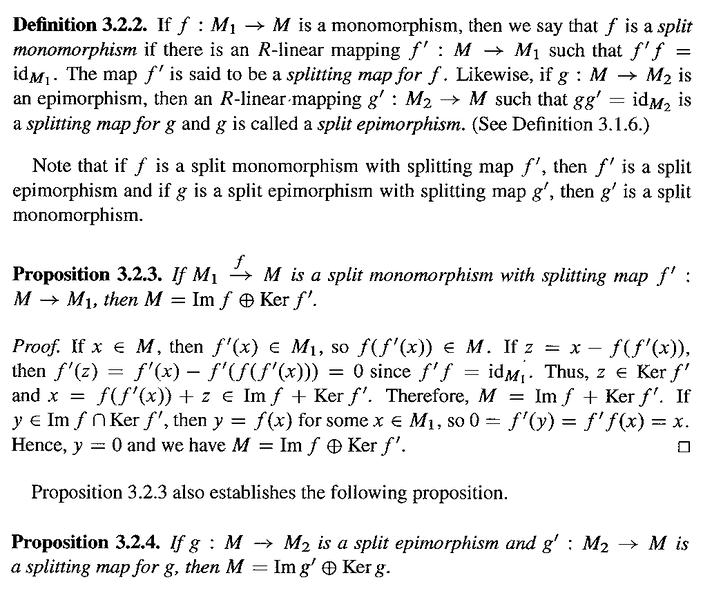
Printed textbook page with Definition 3.2.2 on split monomorphisms and split epimorphisms, Proposition 3.2.3 with its proof, and the statement of Proposition 3.2.4 about split epimorphisms and splitting maps.

Can someone please explain exactly how Proposition 3.2.3 establishes Proposition 3.2.4 ...
Help will be much appreciated ...

Peter
 
Attachments
  • Printed textbook page with Definition 3.2.2 on split monomorphisms and split epimorphisms, Proposition 3.2.3 with its proof, and the statement of Proposition 3.2.4 about split epimorphisms and splitting maps.
    Bland - Prposition 3.2.4 ... ....png
    46.3 KB · Views: 617
Start with the premises of 3.2.4 about ##g,g'##.

Then, from the author's comment after Definition 3.2.2 we see that ##g'## is a split monomorphism with monomorphism-splitting map ##g##.

Hence by Proposition 3.2.3, the range ##M## of the split monomorphism ##g'## can be written as a direct sum of the split monomorphism's image (##\textrm{Im}\ g'##) and the Kernel of the monomorphism-splitting map ##g##.

I find it helps to attach the word 'epimorphism-' or 'monomorphism-' as a prefix to the words 'splitting map' in order to avoid confusion as to whether the map in question is splitting an epimorphism or a monomorphism.

Are you able to satisfy yourself as to the truth of the author's comment after Definition 3.2.2?
 
  • Like
Likes   Reactions: Math Amateur
Hi Andrew ... thanks for the help ...

Regarding the authors comments after Definition 3.2.2 ...

Firstly, if ##f## is a split monomorphism with splitting map ##f'##... then any point/element of ##M_1##, say ##a##, must be mapped to itself: ... hence ##f'## must be surjective ... that is ##f'## is an epimorphism ...

Secondly if ##g## is a split epimorphism with splitting map ##g'##... then any point ##a \in M_2## will be mapped to ##g'(a)## ... and no other point of ##M_2##, say ##b##, may be mapped to ##g'(a)## ... otherwise ... ##g## must map the point ##g'(a)## back to both ##a## and ##b## ... which is impossible since ##g## is a map ... therefore ##g'## is injective ... that is, ##g'## is a monomorphism ... ...

Peter
 
Yes. A neat way to put the second one is to let ##a,b\in M_2## and assume ##g'(a)=g'(b)##. Then we have

$$a=id_{M_2}(a) = (g\circ g')(a) = g(g'(a)) = g(g'(b)) = (g\circ g')(b) = id_{M_2}(b) = b$$

which gives us the injectivity property of ##g'##.
 
  • Like
Likes   Reactions: jim mcnamara and Math Amateur
The key to your question is this lemma:

If ##f:M \to N## and ##g:N \to M## are R-maps such that ##g \circ f = 1_M## then ##f## is an R-monomorphism and ##g## is an R-epimorphism. You may prove that.
Here we have a sequence

##M\overset{f}{\rightarrow}N\overset{g}{\rightarrow}M##

of R-maps such that ##g \circ f = 1_M##.In proposition 3.2.3. we have this sequence

##M_1\overset{f}{\rightarrow}M\overset{f’}{\rightarrow}M_1##

of R-maps such that ##f’ \circ f = 1_{M_1}##.

By the lemma, ##f## is a monomorphism and we have ##f’ \circ f = 1_{M_1}##: definition 3.2.2. calls ##f## the split monomorphism and calls ##f’## the splitting map for ##f##.

Proposition 3.2.3 says ##M = \text{im } f \oplus \text{ker } f’##


Can you see this:

By the lemma, ##f’## is an epimorphism and we have ##f’ \circ f = 1_{M_1}##: but now definition 3.2.2. calls ##f’## the split epimorphism and ##f## the splitting map for ##f’##.

Proposition 3.2.3 says ##M = \text{im } f \oplus \text{ker } f’##This is exactly the situation we have in proposition 3.2.4. here we have this sequence

##M_2\overset{g’}{\rightarrow}M\overset{g}{\rightarrow}M_2##

of R-maps such that ##g \circ g’ = 1_{M_2}##: ##g## the split epimorphism and ##g’## the splitting map for ##g##.

So change ##f## into ##g’##, and ##f’## into ##g##, and ##M_1## into ##M_2## and proposition 3.2.3 becomes proposition 3.2.4. And the conclusion is ##M = \text{im } g’ \oplus \text{ker } g##
 
  • Like
Likes   Reactions: Math Amateur