Split Short Exact Sequences .... Bland, Proposition 3.2.6 ....

  • Context: Undergrad 
  • Thread starter Thread starter Math Amateur
  • Start date Start date
  • Tags Tags
    Sequences Short Split
Click For Summary

Discussion Overview

The discussion revolves around understanding the proof of Proposition 3.2.6 from Paul E. Bland's "Rings and Their Modules," specifically focusing on the concepts of exact sequences in the category of modules over a ring. Participants seek clarification on the implications of certain expressions within the proof and the well-defined nature of a function defined in the context of the proposition.

Discussion Character

  • Technical explanation
  • Conceptual clarification
  • Debate/contested

Main Points Raised

  • One participant requests clarification on why the expression ##(x - x') - f(f'(x - x')) \in \text{Ker } f' \cap \text{Im } f = 0##, seeking a detailed explanation of its implications.
  • Another participant questions whether the definition of ##g'## implies that ##g'(y) = x' - f(f'(x'))## for another element ##x'## such that ##g(x') = y##.
  • A later reply elaborates on the reasoning behind the equality and the implications of linear combinations in the context of kernels and images of linear maps, asserting that the expression being in both the kernel and image leads to the conclusion that it is in their intersection.
  • It is noted that the definition of ##g'## is considered well-defined as long as changing the element ##x## does not alter the value of ##g'(y)##, with a need to show that if ##g(x) = g(x')##, then the values of ##g'## remain equal.
  • Participants discuss the formal proof that shows the equality of the expressions involved, emphasizing the conditions under which the definition of ##g'## holds.

Areas of Agreement / Disagreement

Participants generally agree on the need for clarification regarding the proof, but there are multiple viewpoints on the implications of the expressions and the well-defined nature of the function ##g'##. The discussion remains unresolved in terms of fully establishing consensus on the interpretations of the proof.

Contextual Notes

Participants express uncertainty regarding the specific steps in the proof and the implications of certain mathematical expressions, highlighting the complexity of the concepts involved in exact sequences and module theory.

Math Amateur
Gold Member
MHB
Messages
3,920
Reaction score
48
I am reading Paul E. Bland's book "Rings and Their Modules" ...

Currently I am focused on Section 3.2 Exact Sequences in ##\text{Mod}_R##... ...

I need some help in order to fully understand the proof of Proposition 3.2.6 ...

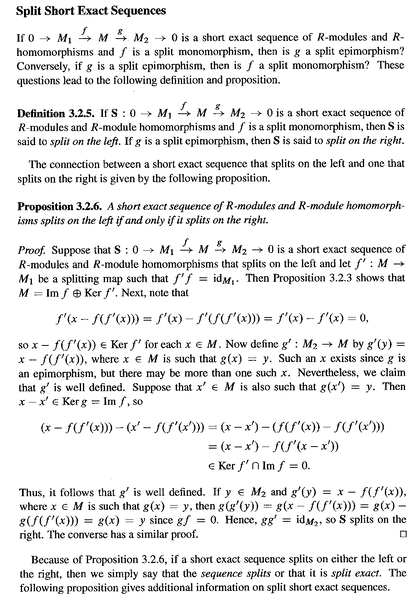
Proposition 3.2.6 and its proof read as follows:
Bland - Prposition 3.2.6 ... .....png

In the above proof of Proposition 3.2.6 we read the following:"... ... Then ##x - x'\in \text{Ker } g = \text{Im } f##, so##(x - f( f' (x))) - (x' - f( f' (x'))) = ( x - x') - ( f ( f'(x) ) - f ( f'(x') ) )##

##= ( x - x') - f ( f' ( x - x') )##

##\in \text{Ker } f' \cap \text{Im } f = 0 ## ... ...

Thus it follows that ##g'## is well-defined ... ... "Can someone please explain exactly why/how ##( x - x') - f ( f' ( x - x') ) \in \text{Ker } f' \cap \text{Im } f = 0## ... ...Further, can someone please explain in some detail how the above working shows that ##g'## is well-defined ...
Help will be much appreciated ...

Peter
 

Attachments

  • Bland - Prposition 3.2.6 ... .....png
    Bland - Prposition 3.2.6 ... .....png
    44.8 KB · Views: 584
Physics news on Phys.org
I am reading Paul E. Bland's book "Rings and Their Modules" ...

Currently I am focused on Section 3.2 Exact Sequences in ##\text{Mod}_R## ... ...

I need some further help in order to fully understand the proof of Proposition 3.2.6 ...

Proposition 3.2.6 and its proof read as follows:
Bland - Prposition 3.2.6 ... .....png

In the above proof of Proposition 3.2.6 we read the following:"... ... now define ##g' \ : \ M_2 \longrightarrow M## by ##g'(y) = x - f(f'(x))##, where ##x \in M## is such that ##g(x) = y## ... ... ... ...

... ... Suppose that ##x' \in M## is also such that ##g(x') = y## ... ... Does the above text imply that ##g'(y) = x' - f( f'(x') )## ... ... ?

Peter
 

Attachments

  • Bland - Prposition 3.2.6 ... .....png
    Bland - Prposition 3.2.6 ... .....png
    44.8 KB · Views: 497
Math Amateur said:
"... ... Then ##x - x'\in \text{Ker } g = \text{Im } f##, so##(x - f( f' (x))) - (x' - f( f' (x'))) = ( x - x') - ( f ( f'(x) ) - f ( f'(x') ) )##

##= ( x - x') - f ( f' ( x - x') )##

##\in \text{Ker } f' \cap \text{Im } f = 0 ## ... ...
The LHS of the first line has two terms, ##(x - f( f' (x)))## and ## (x' - f( f' (x')))## with ##x,x'\in M##. The 6th line of the proof of Proposition 3.2.6 concludes that terms of that form are in Ker ##f'##. Since the kernel of a linear map is a subspace, that means the LHS of that line, which is a linear comb of the two terms, is also in the kernel.

Now look at the last equality: ##= ( x - x') - f ( f' ( x - x') )##. The second term is in I am ##f##, and the first term was shown to be in I am ##f## in the extract's line immediately before that series of equalities you quoted. Again, since Images of linear maps are subspaces, the linear combination of the two terms must be in the image. So the item is both in I am ##f## and in Ker ##f'##, hence in their intersection.
Further, can someone please explain in some detail how the above working shows that ##g'## is well-defined ...
##g'## was defined as ##g'(y) = x-f(f'(x))## where ##g(x)=y##, ie where ##x\in g^{-1}(y)##. There may be more than one ##x## such that ##g(x)=y##. That doesn't matter, ie does not make the definition 'not well-defined', as long as changing the ##x## doesn't change the value of ##g'(y)##, ie of ##x-f(f'(x))##. So what is needed is to prove that if there is another such ##x##, call it ##x'##, such that ##g(x')=y=g(x)##, we will have ##x-f(f'(x))=x'-f(f'(x'))##, ie ##(x-f(f'(x))-(x'-f(f'(x'))=0##.

And that is what has just been proved by that series of equalities.
To be absolutely formal, what was proved was:
$$(x-f(f'(x))-(x'-f(f'(x')) \in \mathrm{Ker }f'\cap \mathrm{Im }f=\{0\}$$
from which it follows that
$$(x-f(f'(x))-(x'-f(f'(x'))=0$$
 
  • Like
Likes   Reactions: Math Amateur
Well! That was extremely helpful!

Thanks Andrew ...

Peter
 

Similar threads

  • · Replies 2 ·
Replies
2
Views
1K
  • · Replies 1 ·
Replies
1
Views
1K
  • · Replies 7 ·
Replies
7
Views
2K
  • · Replies 2 ·
Replies
2
Views
2K
  • · Replies 25 ·
Replies
25
Views
4K
Replies
2
Views
2K
Replies
2
Views
1K
  • · Replies 5 ·
Replies
5
Views
2K
  • · Replies 12 ·
Replies
12
Views
3K
  • · Replies 9 ·
Replies
9
Views
2K