Standard designation for generalization of Euler-Lagrange?

Join the discussion
Ask a follow-up here, or get your own question answered by working scientists, mathematicians and engineers — people, not an autocomplete.
Real named experts · corrections over time · the nuance an AI answer skips
5 replies · 2K views
nomadreid
Gold Member
Messages
1,779
Reaction score
258
TL;DR
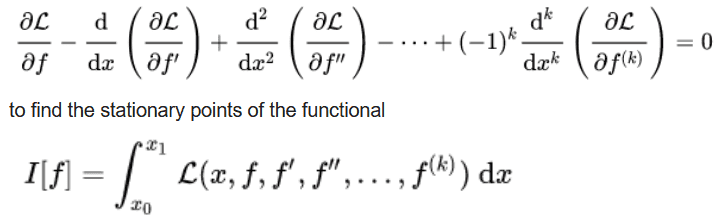
In Wiki's article on the Euler-Lagrange equation , under "Generalizations">'Single function of single variable...', there is an equation (stated in main text). Is there a standard name for it? Some Russian authors call it the Euler-Poisson equation.
In English, does the equation
1641272080870.png

have any standard name besides (generalization of) the Euler-Lagrange Theorem? I have seen the designation "Euler-Poisson Equation" used by the Russian mathematician Lev Elsholtz way back in 1956 repeated in recent Russian webpages, but am not sure whether this would be recognizable (perhaps with a footnote?) by English-speaking mathematicians. (Not to get mixed up with either the Euler-Poisson-Darboux Equation or the Euler-Poisson Integral.)

I was unsure whether to post this in the mathematics or the physics section, as it is strictly speaking mathematics but mainly used in physics. If a moderator wishes to move it, then my thanks in advance to that moderator.
 
Physics news on Phys.org
In Schouten's Ricci Calculus (Springer) and his Tensor Analysis for Physicists (Dover),
he refers to the "Lagrange Derivative".

previews from Google Books... search for "lagrange derivative"

From Ricci Calculus,
1642179906915.png

1642179928749.png
From Tensor Analysis for Physicists,
1642180247088.png

1642180287607.png
 
Reply
  • Like
Likes   Reactions: nomadreid
Thanks very much, robphy. (Sorry for the delayed response.)

(You attached the same excerpt twice.)

Unfortunately, when I googled "Lagrange derivative", I came up empty (i.e., nothing under that title, and, google sending me what was closest, everything was about the Euler-Lagrange Equation).

I am working through the text you sent. Given that I am close to nil in differential equations, perhaps you can answer a couple of questions on it. First,
1642344338512.png

1642345096448.png

Wouldn't that make the Script-L a functional?

I am attempting to see whether this text would help me interpret the so-called Euler-Poisson equation in where the partial derivatives such as
1642346559291.png

in the Euler-Lagrange equation are replaced by the "total partial derivative", or "complete partial derivative",
1642346588105.png

which are defined as follows (Elgots, Calculus of Variations)
1642345442946.png

Is the "complete partial derivative" here the same as the "total derivative"?

For which situation(s) is the replacement of partial derivatives by "total partial derivatives" in the Euler-Lagrange equation useful/valid? It appears that when one applies this new equation to a Lagrangian, one is likely to get a different answer than the application of the usual Euler-Lagrange equation, so the circumstances must be different, no?

Sorry if the question is obvious, but my level of "diffy-Q" is rather basic. Thanks for any help.

 
nomadreid said:
Thanks very much, robphy. (Sorry for the delayed response.)

(You attached the same excerpt twice.)

Hmmm... that's odd. I see 4 distinct images, 2 each from the two works (p.111, 112 from Ricci Calculus, p 78-79, 79-80).

with quotes

I've been interested in Schouten's work for a while...
so I recall seeing the "Lagrange derivative"
... and, thus, my response.
Unfortunately, I don't know any more details, except for these terms that may be related to what you seek.
 
Reply
  • Like
Likes   Reactions: nomadreid
I know it as the functional derivative: You define
$$S[q]=\int_{t_1}^{t_2} \mathrm{d} t L(q,\dot{q},\ddot{q},\ldots)$$
as a functional on the space of trajectories ##q(t)## with fixed initial and final point. Then via variation and integration by parts you get
$$\delta S=\int_{t_1}^{t_2} \mathrm{d} t (\partial_q L - \mathrm{d}_t \partial_{\dot{q}} L + \mathrm{d}_t^2 \partial_{\ddot{q}} L+\cdots).$$
This defines the functional derivative as
$$\frac{\delta S}{\delta q(t)} = \partial_q L - \mathrm{d}_t \partial_{\dot{q}} L + \mathrm{d}_t^2 \partial_{\ddot{q}} L+\cdots$$
 
Reply
  • Like
Likes   Reactions: nomadreid
Thanks very much, robphy and vanhees71. Very helpful!