MHB Struggling with Econometrics Proofs? Find Direction & Solutions Here!

  • Thread starter Thread starter EconometricAli
  • Start date Start date
  • Tags Tags
    Econometrics
Click For Summary
SUMMARY

This discussion focuses on the challenges faced by a third-year economics student in understanding econometric proofs, particularly regarding expected values and linear models. The student seeks guidance on resources to improve their comprehension before an impending deadline. Key concepts mentioned include the expected value of sums and the implications of linear models in econometrics. The student has attempted to utilize their textbook but requires additional support to grasp the material fully.

PREREQUISITES
  • Understanding of basic econometric concepts, including expected values
  • Familiarity with linear regression models
  • Knowledge of statistical notation and proofs
  • Experience with econometrics textbooks and academic resources
NEXT STEPS
  • Research "Expected Value in Econometrics" to solidify understanding of E(ΣX_I)
  • Study "Linear Regression Models" to comprehend the implications of linearity
  • Explore "Econometric Proof Techniques" for strategies on proving econometric statements
  • Consult "Econometrics Textbooks" for comprehensive explanations and examples
USEFUL FOR

Economics students, particularly those in advanced undergraduate courses, educators teaching econometrics, and anyone seeking to enhance their understanding of econometric proofs and concepts.

EconometricAli
Messages
4
Reaction score
0
Hey everyone,
I'm doing an 3rd year economics course in university and I'm already running into difficulty trying to show proofs of the following:
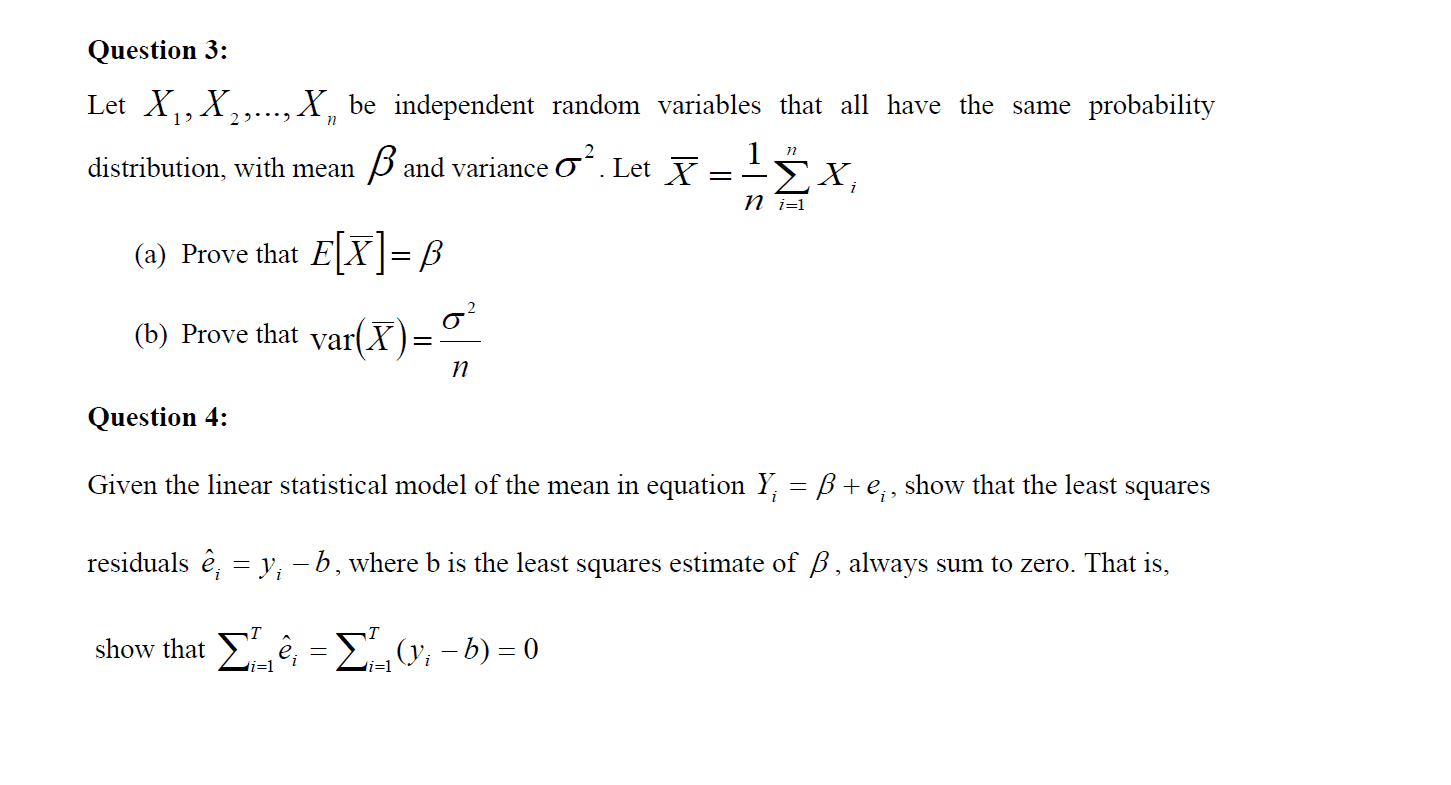
Q3 and 4.png


Now I certainly don't wish to ask for spoon feeding just some direction or source to where I can look up and read for the solution. My knowledge on these are still weak and the deadline is by the end of this Friday. I'm going to try the textbook tomorrow to see alternatives because I couldn't understand the lecture as well as I had hoped.

Thank you
 
Physics news on Phys.org
3a is easy: [math]E\left(\sum X_I\right)= \sum E(X_I)= \sum \beta= n\beta[/math] so the expected value of [math]\frac{1}{n}\sum X_i[/math] is [math]\beta[/math].

Pretty much the same thing for 3b.

For 4, what does "linear model" imply?
 
If there are an infinite number of natural numbers, and an infinite number of fractions in between any two natural numbers, and an infinite number of fractions in between any two of those fractions, and an infinite number of fractions in between any two of those fractions, and an infinite number of fractions in between any two of those fractions, and... then that must mean that there are not only infinite infinities, but an infinite number of those infinities. and an infinite number of those...

Similar threads

  • · Replies 4 ·
Replies
4
Views
2K
Replies
4
Views
4K
Replies
23
Views
3K
  • · Replies 3 ·
Replies
3
Views
2K
  • · Replies 4 ·
Replies
4
Views
2K
  • · Replies 3 ·
Replies
3
Views
4K
  • · Replies 2 ·
Replies
2
Views
5K
Replies
11
Views
3K
  • · Replies 3 ·
Replies
3
Views
2K
  • · Replies 16 ·
Replies
16
Views
3K