vxr
- 25
- 2
Not sure if this thread belongs in this section. I was thinking who could give a better advice than the teachers themselves? Please do move the thread if it does not belong here. Thank you.
I am first year non-physics student. I kind of never had any experience with physics. I have about 3 weeks to teach myself physics to solve tasks presented below (everything that covers standard first year studies), almost from scratch. If that matters I am at least decent~ish at Calculus, so probably no math barrier for the things I will calculate, and anyway most likely rarely will I need to integrate anything or do something fancy.
To give you an idea how difficult or how easy the tasks we are dealing with are:
- Tasks from kinematics/dynamics:
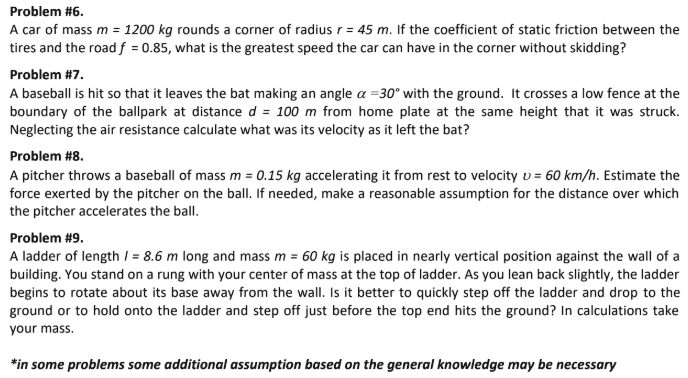
- Tasks from "Conversation principles of material point":
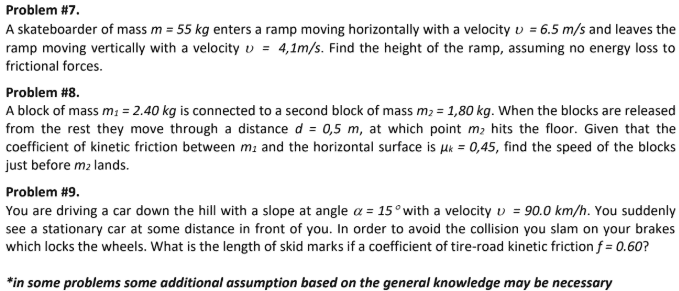
In total there are about ~10 different "subjects" of physics that we have to quickly teach ourselves, covering things like: dynamics, gravitation, thermodynamics, optics, mechanical vibrations, electromagnetism/electrostatic field and whatnot.
I found plenty of online resources, including long .pdf books, that cover theory I need. I hopefully will not have problems with theory.
But I sort of did not find any books that have only tasks with full solutions preferably. I need some book that will not really cover theory, just have bunch of exercies with solutions. Of course I have found some resources online with exercies, but usually there just a few exercises and that's it.
Would anyone be able to share with me with some good resources? Anything is useful for me. Thanks for your time and any advices.
I am first year non-physics student. I kind of never had any experience with physics. I have about 3 weeks to teach myself physics to solve tasks presented below (everything that covers standard first year studies), almost from scratch. If that matters I am at least decent~ish at Calculus, so probably no math barrier for the things I will calculate, and anyway most likely rarely will I need to integrate anything or do something fancy.
To give you an idea how difficult or how easy the tasks we are dealing with are:
- Tasks from kinematics/dynamics:
- Tasks from "Conversation principles of material point":
In total there are about ~10 different "subjects" of physics that we have to quickly teach ourselves, covering things like: dynamics, gravitation, thermodynamics, optics, mechanical vibrations, electromagnetism/electrostatic field and whatnot.
I found plenty of online resources, including long .pdf books, that cover theory I need. I hopefully will not have problems with theory.
But I sort of did not find any books that have only tasks with full solutions preferably. I need some book that will not really cover theory, just have bunch of exercies with solutions. Of course I have found some resources online with exercies, but usually there just a few exercises and that's it.
Would anyone be able to share with me with some good resources? Anything is useful for me. Thanks for your time and any advices.