Stupid Science Tricks: Improvising Toilet Shutoff Valve Repair

  • Thread starter Thread starter Borg
  • Start date Start date
  • Tags Tags
    Science Stupid
Click For Summary
SUMMARY

This discussion focuses on improvisational techniques for repairing toilet shutoff valves, specifically addressing a leak issue after replacing the valve. The user describes using an evaporator method to manage a slow leak, relying on mineral deposits to eventually seal the leak. Additionally, the conversation references Ground Seat Unions used in reactor plant auxiliary systems, highlighting their design and common issues related to sealing. The discussion emphasizes practical, albeit unconventional, repair strategies for plumbing problems.

PREREQUISITES
  • Understanding of basic plumbing systems and shutoff valves
  • Familiarity with leak detection and repair techniques
  • Knowledge of Ground Seat Unions and their applications
  • Experience with pressure testing in plumbing systems
NEXT STEPS
  • Research effective methods for sealing leaks in plumbing systems
  • Learn about the properties and applications of Ground Seat Unions
  • Explore evaporative techniques for managing minor leaks
  • Investigate pressure testing methods for plumbing integrity
USEFUL FOR

Homeowners, DIY enthusiasts, plumbers, and anyone interested in practical plumbing repair techniques and improvisation strategies.

Borg
Science Advisor
Gold Member
Messages
2,331
Reaction score
5,052
Sometimes I just don't feel like doing it the right way and I 'improvise'. I can't be the only one who's done it so feel free to share your stories. Who knows - some of them might be useful to others.

A few weeks ago, I had to replace the shutoff valve for a toilet. Of course, this required shutting of the water for the whole house. Afterward, I noticed that it had a leak and tightened it up a bit more. However, it still leaks about one drop every 5 minutes or so. I didn't feel like shutting off the water again so I put together an evaporator. The paper dries as fast as it gets wet so it works perfect for me. I figure that the minerals in the water will eventually clog the leak. :oldeyes:
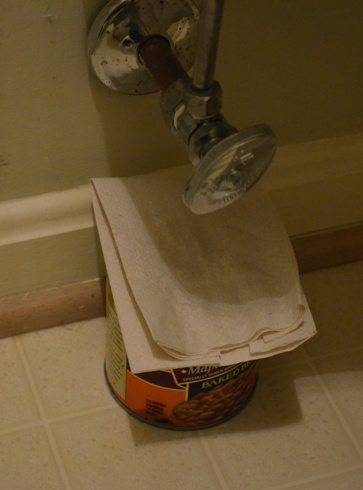
Catchandrelease.jpg
 
Last edited:
Engineering news on Phys.org
In my work I found Ground Seat Unions in reactor plant auxiliary systems, brass unions with a hemispherical male part mating with a conical tail piece. The hemispherical part was expected to have been ground - lapped - to its mate. Never happened, so they were called 'ground seat onions' and came with an O-ring and back up ring to make them tight.

If a compression fitting (as illustrated) isn't leak free at <100 psi, then something is not right.

My home was built by a gentleman whose AB Seaman's card was issued when he was 16 y.o. when he sailed the Great Lakes. I found it when I was moving in. I also found three ground seat onion unions, all sealed by the mineral deposits.
 

Similar threads

  • · Replies 23 ·
Replies
23
Views
3K
  • · Replies 6 ·
Replies
6
Views
3K
  • · Replies 11 ·
Replies
11
Views
4K
  • · Replies 3 ·
Replies
3
Views
2K
  • · Replies 5 ·
Replies
5
Views
3K
  • · Replies 19 ·
Replies
19
Views
9K
  • · Replies 26 ·
Replies
26
Views
4K
Replies
22
Views
4K
Replies
3
Views
12K
  • · Replies 9 ·
Replies
9
Views
3K