Mentor
- 23,902
- 11,357
No, it isn't that stomach flu that's going around.
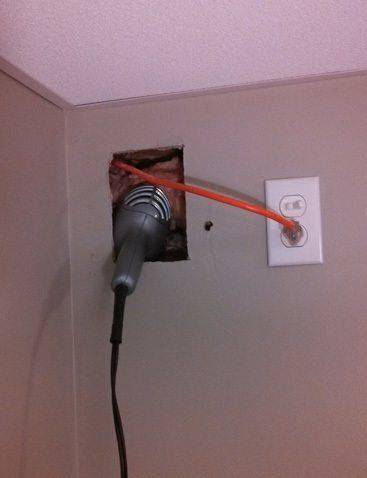
See pic. I live in an end-unit townhouse and I'm finishing my walk-out basement, which was completely (illegally?) un-insulated prior to me starting. The wall on the left is the back wall. Six feet down is an outside hose bib. The pipe runs up the inside of the back wall and then across the ceiling, between the joists. Just inside the access hole is a shutoff valve for the hose bib. The side wall (with the access panel) is the "wet" wall, with my main sewer pipe enclosed in it, There is about 6" between the concrete wall/foundation and the drywall. All of the concrete foundation is covered inside by 5/8" foam sheets and the rest of the wet wall is packed with standard 4" insulation. But I cut the insulation around the hose bib pipe, so that is right up against the concrete, outside of the insulation.
The lighted electrical cord is for heat trace, which is wrapped around the valve and 6" of piping on either side. Then that is covered with a piece of molded foam insulation.
So here's the problem. It was 10F here last night, got up to 20F today and is going to be 10F again tonight. A couple of months ago, I remembered to close the isolation valve, but forgot to open the hose bib to let the water out or plug in the heat trace. Last night, I went outside to open the hose bib and nothing came out...but forgot about the heat trace. Clearly, water is frozen in the pipe. I should have investigated further, but didn't...
Tonight, I opened the access panel and found a little bit of water and ice on the insulation. The pipe insulation is cupped upwards and held a little more water. Altogether, no more than an ounce or two. The hose bib valve is now frozen and won't move. An infrared thermometer recorded temperatures well below freezing in the wall cavity.
I don't think any pipes/joints have burst, but I don't want them to, so I was hoping to thaw out the frozen pipe. So I pulled aside the insulation, turned on the heat in the basement, plugged in the heat trace and stuck a hairdryer on low in the wall. Thinking perhaps the pipe had pulled out of the valve (I can't see it and couldn't really feel it), I closed the isolation valve.
Bad idea. A half hour later, I checked on it and the pipe was too hot to touch. I opened the valve to test it and it made a "thunk" from depressurizing itself. Hopefully this means there were no leaks (not sure if the little bit of water was condensation?), but I certainly don't want to break the pipe by heating it and I'd really like to thaw it while I'm here to avoid any surprises when it does thaw. It's been more than an hour and nothing is coming out yet and the hose bib valve is still frozen. So...
Could the water in/on the insulation be condensation? It's pretty dry here when it is cold...
Could it have squeezed out through the seals in the isolation valve without destroying the valve/bursting a pipe?
Opinions on what I should do? The outside hose bib valve may be frozen for the next week, but the inside isolation valve works. If I don't have success I guess I'll let the system cool a bit, then close the isolation valve. But I'll be pressurizing that last 6' of piping and I'd really rather not.
For now, the isolation valve is open, and I'm checking every few minutes to see if anything is coming out either into the wall or outside. Nothing so far.
Ugh.
See pic. I live in an end-unit townhouse and I'm finishing my walk-out basement, which was completely (illegally?) un-insulated prior to me starting. The wall on the left is the back wall. Six feet down is an outside hose bib. The pipe runs up the inside of the back wall and then across the ceiling, between the joists. Just inside the access hole is a shutoff valve for the hose bib. The side wall (with the access panel) is the "wet" wall, with my main sewer pipe enclosed in it, There is about 6" between the concrete wall/foundation and the drywall. All of the concrete foundation is covered inside by 5/8" foam sheets and the rest of the wet wall is packed with standard 4" insulation. But I cut the insulation around the hose bib pipe, so that is right up against the concrete, outside of the insulation.
The lighted electrical cord is for heat trace, which is wrapped around the valve and 6" of piping on either side. Then that is covered with a piece of molded foam insulation.
So here's the problem. It was 10F here last night, got up to 20F today and is going to be 10F again tonight. A couple of months ago, I remembered to close the isolation valve, but forgot to open the hose bib to let the water out or plug in the heat trace. Last night, I went outside to open the hose bib and nothing came out...but forgot about the heat trace. Clearly, water is frozen in the pipe. I should have investigated further, but didn't...
Tonight, I opened the access panel and found a little bit of water and ice on the insulation. The pipe insulation is cupped upwards and held a little more water. Altogether, no more than an ounce or two. The hose bib valve is now frozen and won't move. An infrared thermometer recorded temperatures well below freezing in the wall cavity.
I don't think any pipes/joints have burst, but I don't want them to, so I was hoping to thaw out the frozen pipe. So I pulled aside the insulation, turned on the heat in the basement, plugged in the heat trace and stuck a hairdryer on low in the wall. Thinking perhaps the pipe had pulled out of the valve (I can't see it and couldn't really feel it), I closed the isolation valve.
Bad idea. A half hour later, I checked on it and the pipe was too hot to touch. I opened the valve to test it and it made a "thunk" from depressurizing itself. Hopefully this means there were no leaks (not sure if the little bit of water was condensation?), but I certainly don't want to break the pipe by heating it and I'd really like to thaw it while I'm here to avoid any surprises when it does thaw. It's been more than an hour and nothing is coming out yet and the hose bib valve is still frozen. So...
Could the water in/on the insulation be condensation? It's pretty dry here when it is cold...
Could it have squeezed out through the seals in the isolation valve without destroying the valve/bursting a pipe?
Opinions on what I should do? The outside hose bib valve may be frozen for the next week, but the inside isolation valve works. If I don't have success I guess I'll let the system cool a bit, then close the isolation valve. But I'll be pressurizing that last 6' of piping and I'd really rather not.
For now, the isolation valve is open, and I'm checking every few minutes to see if anything is coming out either into the wall or outside. Nothing so far.
Ugh.
Attachments


