Surface joining two points in a family of concentric spheres

  • Context: Graduate 
  • Thread starter Thread starter DivGradCurl
  • Start date Start date
  • Tags Tags
    Points Spheres Surface
Click For Summary
SUMMARY

The discussion centers on determining the surface that joins two points, P1 and P2, within a family of concentric spheres, specifically focusing on the optical properties of the resulting surface S. The participants explore mathematical representations, including the equation of a surface of revolution and the relationship between points on a circle and their corresponding 3D surfaces. The conclusion reached is that surface S can be defined as a patch of a sphere, derived from a 2D projection of the points and their relationships. The use of Geometer's Sketchpad is highlighted as a practical tool for visualizing and manipulating these geometric relationships.

PREREQUISITES
  • Understanding of geometric concepts such as concentric spheres and surfaces of revolution.
  • Familiarity with optical properties and the concept of focal points in geometry.
  • Knowledge of mathematical equations related to circles and spheres, including surface area formulas.
  • Experience with interactive geometry software, specifically Geometer's Sketchpad.
NEXT STEPS
  • Study the mathematical principles behind surfaces of revolution in geometry.
  • Learn about the properties of parabolic mirrors and their applications in optics.
  • Explore the concept of solid angles and their relevance in 3D geometry.
  • Investigate advanced features of Geometer's Sketchpad for geometric modeling and visualization.
USEFUL FOR

Mathematicians, physicists, optical engineers, and educators interested in geometric modeling and the optical properties of surfaces.

DivGradCurl
Messages
364
Reaction score
0
Hi,

What's the surface joining two points in a family of concentric spheres? Shown below is the general idea; it's actually optical. Two rays meet at P from P1 and P2, respectively, where each point comes from a different sphere. How do I find surface S if I know the coordinates of P1 and P2?
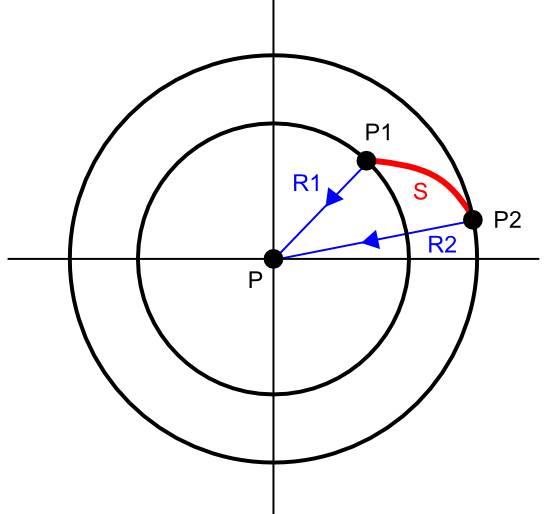
Question_about_Surface.jpg


My best bet is that one can describe S as
(x-h)^2+(y-k)^2=r^2 (\phi _i), \qquad R_1 \leq r (\phi _i ) \leq R_2 \mbox{ and } \phi_2 \leq \phi_i \leq \phi_1
but that seems too abstract and 2D. I'm looking for something like an even asphere description with radius of curvature and coefficients if I know P1 and P2. How can I do that?

Thanks
 
Physics news on Phys.org
I want to confirm one thing, does the question ask you to find the surface by revolution of red line S?
 
I guess you can look at it that way, I'm looking for a surface in 3-space. It would be symmetrical about P. I was hoping this shape S would be a piece of another (simple) conic section.
 
I will first rotate the graph, so that the R2 is on the axis, then find the equation of the line S. use surface area formula to solve it. I think that equation is
∫2 π f(x) √(1+f'(x)2) dx
 
I'm trying a 2D approach to this where all three points P1, P2, and P belong to one circle. It seems that surface S is just the 3D version of this 2D projection. I'm doing this the quick and dirty way using Geometer's Sketchpad - basically just changing the circle size and moving it around. That would mean the shape of S as a mirror would be a patch of a sphere.
 
DivGradCurl said:
I'm trying a 2D approach to this where all three points P1, P2, and P belong to one circle. It seems that surface S is just the 3D version of this 2D projection. I'm doing this the quick and dirty way using Geometer's Sketchpad - basically just changing the circle size and moving it around. That would mean the shape of S as a mirror would be a patch of a sphere.
but you told me the surface is by revolution of line S? did I misunderstand your question?
 
I concluded any 3 points (here P1, P2, and P) can be fit into a new circle and that a mirror prescribed by that new circle shape "C", truncated by the P1 P2 arc "S", should be able to focus light at point P, also on the same circle C. It's very easy to find that new circle in Geometer's Sketchpad by stretching and translating a custom circle until all 3 points are part of the circle.

Ultimately, it is indeed a patch of a sphere, so it is a surface of revolution of the line S. The key problem really was defining S. I'm sorry if I confused you. And the 3D surface comes out easily by bumping "S" out of 2D into 3D with a polar angle.

I think I should be all set. Thanks for the conversation. It helped me think.
 
Your question
"What's the surface joining two points in a family of concentric spheres? Shown below is the general idea; it's actually optical. Two rays meet at P from P1 and P2, respectively, where each point comes from a different sphere. How do I find surface S if I know the coordinates of P1 and P2?"
doesn't seem to be complete. There exist an infinite number of surfaces that contain any finite number of points. There even exist a infinite number of planes that contain two points. Are you asking for a plane that contains two given points on the surface of two concentric spheres and the center of those spheres?
 
Hi,

I'm sorry for the confusing, perhaps incomplete question! I was really looking for a way to connect 3 points in a manner where 2 points could represent a mirror (i.e. surface S) focusing light at the 3rd point, as I represented in the drawing.

As I discovered, this is easiest done with interactive geometry software. You can draw 3 points and then insert a circle and play with its radius and position so that it overlays the 3 points. The fact that 3 points can not only define a plane (as most people immediately associate) but also define a circle is something I didn't quite appreciate before. Once you know the circle and its radius, you can turn that P1-P2 section into a 3D surface with a polar angle with respect to P, defining a solid angle. If you look for the definition of solid angle, it's similar to the resulting picture I'm taking about:

point.gif

except that in the case I'm describing, the focus P is not at the center of the circle or sphere.

I hope this makes sense. I think I'm all set. Best regards.
 
  • #10
That doesn't seem to have anything to do with your original question- and a "circle or sphere" does NOT HAVE a 'focus' although the point at, if I remember correctly, r/2 where r is the radius of the sphere, will act like a "blurry" focus. I order to have a true "focus" your mirror must be parabolic. A paraboloid can be approximated by a sphere with radius equal to twice the focal length of the sphere.
 

Similar threads

  • · Replies 2 ·
Replies
2
Views
2K
Replies
0
Views
2K
  • · Replies 1 ·
Replies
1
Views
1K
Replies
12
Views
1K
  • · Replies 2 ·
Replies
2
Views
2K
  • · Replies 2 ·
Replies
2
Views
2K
  • · Replies 5 ·
Replies
5
Views
4K
  • · Replies 9 ·
Replies
9
Views
2K
  • · Replies 3 ·
Replies
3
Views
4K
  • · Replies 1 ·
Replies
1
Views
1K