Suspension in balance bike

  • Thread starter Thread starter Julian_M
  • Start date Start date
Julian_M
Messages
32
Reaction score
5
Please refer to this kiddie 12" wheel balance bike with suspension.
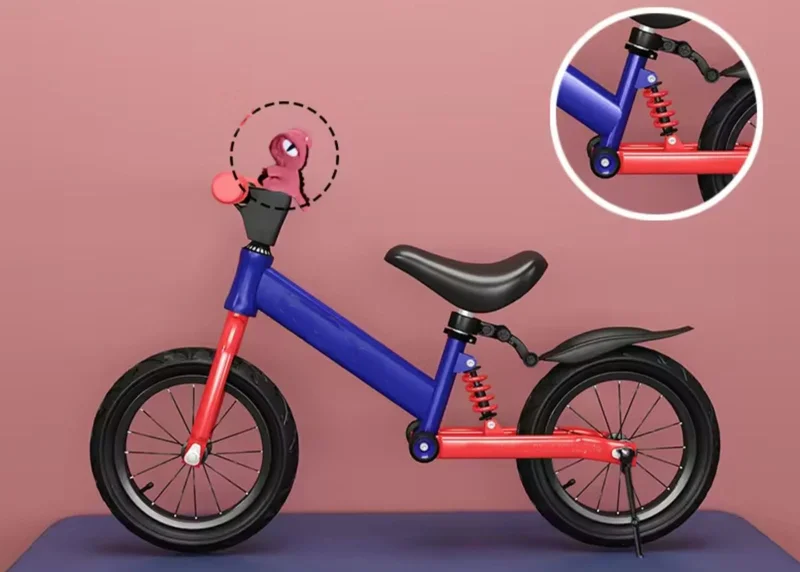
balance bike suspension.webp


Almost all kiddie balance bike (12" or 14" wheel diameter) don't have any suspension. Only a rare few has it, I found the above china made. I'd like to know the following.

1. In bicycle in general. Rear suspension is to make the tire get in contact with the ground more. But this equates to rider comfort too in all cases? Because I read some articles that rear suspension in bicycle is for maneuverability and not more on rider comfort.

2. In kids balance bike, the kid feet are directly on the floor due to lack of pedals instead of bending the knees when using pedals. So the vibration from bumpy floor can reach the kid more. If there is a suspension in the rear, would the vibration from the floor still transmit to the kid feet and body? If kid feet are on pedals, then it won't transmit, but remember in balance bike, there is no pedal so kids feet step directly on the ground.

3. When comparing to mountain bikes, the suspension is put in different places than the above. Do you consider the above as more of a seat suspension than frame suspension? How do you analyze it mechanically? Why don't mountain bikes use the above configuration too?

Thank you.
 
Engineering news on Phys.org
Julian_M said:
Do you consider the above as more of a seat suspension than frame suspension? How do you analyze it mechanically?
There are three forms of suspension present.

Firstly, the pneumatic tires offer a high frequency vibration and noise reduction to the frame and seat pillar.

Secondly, the seat is about halfway between the front and rear wheels. That reduces the vertical movement of the seat, to half the height of any bump in the road.

Thirdly, when crossing larger bumps, the spring in the frame effectively reduces the amplitude and rate of seat vertical movement.
 
IMO, don't waste any money or brain cycles on suspension for a kid's balance bike. Wait until they are riding and pedaling big trails with you and need front and back suspension to absorb the bumps and landings.
 
Baluncore said:
There are three forms of suspension present.

Firstly, the pneumatic tires offer a high frequency vibration and noise reduction to the frame and seat pillar.

Secondly, the seat is about halfway between the front and rear wheels. That reduces the vertical movement of the seat, to half the height of any bump in the road.

Thirdly, when crossing larger bumps, the spring in the frame effectively reduces the amplitude and rate of seat vertical movement.

What is the difference if the wheel is 12" vs 14"? Does 14" wheel have suspension characteristic similar to the 12" with suspension?

Also see the image below. The suspension is put differently. What would happen if the 12" balance bike in original message has this suspension configuration?

Or what would happen if the following big adult bike has suspension placement similar to the original message 12" balance bike suspension (see original image)?

big bike suspension.webp
 
Julian_M said:
What is the difference if the wheel is 12" vs 14"?
The road will appear to be slightly rougher, because the contact patch of the pneumatic tire with the road will be shorter, so it will average less of the road surface.

Julian_M said:
Does 14" wheel have suspension characteristic similar to the 12" with suspension?
No. The wheel diameter does not change the geometry of the spring suspension.

Julian_M said:
What would happen if the 12" balance bike in original message has this suspension configuration?
No difference. The hinge pin is still on the crank axis, so the spring still controls the height of the seat above the ground.
 
Baluncore said:
The road will appear to be slightly rougher, because the contact patch of the pneumatic tire with the road will be shorter, so it will average less of the road surface.


No. The wheel diameter does not change the geometry of the spring suspension.


No difference. The hinge pin is still on the crank axis, so the spring still controls the height of the seat above the ground.

The reason I was looking for suspension for the 12" balance bike was because our enclosed or fenced apartment outdoor flooring uses Clay Brick Pavers like the following:


clay brick pavers.webp


There is no other place to use the 12" balance bike. We can't use it inside house as the area is small. And we can't use it in the public road, obviously to avoid hazard from cars or other vehicles. Do you call the above bumps high frequency or low frequency bumps? How would bigger tire help and suspension? If I get 14" balance bike without suspension, how would it behave compared to the 12" balance bike with the suspension (as in the image in original message)?
 
A balance bike will not be needed for long, see if you can find one second hand, any configuration will do for your yard.

Julian_M said:
There is no other place to use the 12" balance bike. We can't use it inside house as the area is small. And we can't use it in the public road, obviously to avoid hazard from cars or other vehicles.
If it will only be used in the yard then it does not matter what you get. The pavers are mostly level, so lower the tire pressure slightly if needed to hide any uneven joints. Use the smallest wheels available since that will aid turning in the confined space.

Julian_M said:
How would bigger tire help and suspension?
For your yard, suspension is quite unnecessary. Bigger tires will make turning more difficult in the small area.
 
  • Like
Likes   Reactions: berkeman

Similar threads

  • · Replies 7 ·
Replies
7
Views
9K
  • · Replies 65 ·
3
Replies
65
Views
6K
  • · Replies 7 ·
Replies
7
Views
3K
  • · Replies 4 ·
Replies
4
Views
2K
Replies
6
Views
4K
  • · Replies 10 ·
Replies
10
Views
4K
  • · Replies 10 ·
Replies
10
Views
2K
  • · Replies 6 ·
Replies
6
Views
4K
  • · Replies 2 ·
Replies
2
Views
2K
  • · Replies 1 ·
Replies
1
Views
3K