SUSY and GUTs all but eliminated by latest ACME experiment

  • Context: Undergrad 
  • Thread starter Thread starter MrRobotoToo
  • Start date Start date
  • Tags Tags
    Experiment Susy
Click For Summary
SUMMARY

The ACME collaboration's latest measurement of the electron's electric dipole moment (EDM) has established an upper limit of 9.4 x 10⁻²⁹ e cm, significantly improving upon previous measurements. This result effectively rules out many Beyond the Standard Model (BSM) theories, particularly those predicting larger EDM values. The findings were published in Nature and highlight the constraints on model builders in particle physics. The discrepancy between this new limit and the Standard Model prediction of 10-38 e cm raises questions about the implications for theoretical physics.

PREREQUISITES
  • Understanding of electron electric dipole moment (EDM)
  • Familiarity with the Standard Model of particle physics
  • Knowledge of Beyond the Standard Model (BSM) theories
  • Ability to interpret scientific research papers and data analysis
NEXT STEPS
  • Review the ACME collaboration's published paper in Nature for detailed methodology and results
  • Study the implications of the new EDM limit on BSM theories
  • Explore the concept of naturalness in particle physics and its relevance to current theories
  • Investigate the historical context of EDM measurements and their evolution over time
USEFUL FOR

Particle physicists, theoretical physicists, and researchers interested in the implications of experimental results on BSM theories and the Standard Model.

MrRobotoToo
Messages
110
Reaction score
50
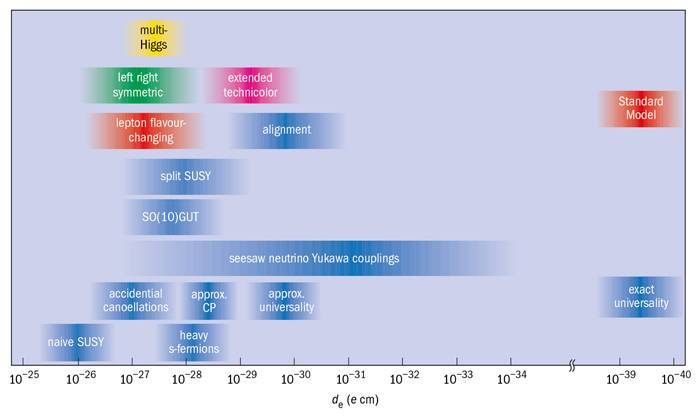
I'm surprised no one has posted about this yet, so I guess I'll take it upon myself to post the link, even though I have no real expertise on the subject. The ACME collaboration had the results of their latest measurement of the electron's EDM published in Nature today. They place an upper limit of 9.4X10⁻²⁹ e cm, an order of magnitude improvement over the previous measurement. According to the chart below, this value eliminates many BSM models. I've also included a couple of pedagogical videos from the ACME group. RIP 'naturalness'.
PW-2013-11-147-Johnston-edm-second.jpg


Attachments

  • PW-2013-11-147-Johnston-edm-second.jpg
    PW-2013-11-147-Johnston-edm-second.jpg
    20.8 KB · Views: 1,130
Last edited:
Physics news on Phys.org
The relevant constraint analysis which that chart is based on is :
https://arxiv.org/abs/1612.08090

It should be noted that the subclass of models that are being considered and ruled out are rather extreme. So significant caveats and loopholes exist in the general case for all models considered. The plots in the original paper are more indicative of the reach of this experiment. Still this experiment quite significantly constrains the relevant theory spaces for model builders.
 
  • Like
Likes   Reactions: dextercioby
Haelfix said:
It should be noted that the subclass of models that are being considered and ruled out are rather extreme

Which makes the title highly misleading.
 
  • Like
Likes   Reactions: king vitamin and dextercioby
I am puzzled by the upper limit value of 9.4X10⁻²⁹ e cm.
Within the Standard Model of elementary particle physics, such a dipole is predicted to be non-zero but very small, at most 10−38 e·cm.

If I am understanding correctly what I am reading, the new upper limit value is 10 orders of magnitudes larger than the upper limit quoted in Wikipedia. Now I know that Wikipedia's reputation in the PF is not on a par with authoritative journals like Nature, but this extreme difference is quite puzzling.
 
Buzz Bloom said:
If I am understanding correctly what I am reading, the new upper limit value is 10 orders of magnitudes larger

The above is an experimental observation

Buzz Bloom said:
than the upper limit quoted in Wikipedia

This a standard model theoretical prediction. Some Beyond the Standard Model theories make larger predictions.
 
  • Like
Likes   Reactions: ohwilleke and Buzz Bloom
Buzz Bloom said:
I am puzzled by the upper limit value of 9.4X10⁻²⁹ e cm.
Within the Standard Model of elementary particle physics, such a dipole is predicted to be non-zero but very small, at most 10−38 e·cm.

If I am understanding correctly what I am reading, the new upper limit value is 10 orders of magnitudes larger than the upper limit quoted in Wikipedia. Now I know that Wikipedia's reputation in the PF is not on a par with authoritative journals like Nature, but this extreme difference is quite puzzling.
I goofed on the upper limit: I quoted the old one--the new one is actually an order of magnitude smaller (by 'smaller' I mean that it's approximately one-tenth the value that I quoted). You can find it in the linked paper. For some reason I'm not able to edit my original post. Also, if I could, I would retitle the thread "Natural SUSY all but eliminated..." to make it more accurate.
 

Similar threads

  • · Replies 2 ·
Replies
2
Views
4K
  • · Replies 0 ·
Replies
0
Views
2K
  • · Replies 1 ·
Replies
1
Views
3K
  • · Replies 8 ·
Replies
8
Views
5K