Math Amateur
Gold Member
MHB
- 3,920
- 48
- TL;DR
- Thread involves finding the dimension of a tangent subspace ...
I am reading Andrew McInerney's book: First Steps in Differential Geometry: Riemannian, Contact, Symplectic ... and I am focused on Chapter 3: Advanced Calculus ... and in particular on Section 3.3: Geometric Sets and Subspaces of ##T_p ( \mathbb{R}^n )## ... ...
I need help with an aspect of the proof of Theorem 3.3.13 ... ...
Theorem 3.3.13 (together with a relevant definition) reads as follows:
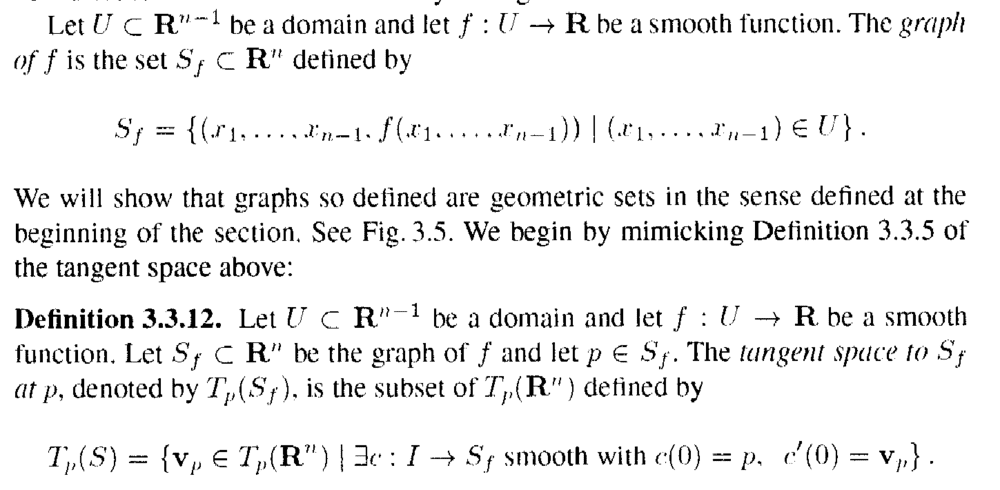
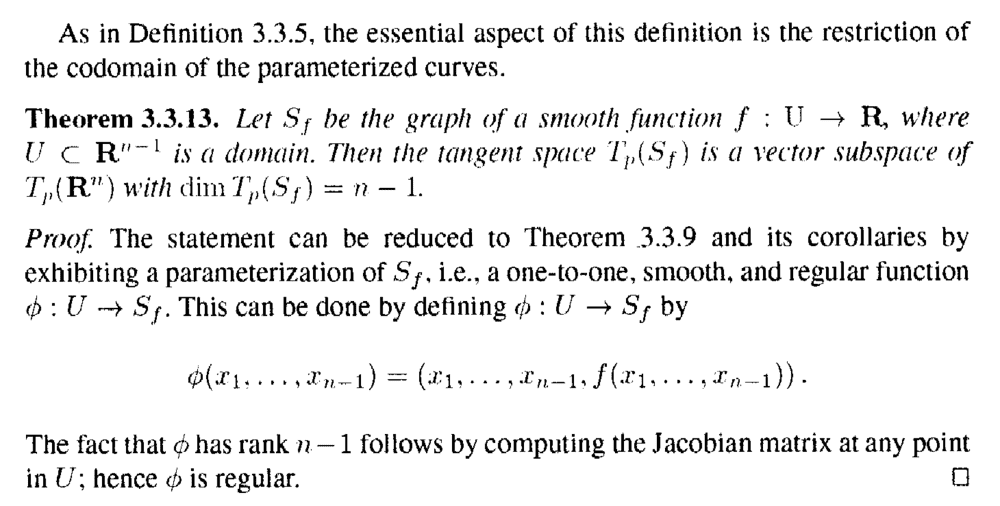
In the above text from McInerney we read the following:
" ... ... The fact that ##\phi## has rank ##n -1## follows by computing the Jacobian matrix at any point in ##U## ... ... "Can someone please demonstrate rigorously, formally and explicitly that ##\phi## has rank ##n -1## ... ...My computations with respect to the Jacobian ##[D \phi(p) ]## were as follows:
We have ##\phi ( x_1, \ ... \ ... \ x_{n-1} ) = ( x_1, \ ... \ ... \ x_{n-1}, f( x_1, \ ... \ ... \ x_{n-1}) )##
Now put ...
##f_1( x_1, \ ... \ ... \ x_{n-1} ) = x_1##
##f_2( x_1, \ ... \ ... \ x_{n-1} ) = x_2##
... ... ...
... ... ...
##f_{n-1}( x_1, \ ... \ ... \ x_{n-1} ) = x_{n-1}##
##f_n( x_1, \ ... \ ... \ x_{n-1} ) = f( x_1, \ ... \ ... \ x_{n-1} )##Then ... the Jacobian ...##[D \phi(p) ] = \begin{bmatrix} \frac{ \partial f_1 }{ \partial x_1} & ... & ... & \frac{ \partial f_1 }{ \partial x_{n-1} } \\ ... & ... & ... & ... \\ ... & ... & ... & ... \\ \frac{ \partial f_{n-1} }{ \partial x_1} & ... & ... & \frac{ \partial f_{n-1} }{ \partial x_{n-1} } \\ \frac{ \partial f }{ \partial x_1} & ... & ... & \frac{ \partial f }{ \partial x_{n-1} } \end{bmatrix}####= \begin{bmatrix} 1 & 0 & 0 & ... & ... & 0 \\ 0 & 1 & 0 & ... & ... & 0 \\ ... & ... & ... & ... & ... & ... \\ ... & ... & ... & ... & ... & ... \\ \frac{ \partial f }{ \partial x_1} & ... & ... & ... & ... & \frac{ \partial f }{ \partial x_{n-1} } \end{bmatrix}##
... now ... how do we show that the rank of ##[D \phi(p) ]## is ##n-1## ...?
Hope someone can help ...
Peter
I need help with an aspect of the proof of Theorem 3.3.13 ... ...
Theorem 3.3.13 (together with a relevant definition) reads as follows:
In the above text from McInerney we read the following:
" ... ... The fact that ##\phi## has rank ##n -1## follows by computing the Jacobian matrix at any point in ##U## ... ... "Can someone please demonstrate rigorously, formally and explicitly that ##\phi## has rank ##n -1## ... ...My computations with respect to the Jacobian ##[D \phi(p) ]## were as follows:
We have ##\phi ( x_1, \ ... \ ... \ x_{n-1} ) = ( x_1, \ ... \ ... \ x_{n-1}, f( x_1, \ ... \ ... \ x_{n-1}) )##
Now put ...
##f_1( x_1, \ ... \ ... \ x_{n-1} ) = x_1##
##f_2( x_1, \ ... \ ... \ x_{n-1} ) = x_2##
... ... ...
... ... ...
##f_{n-1}( x_1, \ ... \ ... \ x_{n-1} ) = x_{n-1}##
##f_n( x_1, \ ... \ ... \ x_{n-1} ) = f( x_1, \ ... \ ... \ x_{n-1} )##Then ... the Jacobian ...##[D \phi(p) ] = \begin{bmatrix} \frac{ \partial f_1 }{ \partial x_1} & ... & ... & \frac{ \partial f_1 }{ \partial x_{n-1} } \\ ... & ... & ... & ... \\ ... & ... & ... & ... \\ \frac{ \partial f_{n-1} }{ \partial x_1} & ... & ... & \frac{ \partial f_{n-1} }{ \partial x_{n-1} } \\ \frac{ \partial f }{ \partial x_1} & ... & ... & \frac{ \partial f }{ \partial x_{n-1} } \end{bmatrix}####= \begin{bmatrix} 1 & 0 & 0 & ... & ... & 0 \\ 0 & 1 & 0 & ... & ... & 0 \\ ... & ... & ... & ... & ... & ... \\ ... & ... & ... & ... & ... & ... \\ \frac{ \partial f }{ \partial x_1} & ... & ... & ... & ... & \frac{ \partial f }{ \partial x_{n-1} } \end{bmatrix}##
... now ... how do we show that the rank of ##[D \phi(p) ]## is ##n-1## ...?
Hope someone can help ...
Peter