Tension of Rope: Cosmonaut & Spaceship Orbit in Planetary Gravity

Click For Summary

Homework Help Overview

The problem involves calculating the tension in a rope connecting a cosmonaut and a spaceship in orbit around a planet. The cosmonaut has a mass of 100 kg, while the spaceship has a mass of 5 tons (5000 kg), and the rope length is 64 m. The context includes gravitational forces and orbital mechanics, with a reference to Kepler's laws.

Discussion Character

  • Exploratory, Assumption checking, Problem interpretation

Approaches and Questions Raised

  • Participants discuss the meaning of "negligible distance" in the problem statement and its implications for the orbital altitude. There are considerations about the choice of reference frames for analysis, such as inertial versus rotating frames. The gravitational attraction calculated using universal gravitation law is mentioned, along with the need to consider other forces acting on the cosmonaut and spaceship.

Discussion Status

The discussion is ongoing, with participants questioning the clarity of the problem statement and exploring different interpretations. Some guidance is offered regarding the gravitational forces and the importance of showing more work for better assistance.

Contextual Notes

There is uncertainty regarding the exact wording of the problem as presented in the physics Olympics, particularly concerning the term "negligible distance." The data provided appears to be limited to one significant figure, suggesting that approximations may be acceptable.

Jorgen1224
Messages
36
Reaction score
0

Homework Statement


What is the tension of this rope?
Cosmonaut m=100kg is outside of spaceship M=5 tons on rope with length 64m. Cosmonaut along with his spaceship moves in orbit at a neglible distance.

m=100kg
M=5000kg
L=64m
Planet's mass 6*10^24
Planet's radius 6400km

Homework Equations

4ea196e90833059c9d91cd86bea05e3ec8b75d24

Kepler's 3rd law(maybe?)

The Attempt at a Solution


It's from physics olympics, so i bet that it requires one complex idea.
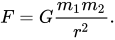
What comes out of universal gravitation law is 8.14208984375×10^-9 N and I'm not sure what to do afterwards.
 
Physics news on Phys.org
Is the statement of the problem exactly as it was given in the physics Olympics? I am not sure what "negligible distance" means. Negligible relative to the radius of the planet or negligible relative to 64 m?
 
  • Like
Likes   Reactions: Merlin3189
kuruman said:
Is the statement of the problem exactly as it was given in the physics Olympics? I am not sure what "negligible distance" means. Negligible relative to the radius of the planet or negligible relative to 64 m?
My guess is that the "negligible" refers to the orbital altitude above the planet's surface. The input data is good to one significant figure. So the use of reasonable approximations is apparently encouraged.

Perhaps the first order of business is to pick a frame of reference to use. An inertial frame nailed to the planet's center? A rotating frame nailed to the planet as a whole? Then the free body diagrams.
 
jbriggs444 said:
My guess is that the "negligible" refers to the orbital altitude above the planet's surface.
That would also be my guess, because otherwise the answer is trivial. However, I still would like to see the statement of the problem if it is different from the posted one.
 
  • Like
Likes   Reactions: jbriggs444
Jorgen1224 said:
Cosmonaut m=100kg is outside of spaceship M=5 tons
Jorgen1224 said:
M=5000kg
I'm still trying to parse this part...
 
Jorgen1224 said:
What comes out of universal gravitation law is 8.14208984375×10^-9 N
That is the gravitational attraction between the cosmonaut and the spacecraft based on their respective masses and separation. That could be important if we had a pole holding them apart. But in the case at hand we have a rope holding them together. What other force tends to separate the two?

[Note that it is easier to provide help when more of the work is shown and one does not have to reverse-engineer the result to figure out what went wrong]
 

Similar threads

  • · Replies 2 ·
Replies
2
Views
3K